

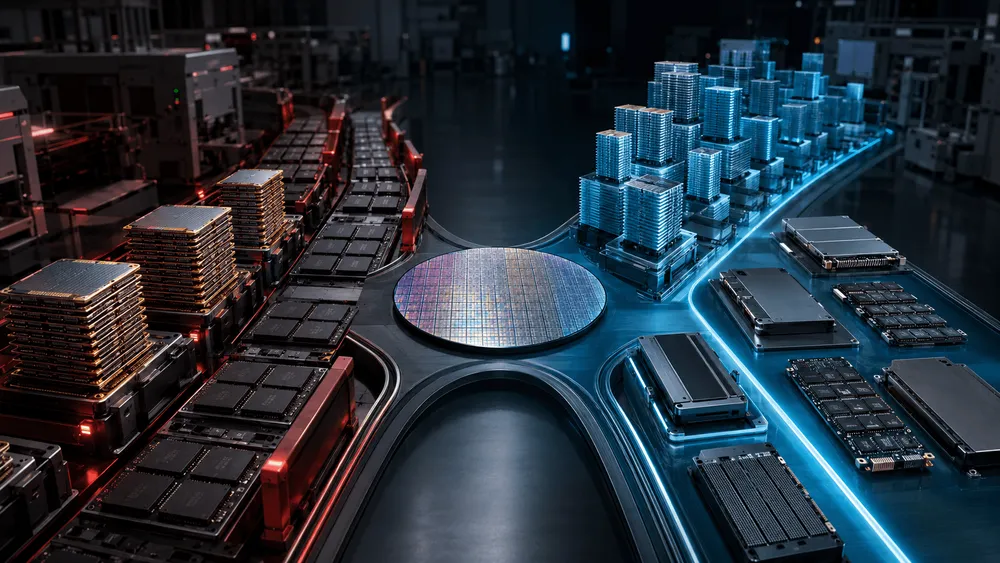
On July 30, TrendForce released a forecast indicating that supply and demand for DRAM and NAND flash will move in opposite directions in the 2027 memory market. AI servers are pushing up demand for both. Even so, DRAM will continue to see a large share of wafer capacity consumed by HBM, and it will take time before the effects of new fab capacity additions materialize. For NAND, higher layer counts are increasing the number of bits obtainable from a single wafer, and new production buildings have already come online. Even as both categories benefit from the same AI-driven investment, differences in supply-side technology are set to split their price cycles.
Two Diverging Supply-Demand Ratios in 2027
TrendForce estimates the 2026 DRAM supply-demand ratio at roughly minus 1–2%, a figure indicating supply falling short of demand. In 2027, the shortfall is expected to widen further as bit demand growth outpaces supply growth even more. In addition to capital expenditure by North American cloud providers, next-generation CPUs from Intel and AMD and the adoption of SOCAMM are pushing up the amount of DRAM used per server. Global server shipment growth, which was 17% year-over-year in 2026, is forecast to exceed that pace in 2027.
NAND starts from a similar shortage position. According to TrendForce's July estimate, the 2026 supply shortfall stands at 4–5%. However, the shift to high-layer 3D NAND and the ramp-up of new equipment are expected to increase bit supply, turning the supply-demand balance positive in the latter half of 2027. This is not a confirmed figure for a major supply glut, but rather a forecast that supply constraints will ease and begin exerting downward pressure on prices.
The strength of AI demand alone cannot explain this divergence. Server DRAM, HBM, and enterprise SSDs are all growing. What creates the difference is how many bits can be extracted from the wafers and equipment used for expanded production.
HBM's 3-to-1 Ratio Offsets DRAM Capacity Expansion
In its December 2025 earnings briefing, Micron explained that the "trade ratio" between HBM and DDR5 is 3-to-1. To supply the same amount of bits, HBM consumes roughly three times the wafer capacity of DDR5, and the ratio rises further with next-generation HBM. Because HBM achieves wide bandwidth by stacking multiple DRAM dies, increasing HBM sales volume reduces the bits that can be allocated from the same fab to standard DDR5 or LPDDR.
Even as wafer input increases, overall DRAM bit supply does not grow proportionally. In the second half of 2026, Samsung plans to focus on meeting strong demand centered on high-value-added products ranging from HBM4 to DDR5 and SOCAMM2. SK hynix also began mass shipment of HBM4 in the second quarter. This shift of capacity toward AI products with strong demand is squeezing the supply of standard server DRAM and mobile DRAM.
New fabs also come with a time lag. TrendForce notes that even DRAM capacity scheduled to come online in 2027 will not fully ramp up until the latter half of that year—after construction, equipment installation, and material preparation—meaning a significant contribution to supply will not materialize until 2028. Micron's ID1 fab in Idaho is also expected to produce its first wafer output in mid-2027. The existing fab in Taoyuan, Taiwan, is scheduled to begin meaningful shipments around the same time, but wafer output, yield improvement, and customer qualification are not synonymous with mass production.
332 Layers and K2 Are Boosting NAND Bit Supply
For NAND, stacking cells vertically at higher layer counts is increasing supply per wafer. On July 3, Kioxia and Sandisk began production of their 10th-generation 3D flash memory at Fab2 (K2) in Kitakami, Iwate Prefecture. K2 began operations in September 2025, producing 8th-generation products. Going forward, output will expand with the addition of 10th-generation products.
The TLC version of the 10th-generation BiCS FLASH has 332 layers, and according to Kioxia, offers 59% higher bit density than the 8th generation. By increasing the number of memory cells vertically while also improving horizontal density, the amount of storage capacity extracted from a single wafer increases. The company plans to raise capital expenditure for fiscal 2026 to 450 billion yen, up from 280 billion yen the previous fiscal year, with a similar level planned for fiscal 2027. Through expanded 8th-generation output, the ramp-up of the 10th generation, and investment in Yokkaichi Fab7 and Kitakami Fab2, the company aims to grow GB output at an average annual rate of 22%.
At SK hynix, 321-layer products already make up the largest share of NAND production, with plans to expand this to about 50% of domestic Korean capacity by the end of 2026. Multiple companies are advancing to higher layer counts simultaneously. Meanwhile, the company's new NAND fab M17, announced in July, targets operation in the first half of 2029—too late to contribute to increased supply in 2027. What will determine supply that year is not the scale of new fab announcements but the pace of K2's output expansion and the generational transition of existing lines.
NAND Weakness and Persistent DRAM Strength: The Impact on Device Costs
NAND supply and demand are not determined by AI servers alone. According to TrendForce, while servers have grown to account for over 40% of NAND bit demand, smartphones and notebook PCs together still make up about 40% as well. Even if enterprise SSD demand grows, if consumers do not replace their devices, the overall market becomes more prone to oversupply.
The company forecasts a 15–20% year-over-year decline in smartphone production and roughly a 10% decline in notebook PC shipments for 2026, with the decline expected to continue into 2027. If this coincides with increased bit supply from higher layer counts, enterprise SSD demand alone may not be enough to absorb the expanded output, raising the possibility of falling NAND prices. That said, the primary application for Kioxia's sampled 10th-generation 1Tb TLC product is enterprise and data center SSDs. It is not certain that the increased bit supply will immediately flow into lower-priced client SSDs or smartphones.
Component costs for devices will not necessarily fall uniformly either. Smartphones and PCs use both NAND storage and DRAM together. TrendForce's smartphone market report points out that even if NAND prices alone adjust downward, the shortage and high prices of mobile DRAM will persist, limiting the overall reduction in bill-of-materials costs. Even if NAND prices fall in the latter half of 2027, it is difficult to expect device prices to drop by a comparable margin.
Micron's Alternative Scenario: "Shortage Persists Beyond 2027"
The view that NAND will ease in the latter half of 2027 is not unanimous across the industry. As of June 24, Micron forecasts that tight supply-demand conditions for both DRAM and NAND will persist beyond 2027. Even assuming 2026 industry bit shipment growth of low-to-mid 20% for DRAM and about 20% for NAND year-over-year, the company judges this insufficient to keep pace with AI data center demand.
Current manufacturer materials also point to persistent shortage strength. Samsung stated that for the second half of 2026, even as mobile and PC demand partially slows, growth in server DRAM, enterprise SSDs, and HBM will keep the market in a supply shortage. SK hynix has signed long-term supply agreements with roughly 10 companies and is accelerating its transition to 321-layer NAND. However, the company has not disclosed the products, terms, or volumes covered by these contracts, making it impossible to draw conclusions about 2027 NAND spot market supply-demand conditions from this alone.
The conditions that will determine which forecast proves correct are clear. If the ramp-up of K2 and high-layer NAND proceeds as planned and the slump in smartphones and notebook PCs continues, the market will move closer to the price adjustment scenario TrendForce envisions for NAND. If agentic AI drives demand for high-speed SSDs beyond expectations, Micron's scenario of persistent shortage becomes more plausible. The figures that will determine the outcome for 2027 are not the amounts spent on new fab construction, but each company's actual bit shipment volumes, the scale of enterprise SSD contracts, and the timing of when the NAND supply-demand ratio turns positive.