

Advanced reactors have long been described as a technology that will arrive "in the 2030s at the earliest." The track record behind that pessimism is that the Nuclear Regulatory Commission (NRC) design certification review alone takes more than five years. But on July 4, 2026, news from the Idaho desert upended that timeline.
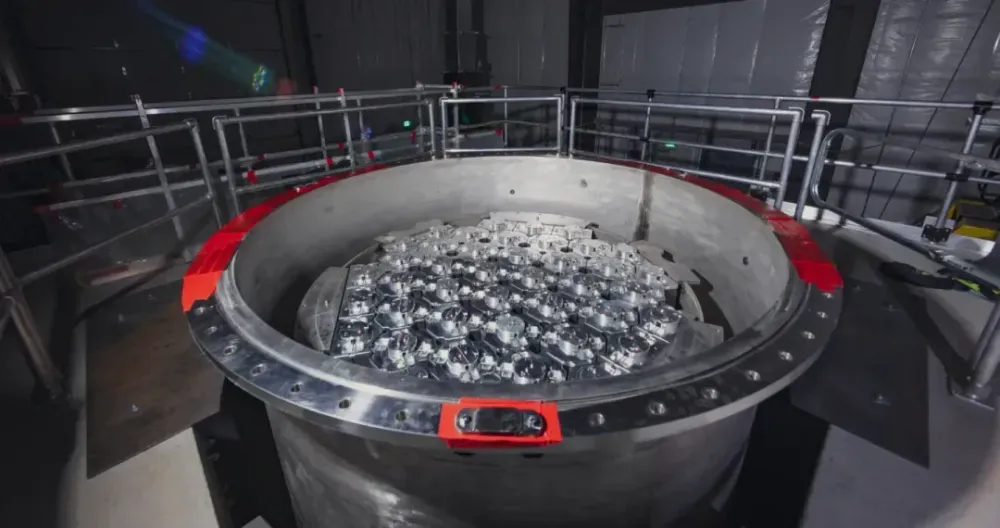
Aalo Atomics' test reactor, Aalo-X, reached criticality just eight months after construction began. It became the fourth reactor to do so, one more than the "three advanced reactors by July 4" goal President Trump set in his May 2025 executive order. The speed did not come from technological innovation itself. It came from a "shortcut" created by where the reactor sits and the regulatory jurisdiction attached to that location.
Eight Months from Groundbreaking to Criticality
At 12:20 a.m. local time on July 4, 2026, control rods were slowly withdrawn in a control room on the Idaho National Laboratory (INL) campus. U.S. Energy Secretary Chris Wright summed up the night in one line: "We exceeded that requirement (of three) and achieved four."
Criticality is the state in which the fission reaction inside a reactor sustains itself without outside intervention. Control rods, which absorb neutrons, are withdrawn little by little, and criticality is reached at the moment the neutrons produced by fission trigger exactly enough subsequent fissions. Power output is still close to zero, and this is not the stage at which power is sent to the grid. Aalo-X has crossed that first line, and test operations will continue, gathering data while output is raised in stages.
The reactor is a sodium-cooled, graphite-moderated design using low-enriched uranium-based fuel. Sodium conducts heat better than water and can carry heat efficiently even at low pressure, which allows thinner pressure vessels and makes it easier to shrink the whole reactor. It is a small test reactor, rated at 10 megawatts electric and 30 megawatts thermal, and is not itself a commercial reactor. Developer Aalo Atomics is headquartered in Austin, Texas, was incorporated in late 2022 and went public with its business in March 2023. CEO Matt Loszak and President and CTO Yasir Arafat both come from the nuclear industry; Arafat was previously chief designer of INL's small reactor program MARVEL.
The Real Reason for the Speed: A DOE Shortcut Bypassing the NRC
Aalo-X is built on the INL campus, a federal research site owned and managed by the U.S. Department of Energy (DOE). That location, outside the NRC's ordinary licensing regime for commercial nuclear power plants, was the core of the speed. According to Power Magazine, Aalo-X was authorized by the DOE under the department's own technical standard, "DOE-STD-1271-2025," and the NRC is involved only as an observer rather than a party to the review. The framework can bypass altogether the multi-year design certification and operating license procedures required of commercial reactors.
What broadened that framework all at once was the executive order President Trump issued in May 2025. It created the "Reactor Pilot Program," a fast-track review program under DOE authority, and on August 13 selected about 10 companies and 11 projects to support construction of test reactors. The goal of "three by July 4" was essentially the product of taking the regulatory latitude DOE jurisdiction over national laboratory sites already offered and using it to the fullest, riding the political tailwind of surging electricity demand from AI.
There is also an example of technology supporting regulatory speed. Microsoft has said that, as a case study of its collaboration with Aalo, using Azure AI tools to draft licensing-related documents cut the workload by 92% and saved about $80 million a year. That figure is a customer case Microsoft itself announced and has not been independently verified. Even so, faster preparation of documents for regulators may have contributed to the eight-month schedule from groundbreaking to criticality.
NuScale's 64 Months vs. Aalo-X's 8 Months: Two Clocks That Can't Be Compared
NuScale Power offers a benchmark for how heavy advanced reactor regulatory procedures can be. The company applied to the NRC for design certification of its small modular reactor in March 2017, and certification came in July 2022. That is five years and four months from application to approval, roughly 64 months. And that was only the time needed to win approval of the design itself, before actual construction began.
Aalo-X, by contrast, completed its reactor building from bare ground in 70 days and ran from groundbreaking to criticality in about eight months. Compared on months alone, Aalo-X took one-eighth of NuScale's 64 months. But the two clocks are not running on the same field.
NuScale's five years and four months was a design certification review for selling power to the U.S. grid as a commercial reactor, while Aalo-X's eight months was for a DOE test reactor on a track that does not pass through NRC review at all. The difference in speed did not come from superior technology. The number of procedures that must be cleared in the first place is different.
How It Differs from the Three Earlier Reactors, and Hitachi's Name Among the Investors
Before Aalo-X reached criticality, three reactors had already cleared the same goal. Antares' "Mark-0" reported criticality on June 4, Valar's "Ward 250" on June 18, and Deployable Energy's "Unity" on the night of June 30 into around July 1. These four, including Aalo-X, are all of the advanced reactors that obtained DOE authorization within the executive order's deadline.
The four are only part of the Reactor Pilot Program, which DOE launched on August 13, 2025 by selecting about 10 companies and 11 projects. The program was expanded in March 2026 into a longer-term framework called the "Nuclear Energy Launch Pad." The selection list reportedly also includes names such as molten salt reactor developer Kairos Power, high-temperature gas reactor developer X-energy and TerraPower, which is working on a large sodium-cooled reactor, but only four projects managed to reach criticality by the July 4 deadline.
TerraPower is aiming for a large reactor capable of commercial-scale power transmission, so there are inherently more elements to settle in fuel, cooling system and safety system design than for a 10-megawatt-class test reactor like Aalo-X. Kairos Power's molten salt reactor and X-energy's high-temperature gas reactor are also reactor types with thinner commercial operating records than Aalo-X's sodium-cooled, graphite-moderated approach, so with less precedent data to refer to in DOE technical standard reviews, finalizing the designs tends to take longer. Detailed construction progress for both companies has been disclosed by neither the DOE nor the projects, and differences in scale and type complexity appear to be a structural factor in how quickly reactors reached criticality.
Aalo Atomics announced a Series B round of $100 million in August 2025, led by Valor Equity Partners, with Hitachi Ventures also participating. Cumulative funding exceeds $136 million (about ¥22.1 billion at ¥162.58 to the dollar, the July 1, 2026 rate), and Japanese companies appear here too, in the same row as Mitsubishi Heavy Industries, IHI and Nippon Steel, which supply equipment to TerraPower.
When It Moves to Commercial Sites, the NRC Review Awaits
Aalo Atomics' next target is "Project Ascension," a commercial-scale reactor under construction on the INL campus. It plans to begin supplying power to data centers in 2027, and the commercial design, the "Aalo Pod," is configured with five 10-megawatt-class "Aalo-1" units arranged around a single turbine to produce 50 megawatts. CEO Matt Loszak said, "Reaching criticality is the biggest milestone, and it opens the way to deploying the Aalo Pod for commercial data centers."
Because Project Ascension is also planned for the INL site, it will likely be able to use the same DOE regulatory shortcut. The situation changes once the Aalo Pod is built outside the national laboratory, on land owned by utilities or private data center operators. There, it will likely be impossible to avoid the NRC's ordinary review, the procedure on which NuScale spent five years and four months. According to the Electric Power Research Institute (EPRI)'s February 2026 forecast, data center electricity demand is expected to grow from 177 to 192 terawatt-hours in 2024 to 380 to 790 terawatt-hours in 2030, an upward revision of about 60% from earlier forecasts. The scale of that demand pressure is also the background to DOE creating the shortcut.
Some elements remain undisclosed. Whether Aalo Atomics can actually achieve its target generation cost of 3 cents per kilowatt-hour has not yet been demonstrated. The name of the "major cloud company" to which Project Ascension will supply power is also still withheld, and how firm the demand-side commitments are has not been made public. Aalo Atomics itself has not disclosed a specific fuel enrichment level either, leaving only the framework of low-enriched uranium-based fuel as public information.
The eight months it took Aalo-X to reach criticality is the result of an experiment in how far DOE can use a regulatory path it built under its own authority. It does not represent a technological breakthrough in the reactor itself. The shortcut works only inside federal facilities like INL, and when the Aalo Pod is to be connected to the grid as a true commercial reactor, a different clock, the NRC's, will start running. Whether the eight-month figure can be repeated will become clear only when Project Ascension steps outside the national laboratory.