

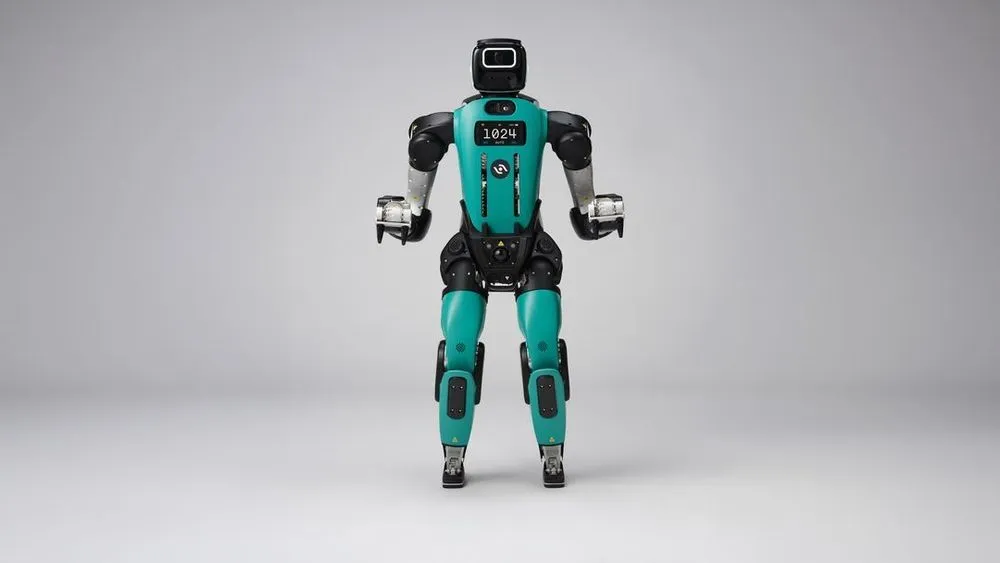
On September 15, 2026, Agility Robotics unveiled its next-generation humanoid robot, "Digit 5." Built on insights from more than 65,000 hours of cumulative commercial operation, the robot has been comprehensively redesigned around "cooperative safety" as its core principle—eliminating the physical safety barriers traditionally used to keep humans away from robots in logistics and manufacturing settings. The company has already secured multi-year orders exceeding $300 million and has stepped forward as the inaugural launch partner for NVIDIA's robotics safety platform, "Halos for Robotics." How can industrial robots, once confined behind isolation cages, now move into the same walkways as human workers?
Removing Safety Barriers: Cooperative Safety in Practice
Under occupational health and safety regulations, conventional industrial robots have historically been required to operate isolated inside sturdy metal safety cages or interlocked barriers. Whenever a human needed to enter the robot's working area, the robot had to be brought to an emergency stop—making flexible layout changes or shared human-robot workflows difficult to achieve. Using its previous-generation robot, "Digit 4," Agility Robotics has accumulated field deployment experience at sites including GXO Logistics' Atlanta distribution center, Amazon, automotive parts manufacturer Schaeffler, and Toyota Motor Manufacturing Canada. At the GXO facility, the robot handled roughly 100,000 totes (collapsible containers) with approximately 98% accuracy—yet even this track record still required dedicated zones to separate work areas.
Digit 5's stated goal is to eliminate this physical separation altogether. In warehouse aisles and picking areas, the robot is designed to walk and handle cargo autonomously right alongside workers operating forklifts and carts. The more than $300 million in multi-year orders reflects demand from shippers and logistics contractors eager to avoid the hassle and floor-space costs of installing safety cages.
Why Cages Can Now Be Removed
For an autonomous robot handling heavy loads in the same space as humans to operate without a safety cage, it needs more than the ability to avoid accidental contact—it requires multiple layers of protection to prevent injury in the event of a system failure or fall. In an interview with Ars Technica, Agility Robotics CTO Pras Velagapudi described the staged safety-behavior hierarchy that activates when Digit 5 detects a human nearby.
Multimodal vision sensors positioned throughout the robot continuously monitor the surrounding environment. When a human or obstacle is detected at a distance, the robot autonomously recalculates its path to avoid them. If a person moves closer and no clear avoidance route is available, the robot stops in place and waits. And if a person enters very close range, or there is a risk of sudden contact, Digit 5 rapidly bends its knees and drops into a crouching (seated) posture. By lowering its center of gravity close to the floor, the robot physically eliminates the fall risk inherent to humanoid form factors, preventing accidents that could involve a human.
Underpinning this multi-layered defense, Digit 5 is equipped with an independent safety controller that is physically separated from the processor handling autonomous navigation. Its computing platform is built on NVIDIA IGX Thor, running "Halos Core," a comprehensive safety framework for robotics. The company is also drawing on inspection processes from the ANSI/ANAB-accredited third-party testing body, the "NVIDIA Halos AI Systems Inspection Lab," to rigorously validate functional safety.
Safety assurance here doesn't rest on one company's proprietary implementation alone. Agility Robotics serves as project leader for "ANSI/A3 TR R15.108," the safety guideline for dynamically stable mobile robots in the United States and Canada. The company is also playing a leading role in supporting the development of "ISO 25785-1" within the International Organization for Standardization's robotics technical committee (ISO/TC 299)—what would be the world's first international safety standard specifically for humanoid robots. By helping shape the common rules needed for humanoid robots to take hold in industrial settings, the company is smoothing the path for adopting companies to pass safety reviews.
The Real-World Impact of 50-Pound Payload and 9-Minute Fast Charging
Even with safety assured, a robot won't gain a lasting foothold in logistics and manufacturing unless it can perform practical work at scale. Digit 5 adopts a cycloidal reduction gear in its leg drive structure, substantially increasing drive rigidity and impact resistance over the previous generation. This has enabled the robot to raise its payload capacity to 50 pounds (22.7 kg)—a 40% increase over its predecessor—while maintaining stability during continuous walking. That figure fully covers the manual lifting limits set per worker by the U.S. Occupational Safety and Health Administration (OSHA), giving the robot the capability to take over tasks like moving heavy totes and cardboard boxes from human workers.
Another major advance lies in energy management and duty-cycle improvements. Digit 5 can recharge its battery to resume 90 minutes of continuous operation with just a 9-minute fast charge. This pushes the ratio of operating time to charging time from 2:1 in Digit 4 up to a dramatic 10:1. By minimizing downtime spent waiting to charge, the robot can now sustain more than 20 hours of actual operation per day—significantly improving the return on investment for fleet operations that rotate multiple units.
The robot's arm features a swappable end effector (gripper) with an ISO-standard mounting flange at the tip. In addition to grasping and moving totes, it can be reconfigured for tasks like palletizing and machine tending—loading workpieces into machine tools—by swapping tools to match the process. Reach height has been extended from 5.5 feet in Digit 4 to 7.2 feet (2.2 m) in Digit 5, while the robot maintains a footprint suited to human workspaces, standing 5 feet 11 inches (1.81 m) tall and weighing 284 pounds (129 kg).
Comparing the key specifications of the previous-generation Digit 4 and the new Digit 5 shows a clear step up in field adaptability on both the cargo-handling and operational fronts.
| Item | Digit 4 | Digit 5 |
|---|---|---|
| Payload capacity | Previous-generation baseline | 50 pounds (22.7 kg, up 40% from previous generation) |
| Operating-to-charging ratio | 2:1 | 10:1 (9-minute charge for 90 minutes of operation) |
| Reach height | 5.5 feet | 7.2 feet (2.2 m) |
| Robot dimensions | Previous-generation footprint | Height 5 feet 11 inches (1.81 m), weight 284 pounds (129 kg) |
| Real-world operating capacity | Limited by split charging | Supports over 20 hours of actual operation per day |
With these performance gains, the robot's role expands from an auxiliary machine repeating a single task at a fixed station to a primary workhorse capable of moving across an entire facility and handling multiple processes in sequence. The combination of expanded payload capacity and fast charging reduces the need for shift-based robot swaps and cuts downtime along transport lines.
From "Cooperative" to "Collaborative": The Hurdles Ahead for Industrial Adoption
Agility Robotics plans to begin early-access deployment of Digit 5 in the first half of 2027, moving to general availability (GA) by the end of 2027. At the company's own factory, "RoboFab," in Salem, Oregon—with annual production capacity of up to 10,000 units—production lines are being retooled to support mass production of Digit 5. Beyond the United States and Canada, the company is also eyeing commercial rollout in the European Union (EU) and the United Kingdom (UK).
Still, it's important not to misjudge the technical and operational boundaries of real-world deployment. As Velagapudi points out, what Digit 5 offers is "cooperative safety"—coexisting with humans in the same space while maintaining a safe distance—not "collaborative safety," in which the robot and a human might hand parts back and forth directly. The robot senses humans and responds by avoiding, stopping, or crouching, but it has not yet reached the stage of working directly alongside a person in physical, hands-on collaboration.
Regulatory and safety-standard frameworks are also still works in progress. While the company is leveraging NVIDIA Halos' third-party verification lab, the international standard ISO 25785-1 remains at the Committee Draft stage of deliberation within ISO/TC 299. Further validation will be needed before formal regulatory approval aligned with each country's occupational safety standards, and standardized methods for dynamic risk assessment in real warehouse environments, are fully established.
Whether humanoid robots move beyond the pilot-project stage to become genuine industrial infrastructure won't be decided by flashy demonstrations at trade shows. It will hinge on operational track records—maintaining that 10:1 operating-to-charging ratio in high-density logistics hubs without unexpected stoppages—and on whether third-party safety certifications aligned with ANSI/A3 TR R15.108 and ISO 25785-1 can be finalized before shipments begin in 2027. Once those conditions are met, humanoid robots will shift from being specialized machines confined behind fences to ordinary coworkers carrying loads alongside humans on the floor.