


Since ancient times, humanity has used "keys" to protect what it holds dear. Whether it is a physical brass key or a modern, sophisticated digital cipher, the underlying design philosophy has remained unchanged: hold a specific pattern as a physical or electronic entity, and open the system's door only when a match is found. But this concept of the static key, which has persisted for thousands of years, is now approaching an unprecedented turning point.
We are facing a hyper-connected society in which an enormous number of devices link to one another every single second. Cardiac pacemakers, self-driving cars, and even industrial systems controlling massive data centers—everything is tied into networks. To secure this vast web of communication, secret digital keys are embedded deep within each device. Yet the very premise of generating, distributing, and storing keys is itself becoming the greatest vulnerability in modern digital infrastructure.
The "Static Fortress" Reaches Its Limits: The Paradox of the IoT Era
Behind the cloud services and IoT devices we use every day lie robust mathematical cryptographic algorithms, underpinned by static digital cryptographic keys. Data is transformed into an unreadable state through complex mathematical formulas, and only a device holding the legitimate key can restore it. For a long time, this approach served as the absolute foundation of digital security.
However, in today's world—where the number of connected devices has reached into the billions and edge computing and virtual environments are intricately intertwined—this foundation is quietly on the verge of collapse. Conventional authentication systems require a fixed digital key to be pre-stored in a device's internal storage, such as flash memory. As the number of connected nodes increases, the infrastructure cost and network burden required to securely manage and periodically update these keys grows exponentially.
For hackers, a key fixed in memory is a prime target. As long as a key exists as electronic data in storage, no matter how advanced the cryptographic technology built around it, there is always a risk that the key itself could be stolen from the outside—whether through physical disassembly and analysis of the chip, or side-channel attacks that read minute fluctuations in a device's power consumption. Furthermore, as the practical realization of quantum computers with overwhelming computational power comes into view, the security of current cryptographic technology is being shaken to its core. Keys that rely on specific mathematical difficulty are highly likely to be easily broken in the face of quantum algorithms.
To overcome this structural limitation, it was necessary to fundamentally overturn the very framework of preparing a key in advance as electronic data.
Taming Chaos: The Dynamic "Light Fingerprint" Etched by Lasers
The team that took on this paradigm shift was led by Yating Wan and colleagues at King Abdullah University of Science and Technology (KAUST). Their research, published in Nature Electronics, presents a bold approach: using an unpredictable physical phenomenon as an on-demand security key. What they focused on was the "chaos" produced by a tiny semiconductor device—the vertical-cavity surface-emitting laser (VCSEL).
Chaos in the natural world refers to behavior that is extremely complex and unpredictable. Just as it is impossible to completely predict the trajectory of water spray falling from a waterfall or the shape of rising smoke, the optical signal emitted from a VCSEL injected with a specific strong current also exhibits an extremely random waveform due to the complex nonlinear interaction between photons and electrons. This phenomenon—which could be called optical turbulence—is physically impossible to completely replicate or predict from the outside.
Here, an intriguing physical law comes into play. When the same device is given identical conditions, such as a specific current or temperature, the minute statistical characteristics of the output optical signal retain a "quirk" originating from the extremely subtle physical differences that arose during the device's manufacturing process. Nanometer-scale surface irregularities and impurity distributions created during chip fabrication alter the light's reflection pattern like a kaleidoscope, producing a signal that is completely unique to each device.
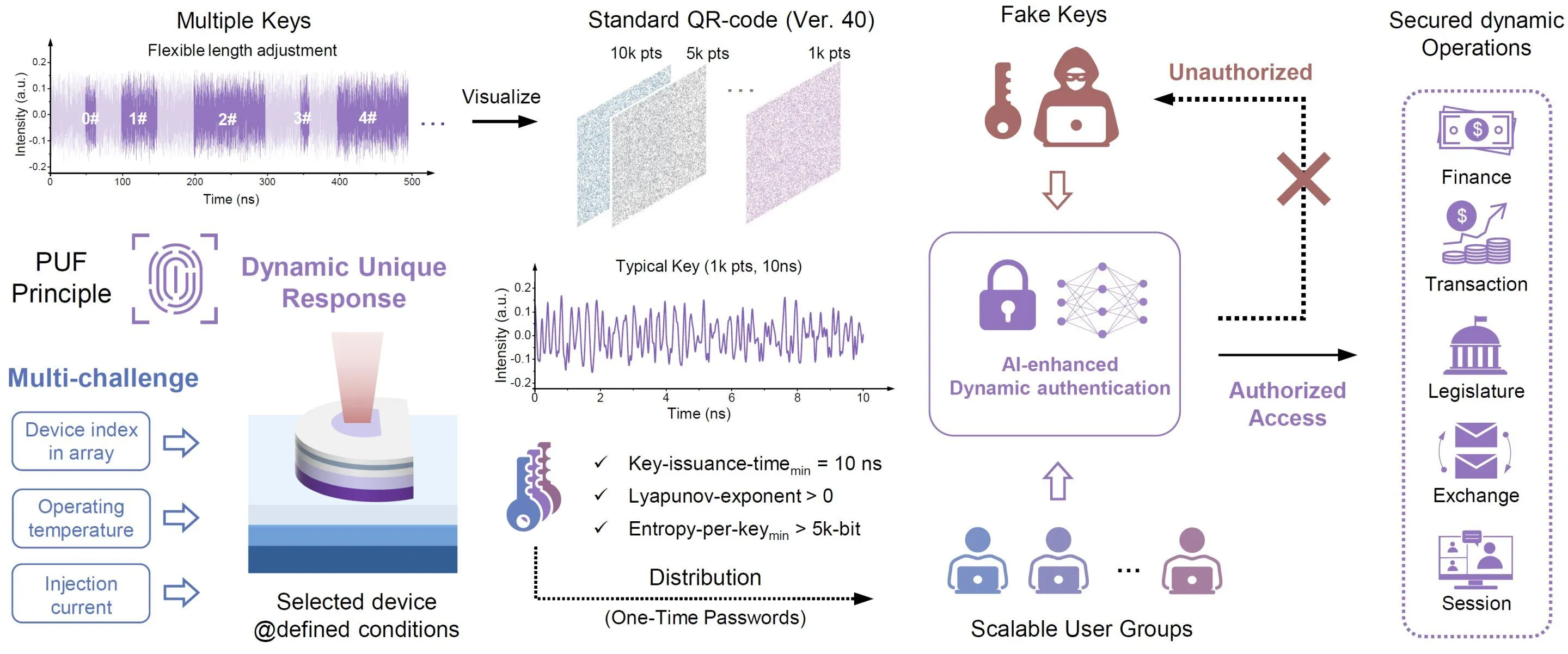
The research team leveraged this as a device-specific hardware fingerprint. This extends a security concept known as a Physical Unclonable Function (PUF)—traditionally applied in the electronic domain—into the realm of light.
Rather than storing the key in a device's memory, the team lets a "one-time fingerprint" spontaneously emerge from the chaotic light waves by driving the laser at the very moment authentication is needed. Once authentication is complete, the laser is switched off. As a result, the key literally vanishes into thin air, and no physical data remains anywhere on the device to be stolen.
However, this light fingerprint presented one major challenge. Because the chaotic optical signal is so complex and highly variable, conventional deterministic computational algorithms struggled to accurately distinguish noise from the true fingerprint features. Artificial intelligence (AI) was introduced to break through this barrier.
The research team positioned the laser as the source of entropy (randomness) and placed an AI model in the role of an advanced appraiser. The AI learns the subtle patterns hidden within the chaos from vast amounts of data, allowing it to instantly discern whether a given chaotic light wave was "a signal emitted by the genuine device." Furthermore, by combining this with a generative encoding framework, the team also eliminated the risk of fingerprint information being intercepted during transmission. It is an achievement that beautifully fuses the physical-world property of entropy with the advanced pattern-recognition capability of the information world.
What the Numbers Reveal: An Overwhelming Breakthrough in Ultra-High Speed and Ultra-Low Power Consumption
The true value brought by this photonic PUF system is not limited to its conceptual elegance—it lies in a level of overwhelming performance that could actually be implemented in real-world network infrastructure. In the early-stage experiments conducted by the KAUST team, the system delivered astonishing figures that surpass existing electronics-based PUF technologies.
According to the experimental results, the laser emitter recorded a response speed exceeding 500 Gbps (gigabits per second). This means it can generate and process 500 billion combinations of 0s and 1s per second. For systems where millisecond-level decisions are a matter of life and death—such as self-driving cars or drones—this speed prevents fatal communication delays.
Even more notable is that the minimum latency required for key generation has been kept to roughly 10 nanoseconds. Ten nanoseconds is a time scale of one hundred-millionth of a second, far beyond the reach of human perception. The moment a device attempts to connect to a network, rigorous authentication is completed with virtually zero delay through the combination of light reflection and AI inference.
Dramatic progress was also seen in energy efficiency. The energy consumed to generate one bit of key data is less than 1 picojoule (pJ). "Pico" denotes one-trillionth, meaning this represents ultra-low power consumption—somewhere between a few thousandths and a few tens-of-thousandths—compared to conventional electrical cryptographic processing. For wearable devices such as smartwatches, or remote environmental sensors where battery replacement is difficult, this minuscule energy consumption is a decisive advantage.
| Comparison Item | Conventional Digital Key Authentication | Electronics-Based PUF (SRAM PUF, etc.) | This Study's Photonic PUF + AI Authentication |
|---|---|---|---|
| Form of Key Existence | Stored as static data in the device's memory | Dynamically generated from the circuit's initial state | Dynamically generated from the laser's physical dynamics |
| Noise Resistance / Error Rate | Low noise impact since data is read directly | Extremely vulnerable to temperature changes and electromagnetic noise; error correction essential | Immune to electromagnetic interference due to optical communication; extremely stable thanks to AI correction |
| Security Risk | Constant risk of physical/electronic theft from memory | No memory storage, but can be targeted by side-channel attacks | Vanishes immediately after generation; interception of the optical signal is also difficult, making theft impossible |
| Processing Speed Bottleneck | Delay from encryption/decryption via complex mathematical computation | Increased latency and processing overhead from error-correction circuitry | Instantaneous AI verification of the optical signal (latency of approximately 10 nanoseconds) |
| Energy Consumption | Continuous, substantial power consumption from computational processing | Power consumption to drive error-correction circuitry is a challenge | Ultra-low power consumption of less than 1 picojoule per bit |
A Macro Perspective: A Future Where Light, Beyond the Limits of Silicon, Underpins the Foundation of Security
In the broader industry context, this discovery serves as a powerful driving force for shifting the foundation of cybersecurity from "electronics" to "photonics."
Global data traffic is currently increasing explosively, and the processing capacity of silicon-based electronic circuits is facing the physical limits of miniaturization. In addition, as noted above, the growing practicality of quantum computers is shaking the security of conventional cryptographic methods that rely on mathematical difficulty.
As the transition to so-called "post-quantum cryptography" becomes an urgent priority, PUF technology—which uses the unpredictability of physical laws itself as a defensive wall—has been gaining attention as a next-generation security approach. However, existing electronic-circuit-based PUFs, such as SRAM PUFs, have a fatal weakness. Because they rely on reading minute voltage differences at chip startup, they are extremely susceptible to ambient temperature fluctuations and electromagnetic noise emitted from other circuits. As a result, errors easily arise in hardware fingerprints that should theoretically remain the same, necessitating large-scale error-correction circuitry to fix them. This has been a major factor increasing processing latency and driving up power consumption.
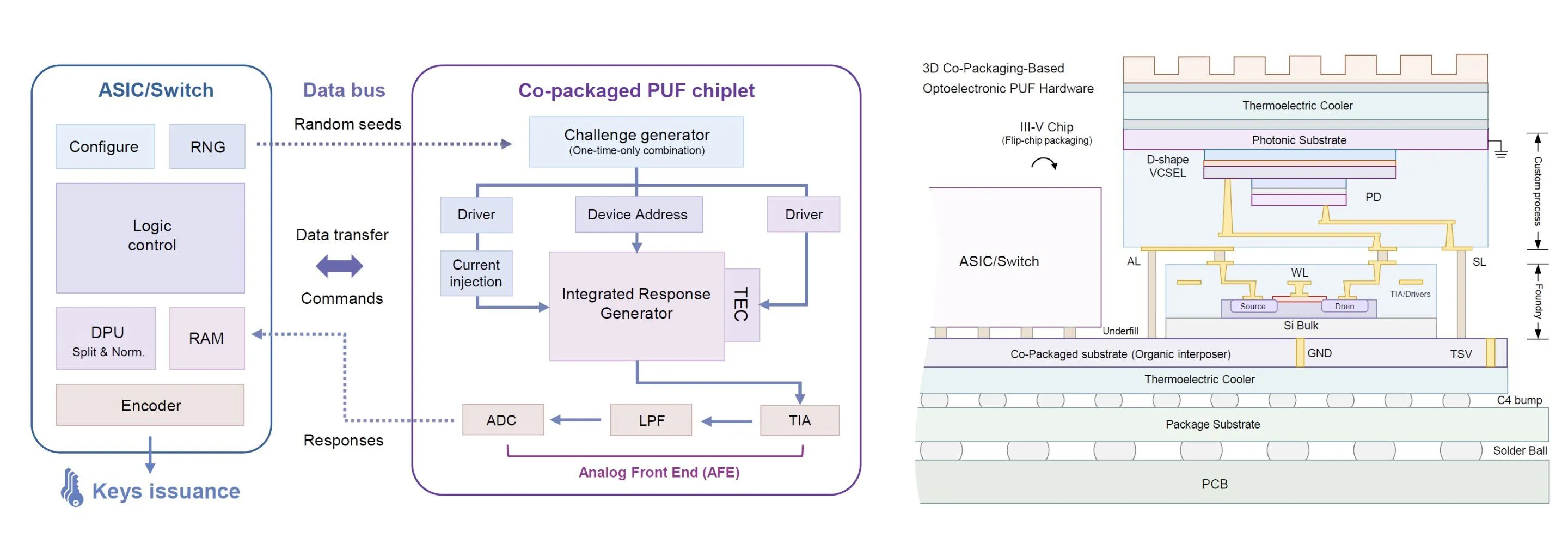
The approach presented by the KAUST research team elegantly overcomes this challenge by using light—a medium resistant to external electromagnetic interference—as the source of entropy. As Yating Wan, the study's senior author, emphasizes, this is not simply a matter of "observing an interesting physical phenomenon in a laser." The team built a full-stack authentication system that integrates everything: dynamic key generation, AI-based verification, a protected data transmission protocol, and even hardware design employing 3D co-packaging that combines electronic and photonic circuits.
In recent years, quantum cryptographic technologies such as Quantum Key Distribution (QKD) have attracted attention as a means of completely preventing eavesdropping along communication paths. However, robust hardware security is still required for the "authentication" process that confirms whether the device itself, at the endpoint of communication, is genuine. No matter how quantum-mechanically protected a communication channel may be, if the terminal itself is spoofed, the entire system can be hijacked. Photonic PUFs, as a robust identity-verification technology at this endpoint, are in a perfectly complementary relationship with future quantum communication networks.
This suggests a future in which, from cloud servers to edge devices, and even in future 6G communication networks, an "unforgeable root of trust" using optical circuits becomes standard infrastructure.
The Path to Implementation and Remaining Uncharted Territory
While this research demonstrates overwhelming potential, several unresolved challenges remain in transitioning from a tightly controlled laboratory environment to the real world, where countless unpredictable variables exist.
Currently, this system is at the proof-of-concept prototype stage. Optical devices are extremely delicate systems, and even minute environmental changes can have unexpected effects on the behavior of light. The next phase the research team has set its sights on is verifying long-term operational stability under harsh real-world conditions.
For example, when a device is exposed to extreme outdoor heat or cold, what kind of error will temperature drift caused by thermal expansion of components introduce into the AI's fingerprint recognition rate? It is also necessary to clarify how continuous packaging stress—such as that expected in automotive equipment—or the aging of the laser element itself over several years might alter the statistical characteristics of the chaotic optical signal. These are essential verification steps toward commercialization.
Furthermore, manufacturing challenges also stand in the way: how to scale this system into larger VCSEL arrays, and how to mass-produce, at high density and low cost, both the photonic component that serves as the light source and the electronic circuitry that controls and processes it. Assuming operation in massive cloud environments where millions of devices connect simultaneously, stress testing against large-scale cyberattack scenarios targeting the entire system must also be conducted continuously.
The horizon opened up by this research is extraordinarily vast. It puts an end to the fruitless battle in cyberspace over managing "stored keys" at enormous cost and fighting over who can steal them, instead proving the legitimacy of a connection with a "one-time fingerprint" that light creates only at the moment it is needed. This small laser element, where the depths of optical physics merge with the recognition capabilities of artificial intelligence, is poised to become the most robust and invisible shield in the next-generation hyper-connected society.