

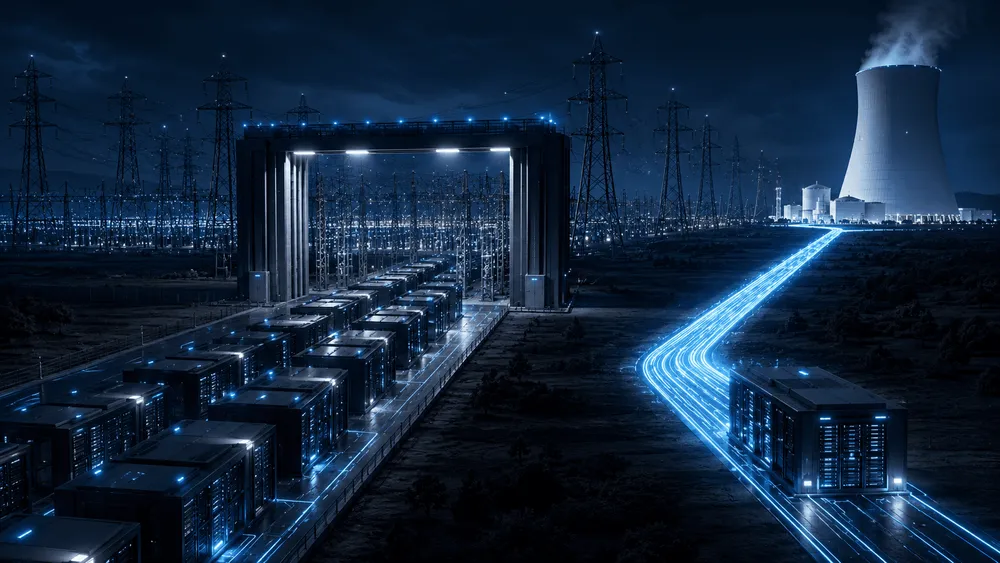
More people, especially in the United States, are noticing unfamiliar line items appearing on their electricity bills. PJM (the grid operator spanning 13 states across the U.S. Midwest and East Coast) saw its capacity auction price jump ninefold year-over-year in the results published in July 2024, and market monitors attributed 63% of that increase—roughly $9.3 billion—to surging data center demand. Even so, Amazon has locked in nuclear plant power under a 17-year contract, and Meta is footing the entire construction bill for three gas turbines just to accelerate groundbreaking. The "power shortage" that has utilities crying out for relief and the "construction boom" that keeps piling up investment are, in fact, two sides of the same coin.
AEP Ohio's 30GW Freeze and PJM's Ninefold Price Spike Reveal a Contradiction
In March 2023, Ohio-based utility AEP Ohio froze new data center interconnection requests in the central Ohio region. The application queue had swollen past 30GW—roughly three times the state's peak power demand of 9.4GW. Even if just one-third of these applications materialized, the state's peak demand would nearly double. That same year, Georgia utility Georgia Power got approval on April 16, 2024, to revise its 2031 demand forecast upward by a factor of 17—from roughly 400MW as of 2022 to about 6,600MW. What both companies share is the same underlying fact: demand growth far exceeded their own projections.
Utility demand forecasts are typically built on multi-year plans known as Integrated Resource Plans (IRPs). These rely mainly on extrapolating historical performance and existing contract growth, and never anticipated a scenario where a single massive customer could increase its power consumption by orders of magnitude within just a few years. Georgia Power's 17-fold upward revision shows that this extrapolation method underlying IRPs simply couldn't capture the demand surge of the generative AI era. To the extent forecasts missed the mark, utilities on the ground were left scrambling to process a flood of connection applications.
PJM's capacity auction is an annual bidding system that requires utilities to secure supply capacity years in advance, with bid prices directly reflecting how tight supply and demand have become. Market monitors cited the surge in data center demand as the primary driver behind the results published in July 2024. In other words, at the very same time AEP Ohio froze connections and Georgia Power revised its demand forecast 17-fold, the same signal of supply-demand tightness was showing up in price data as well.
Despite all this, construction plans from Amazon, Meta, and Microsoft show no signs of slowing. In the very same year AEP Ohio froze its connections, Amazon was moving forward on a contract to secure power from a nuclear plant in Pennsylvania. Even as grid operators declared a "waiting line," efforts to secure power itself through alternate channels were advancing in parallel.
From "6% Increase" to "Doubling": Power Demand Forecasts That Kept Missing the Mark
In February 2020, the U.S. academic journal Science published a paper (Masanet et al.) finding that even though global data center processing load grew by more than 550% between 2010 and 2018, power consumption rose by only 6%. The conclusion—that efficiency gains from virtualization and server consolidation absorbed the growth in demand—was widely cited at the time as evidence that "data center power consumption would remain flat." Just two years and nine months after this paper was published, its very premise would be overturned.
On November 30, 2022, OpenAI launched ChatGPT. Within just two months of launch, monthly active users were estimated to have reached 100 million, and the computational demands of training and running generative AI began rewriting the assumptions behind power demand. In a report titled "Electricity 2024," published on January 24, 2024, the International Energy Agency (IEA) forecast that global data center power consumption would more than double, from 460TWh in 2022 to over 1,000TWh by 2026. On May 29 of the same year, the U.S. Electric Power Research Institute (EPRI) also published an estimate that the share of U.S. electricity consumed by data centers would rise from 4–4.5% as of 2023 to as much as 9% by 2030. The figure of "6% growth over 8 years" from the Masanet et al. paper had become a thing of the past within just four years.
Goldman Sachs progressively raised its estimate for global data center power demand through 2030, from 165% growth to 220% growth between late 2025 and 2026, reaching 1,350TWh worldwide (of which roughly 750TWh in the U.S. alone). The estimate itself ended up expanding by more than 1.3 times. Following on the heels of utility forecasts, even investment bank projections have kept playing catch-up.
On December 20, 2024, the U.S. Department of Energy and Lawrence Berkeley National Laboratory announced that U.S. data center power consumption would expand from 176TWh in 2023 to somewhere between 325TWh and 580TWh by 2028, accounting for 6.7% to 12% of total U.S. electricity. This forecast range—with nearly a 1.8-fold gap between its lower and upper bounds—stands out as remarkably wide even alongside the upward revisions from Goldman Sachs and the IEA discussed above. Even specialized institutions, it turns out, cannot precisely foresee demand just a few years out.
A similar concern arose in the early 2010s, when rapid expansion of cloud computing sparked fears of surging power demand. Back then, server virtualization and consolidation advanced, and actual power consumption was kept in check. The reason the IEA and EPRI now frame this current surge as something "efficiency gains alone cannot keep pace with" is that they see it as a different kind of demand growth—one that can't be absorbed through the same methods as virtualization.
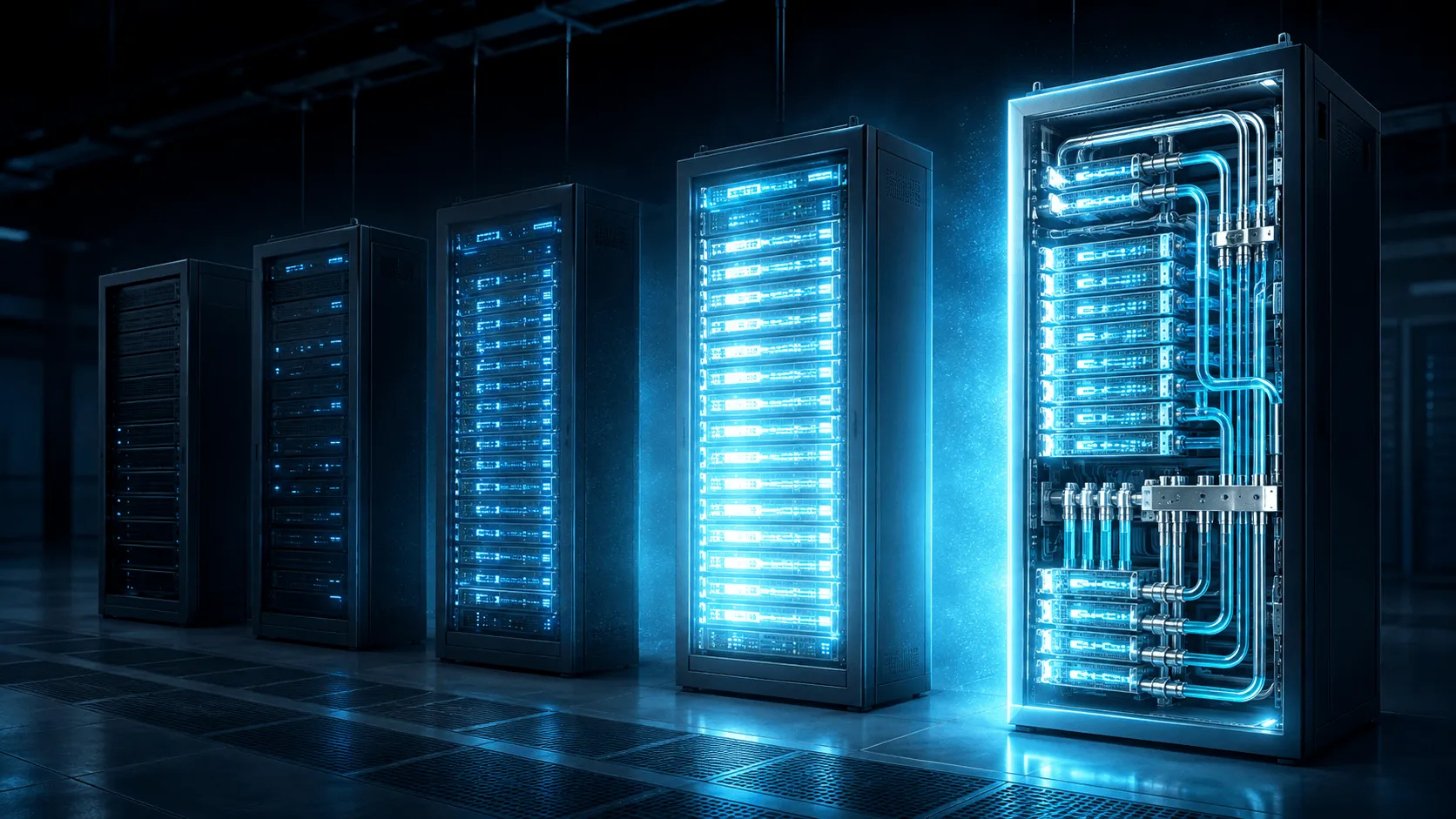
While figures vary by vendor and configuration, the A100-generation GPU rack of 2022 consumed roughly 25kW per unit. This rose to about 40kW for the H100 generation in 2023, about 72kW for the GH200 generation in 2024, and up to 132kW for the GB200 generation in 2025 (of which 115kW comes from liquid cooling). The upper limit for air cooling is generally considered to be around 40kW, meaning racks from the GB200 generation onward cannot operate without liquid cooling. TrendForce projects that the next-generation VR200 will reach approximately 225kW. Behind the surge in demand lies this explosive growth in per-rack power consumption, with the increase in hardware power draw itself now outpacing what efficiency gains can absorb.
Why Grid Interconnection Now Takes 3 to 8 Years
For new generation and storage projects seeking to connect to the grid within PJM's territory, the average time from review to commercial operation was under two years in 2008. By 2025, that had stretched to over eight years. A study by Lawrence Berkeley National Laboratory similarly found that the median time from interconnection application to commercial operation for projects completed in 2023 reached five years, up progressively from three years in 2015 and under two years before 2008. This statistic covers a generation and storage queue in which solar, batteries, and wind account for roughly 95% of projects, and the laboratory itself notes that "queue size is an indicator of long-term development appetite, and offers limited resolution for capturing short-term supply-demand tightness driven by load growth such as data centers."
At PJM and ERCOT, new load projects like data centers—in addition to generation and storage projects—are subject to the same framework known as "cluster studies," under which applications are generally reviewed in the order received. Under this system, projects submitted around the same time are bundled together for joint review, with the cost of necessary transmission upgrades allocated across the projects in the batch. But whenever a project within the review pool withdraws or changes its specifications, every other project in that same cluster must be re-reviewed. This mechanism itself is the primary cause of the delays.
The allocation of transmission upgrade costs that earlier-stage projects were supposed to bear also gets reworked each time. On top of that, building new transmission lines involves land acquisition and environmental review, taking several years from groundbreaking to completion. Most of the length of the waiting line stems from this physical construction time itself.
At ERCOT, the Texas grid operator, the interconnection queue for large loads exceeded 233GW as of the end of 2025—a roughly 300% surge from the previous year-end—with data centers accounting for about 77% of these applications. At PJM, the pre-reform backlog reportedly exceeded 2,700 projects. A single massive data center project has grown large enough to rewrite an entire regional grid plan.
PJM is moving in 2026 to shift from its traditional first-come-first-served approach to a "cycle" system that prioritizes projects with completed documentation and secured funding. ERCOT also approved a new system in June 2026 for batch-reviewing large-load interconnection applications. The very review methods that have produced years-long waiting lines are themselves now up for reconsideration.
The Mechanism for Buying Your Way Past the Grid Queue with Money and Contracts
On June 11, 2025, Amazon signed a 17-year power purchase agreement (PPA) to procure up to 1,920MW (1.92GW) of electricity from the Susquehanna nuclear plant in Pennsylvania. Full supply is set to begin by 2032, with the contract running through 2042. According to Talen Energy's own estimates, the deal is expected to generate roughly $18 billion in total revenue for the company. Transmission will be handled by PPL Electric Utilities under a "front-of-the-meter" arrangement, with a phased transition following planned grid reconfiguration work in spring 2026. The key point is that this is a contract to directly procure power from an already-operating nuclear plant, bypassing any new interconnection review entirely.
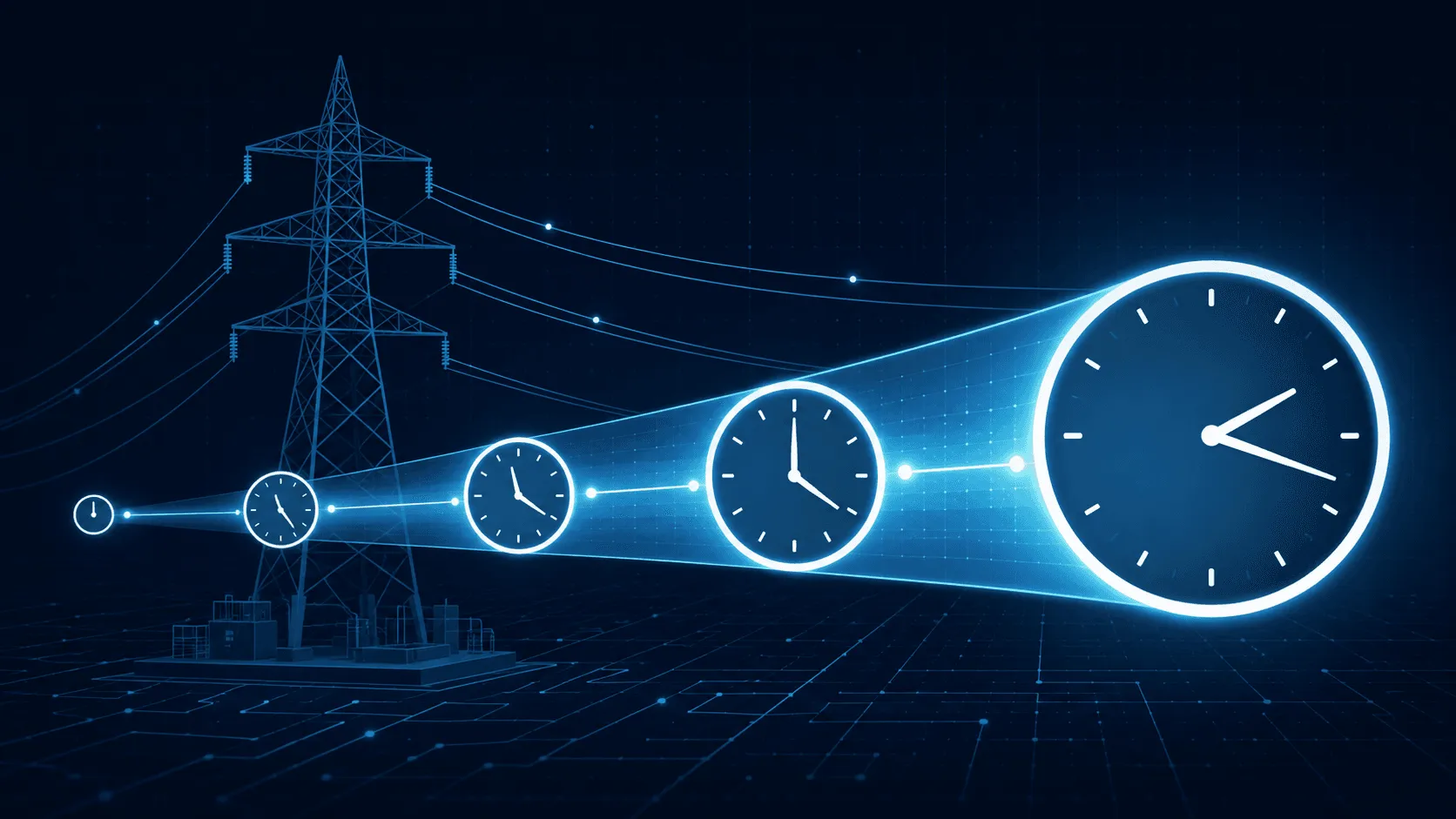
Existing nuclear plants are already connected to the grid and require no new interconnection review. While new load projects must wait their turn through years-long cluster studies, securing a power source whose generation and transmission are already fully established via contract allows the entire process to be skipped altogether. If the grid interconnection queue represents competition over "the right to newly connect to the power grid," then a PPA amounts to purchasing "the right to use a power grid that's already connected."
Meta chose a different path. For its Louisiana data center, the company signed a contract to fully fund the $3.2 billion construction cost of three new gas turbines (totaling 2,262MW) being built by utility Entergy. Under this approach—building dedicated generation capacity alongside the demand itself—the project is approved by state regulators as a separate negotiation for building and connecting generation equipment dedicated to a specific project. This is an entirely different review framework from the standard interconnection application process for cutting into the existing grid as new load.
Even though Meta is footing the construction bill, Entergy remains the owner of the gas turbines, and the plan calls for them to be connected to part of the transmission grid as well. The contract appears to prioritize supply to Meta, but it hasn't been disclosed to what extent other users might benefit from this generation capacity.
OpenAI, under its "Stargate" initiative, has laid out a $500 billion, four-year plan targeting 10GW secured by 2029, with about 7GW worth of plans already finalized as of September 2025. At its Abilene, Texas site, developer and operator Crusoe has procured 29 GE Vernova gas turbines (LM2500XPRESS units, 35MW each, totaling over 1GW), while Parker Hannifin has signed a contract to supply ancillary equipment such as intake filtration systems and sound attenuation. This on-site generation is reported not as a primary power source fully replacing grid electricity, but as a supplement to grid-supplied power.
Microsoft took the same approach in its own way. It signed a 20-year PPA with Constellation Energy to revive Unit 1 of the Three Mile Island nuclear plant in Pennsylvania as the "Crane Clean Energy Center," targeting restart by 2028. The deal involves a $1.6 billion investment in restart costs to secure 835MW under a long-term contract. Whether through restarting a nuclear plant, self-funding gas turbine construction, or signing power purchase agreements, what these approaches share is a single common thread: securing generation and transmission capacity without going through the grid's public queue.
The Power Procurement Strategies of Microsoft, Amazon, Meta, and OpenAI
Behind the hyperscalers' collective avoidance of building new large nuclear reactors lies the lesson of the Vogtle nuclear plant expansion in Georgia. What was originally a $14 billion project slated for completion in 2017 ballooned to $36.8 billion in total cost and wasn't completed until 2024, following builder Westinghouse's 2017 bankruptcy. The budget grew 2.6-fold and the timeline stretched by more than seven years. It's precisely because of this memory that Microsoft chose to restart the already-built, previously operational Three Mile Island plant rather than build a reactor from scratch.
Meta, working within the same constraints, is combining multiple hedges. The company has signed contracts with TerraPower, Oklo, and Vistra, aiming to secure up to 6.6GW of nuclear-derived power by 2035. It's a two-stage approach: covering near-term power needs with gas turbines while shifting its power mix toward nuclear a decade out.
Investment in next-generation small modular reactors (SMRs) is another common thread across these companies. Amazon, together with other investors, has joined a $500 million funding round for energy company X-energy, supporting over 600MW of combined SMR development in Washington State and Virginia. Google has partnered with Kairos Power on a contract targeting 500MW of deployment by 2035, with its first unit, "Hermes 2" (a roughly 50MW-class reactor in Tennessee), slated to come online in 2030. Startup Oklo's first unit, "Aurora" (at Idaho National Laboratory), is targeting operation from late 2027 to early 2028, though this timeline is subject to change depending on regulatory approval status.
What all four companies share is the mindset of securing power "a few years from now, through a dedicated route." The option of obtaining power "right now, from the grid" isn't even on the table to begin with. Whether it's Microsoft restarting an existing reactor, Amazon pursuing both nuclear PPAs and SMR investment, Meta's two-stage combination of gas turbines and nuclear, or OpenAI's turbine procurement via Crusoe, the underlying goal of avoiding the grid's public queue is the same across the board. SMR startups occupy the position of procurement partners supporting that goal heading into the 2030s.
Japan's Eight Transmission Utilities Also Pass ¥620 Billion a Year on to Households
According to reporting by Nikkei, Japan's eight transmission and distribution utilities applied to the Ministry of Economy, Trade and Industry in July 2026 to raise their transmission tariffs (tenso ryokin), with the increase estimated at an average of ¥620 billion annually. Multiple factors are behind the increase, including inflation and equipment upgrades, with transmission grid investment for data centers counted as one contributing factor. The new rates are scheduled to take effect in November 2026—meaning the same dynamic seen in the U.S. is now beginning to play out in Japan as well.
Transmission tariffs are usage fees for the grid infrastructure that delivers generated power to homes and businesses, and they get passed on to every consumer's electricity bill via retail power companies. If PJM's capacity auction in the U.S. is a mechanism that passes the "cost of securing generation capacity" on to consumers through market pricing, then Japan's transmission tariff hike is a mechanism that allocates that same cost directly to households through regulated rates. Even households that have never once used an AI data center cannot escape this rate increase.
Japan doesn't have anywhere near as broad an array of procurement options—large-scale nuclear PPAs or self-built generation, of the kind chosen by Amazon and Microsoft—as the U.S. does. Because the framework centers on utilities themselves expanding the grid, the resulting costs are more readily distributed across all users in the form of transmission tariffs.
According to one private-sector survey, domestic data center-related investment is expected to expand from roughly ¥400 billion in 2024 to around ¥1.2 trillion by 2028. NTT has announced plans to expand its domestic data center power capacity to roughly 1GW by fiscal year 2033—more than triple current levels. SoftBank is investing over ¥65 billion to expand its Tomakomai data center from an initial 50MW to over 300MW, targeting operation in fiscal year 2026. KDDI's Sakai data center began operations on January 22, 2026, running on 100% renewable energy while housing the latest GB200 NVL72 hardware—domestic data center investment continues to swell across the board.
Mitsubishi Heavy Industries posted net profit of ¥332.1 billion for the fiscal year ending March 2026, up 35% year-over-year and exceeding any previous fiscal year's results. The company has also announced plans to double its large gas turbine production capacity by fiscal year 2030 compared to fiscal year 2024. In stark contrast to the households footing the electricity bill, Japanese companies supplying power equipment are benefiting handsomely from the U.S. data center boom. Without the large-scale option of bypassing the grid through self-built generation as seen in the U.S., Japan finds itself in an asymmetric structure: profits accrue only on the supply side, while the burden falls on households through rate hikes.
The Limits of the Bypass Strategy and the Next Wall: A Three-Year Wait for Gas Turbines
GE Vernova's order backlog surged from 80GW at the end of 2025 to 116GW by the second quarter of 2026, with lead times for new orders now running about 3 to 5 years. The company says data centers account for roughly 20% of its orders. Rival Siemens Energy is likewise carrying a backlog of 69GW, with delivery times similarly estimated at 3 to 5 years. Even the very means of bypassing the grid queue has already generated a new queue of its own.
Still, gas turbine lead times remain shorter than the average eight-year wait for grid interconnection. Precisely because it's shorter than the interconnection wait, the workaround of self-funded gas turbine construction still retains its rationale. But the more backlogs pile up, the longer lead times stretch, edging this workaround ever closer to the same character as the interconnection queue itself. The structural pattern—where the more a bypass route gets chosen, the more congested it becomes—is no different from the very problem plaguing grid interconnection in the first place.
Nuclear operator Constellation Energy, along with gas-fired power players Vistra and NRG Energy, saw their stock prices surge in 2025, with NRG Energy ranking among the top gainers in the S&P 500. Companies that own generation assets are already reaping the benefits in the form of rising stock prices. The longer the grid queue drags on, the more prominent the position becomes for companies that already own power generation or that supply new turbines.
Nuclear PPAs and self-funded gas turbine construction only resolve the queue wait for the specific parties who signed the contracts—they do nothing to speed up the processing of the interconnection queue that other applicants are still waiting in. These contracts, approved by regulators as individual negotiated deals, carry no obligation to ease grid-wide congestion, and no system currently exists to examine how bypass strategies affect the overall waiting line.
Oklo's Aurora is targeting late 2027 to early 2028; Google and Kairos Power's "Hermes 2" is targeting 2030; and the Meta-TerraPower-Oklo-Vistra partnership is targeting 2035. All of these are plans several years to a decade out. Nuclear-based solutions, like gas turbines, take time as well. What the hyperscalers are securing right now is a reservation on power that will be confirmed sometime in the 2030s—these contracts do nothing to fill the immediate shortfall.
The cry of "there isn't enough power" actually conflates two distinct types of shortage: congestion in the queue for newly connecting to the grid, and a genuine tightness in generation capacity itself. In a report titled "Powering Reliability Through Market Design" published May 6, 2026, PJM reported a supply shortfall of roughly 6.5GW (5.2%) against its target reserve margin of 20% for the 2027/2028 capacity auction. This marks the first time in PJM's history that supply has fallen short of its target reserve margin—a sign that, beyond queue congestion, actual generation capacity itself has grown tight.
What hyperscalers are avoiding through nuclear PPAs and self-funded gas turbine construction is the procedural bottleneck of grid interconnection—one of these two shortages—not a mechanism for resolving the shortage in generation capacity itself. The cost of these bypass strategies is being distributed to all consumers through PJM's capacity auctions and Japan's transmission tariffs. As GE Vernova's order backlog fills up delivery slots around 2029, and as several SMRs reach commercialization around 2030, whether the bypass route itself turns into congestion will mark the next turning point in this unfolding story.