

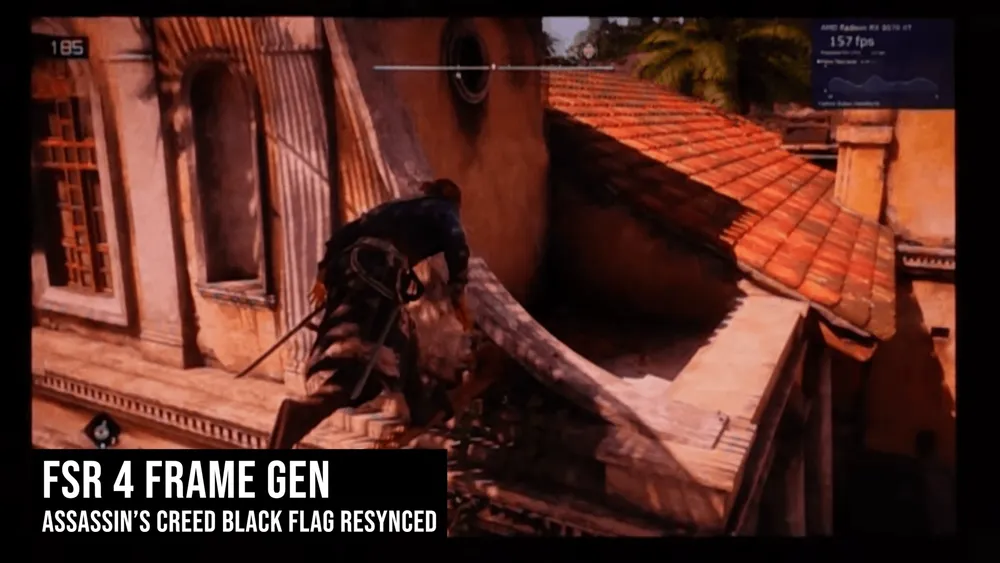
Even when average FPS climbs with Frame Generation enabled, the screen won't feel as smooth as that number suggests unless frames are displayed at even intervals. On August 20, 2026, Hardware Unboxed re-tested AMD FSR Frame Generation across 10 games and captured uneven frame pacing in both the driver-updated FSR 3.1 integration path and native FSR 4-series integrations.
What the testing calls a "double tap" is a sequence where a generated frame is displayed briefly, followed by a real frame that lingers longer. Since this is hard to catch through PresentMon's average FPS readings, the outlet also used monitor refresh overlays and 960fps slow-motion footage. This is Hardware Unboxed's own qualitative measurement centered on a single test environment—not an issue officially acknowledged or scheduled for a fix by AMD. Still, it offers evidence that FSR's image-quality improvements and temporal display stability can't be treated as the same thing.
AMD has publicized frame-pacing improvements with FSR 3.1, and the current ML-based Frame Generation 4.0.1 is now available. This re-test asks whether display-interval issues persist even after the underlying image-generation model has been updated to a newer generation.
Double Taps Persisted Across 10 Games
Hardware Unboxed's test setup used a Radeon RX 9070 XT, Adrenalin 26.7.1 drivers, and an MSI MAG 321UPX monitor capable of up to 240Hz. The outlet enabled the FSR Frame Generation driver-update toggle across all titles, comparing five games using the driver-updated FSR 3.1 implementation path to Redstone against five games with native FSR 4-series integration. The former group included Cyberpunk 2077, Mafia: The Old Country, Borderlands 4, God of War Ragnarök, and Hogwarts Legacy. The latter group included Crimson Desert, LEGO Batman: Legacy of the Dark Knight, Assassin's Creed IV Black Flag Remastered, Resident Evil Requiem, and Alan Wake 2.
In Cyberpunk 2077, double tap artifacts and some tearing appeared even at roughly 120fps output, below the monitor's 240Hz ceiling. Borderlands 4 stayed relatively stable in the 90fps range while walking, but during fast movement the monitor's refresh display fluctuated even with an average around 98fps. Maintaining an average FPS figure and displaying each frame for an equal duration are two different things.
The results weren't consistently severe, either. In Mafia: The Old Country, at the same session, same settings, and nearly identical ~103fps, some captures showed disruption while others were largely stable. In LEGO Batman: Legacy of the Dark Knight, roughly 20-30 stable frames were followed by one or two disrupted pairs, and the tester rated it as relatively usable by comparison. This fluctuation makes it impossible to pin game integration alone as the sole cause.
Even with native FSR 4 integration, Crimson Desert showed disruption at around 115fps. Turning off Frame Generation and lowering settings to around 90fps produced more consistent frame intervals, which Hardware Unboxed found smoother. Assassin's Creed IV Black Flag Remastered, Resident Evil Requiem, and Alan Wake 2 also showed double taps to varying degrees.
Average FPS and Display Smoothness Are Not the Same Thing
In AMD's design, Frame Generation creates an intermediate image between two real frames before and after it, while a replacement swapchain handles when real and generated frames get displayed. FSR 3 first reached games via patches for Forspoken and Immortals of Aveum on September 29, 2023. Even then, image interpolation and display timing were distinct components with different roles.
The current ML-based FSR Frame Generation 4.0.1 uses optical flow estimation and motion vectors to create intermediate frames. It requires RDNA 4-based Radeon RX 9000-series GPUs or newer, DirectX 12, and Windows 11, with an analytical fallback retained for older GPUs. Meanwhile, Frame Generation Swapchain 3.1.7 calculates target display intervals from a moving average using a high-priority pacing thread, while a separate present thread displays generated and real frames in sequence. The goal is to keep each frame on screen for an equal duration.
Therefore, an intermediate image being visually correct, the GPU or application returning a high average FPS, and the panel scanning images at even intervals are not synonymous. In a double tap, a generated frame is displayed for a short duration while the following real frame lingers longer. Even at an average of roughly 120fps, the result can look far from uniform 120fps-equivalent motion.
Hardware Unboxed also reported that in same-game comparisons with DLSS Frame Generation, NVIDIA's pacing was more consistent. However, the video doesn't present a quantitative comparison table under identical GPU conditions for all 10 titles. Extending these results into a general purchasing recommendation for Radeon would require additional testing under unified conditions.
What 4.0.1 Fixed, and What It Doesn't Claim to Have Fixed
AMD announced frame-pacing improvements with FSR 3.1 in July 2024. Redstone was subsequently released in December 2025, and the current 4.0.1 with SDK 2.3 updated the ML-based Frame Generation. This test spans both older integrations updated through that release and newer titles that built in the FSR 4-series from the start.
However, what AMD lists in the 4.0.1 changelog includes motion vector preprocessing toward the generation rectangle, camera information binding, and handling of race conditions and handles at exit. It does not state that display-interval issues were generally fixed. What should be distinguished here is that ML Frame Generation 4.0.1 handles creating intermediate images, while Swapchain 3.1.7 handles display pacing.
Because of this division, the disruption visible in the video can't be definitively attributed to a flaw specific to the ML model, nor can it be assumed fixable through drivers alone. Which layer—OS, VRR, V-Sync, queuing, or the swapchain—was responsible has not been identified from this footage. The observation that Mafia switched between stable and unstable results further complicates any simple causal explanation.
Cases That Persist Even When Recommended Conditions Are Met
AMD recommends at least 60fps before interpolation and advises against going below 30fps. The Swapchain documentation states that generation itself via 4.0.1 targets 30fps and above, while optimal display pacing is intended for 60fps and above, with the 30-60fps range potentially being suboptimal. This isn't a blanket statement that low FPS falls outside spec—it distinguishes between conditions where generation is possible and conditions where uniform display is more easily achieved.
God of War Ragnarök offers a useful case for considering that distinction. Hardware Unboxed observed clear double taps and tearing at an output of roughly 138fps, even though the pre-interpolation frame rate exceeded AMD's recommended 60fps threshold. Meeting that 60fps recommendation doesn't guarantee display-interval consistency across every implementation and setting.
AMD itself states that good pacing requires unimpeded access to the swapchain. Third-party software that intercepts DXGI could cause problems, and AMD recommends turning V-Sync off when frame times fluctuate under VRR, and on when they're stable. AMD also strongly recommends implementing a frame limiter. It's unclear how these conditions factored into the measurements taken, and combined with the reproducibility fluctuation seen in Mafia: The Old Country, the interplay between settings and implementation needs to be disentangled separately.
Identifying the Cause and a Fix Path Remain Next Steps
The value of this testing lies in making visible, across 10 games and both the driver-updated FSR 3.1 path and native FSR 4-series integration, frame-pacing disruptions that average FPS alone fails to capture. That said, it remains a qualitative test centered on one environment combining a Radeon RX 9070 XT with a 240Hz MSI MAG 321UPX monitor, and doesn't represent behavior across every Radeon GPU, monitor, or setting. The 960fps footage also doesn't directly measure the root cause of the disruption.
Whether AMD's next changelog includes a display-pacing fix will offer a clue as to which layer the problem resides in. More conclusive would be measuring frame-interval distribution alongside average FPS, and comparing reproducibility across varying GPUs, VRR-capable monitors, V-Sync settings, and frame-limiter conditions. Only through that kind of measurement can we determine whether improved image-generation quality extends to uniform motion actually delivered to the screen.