

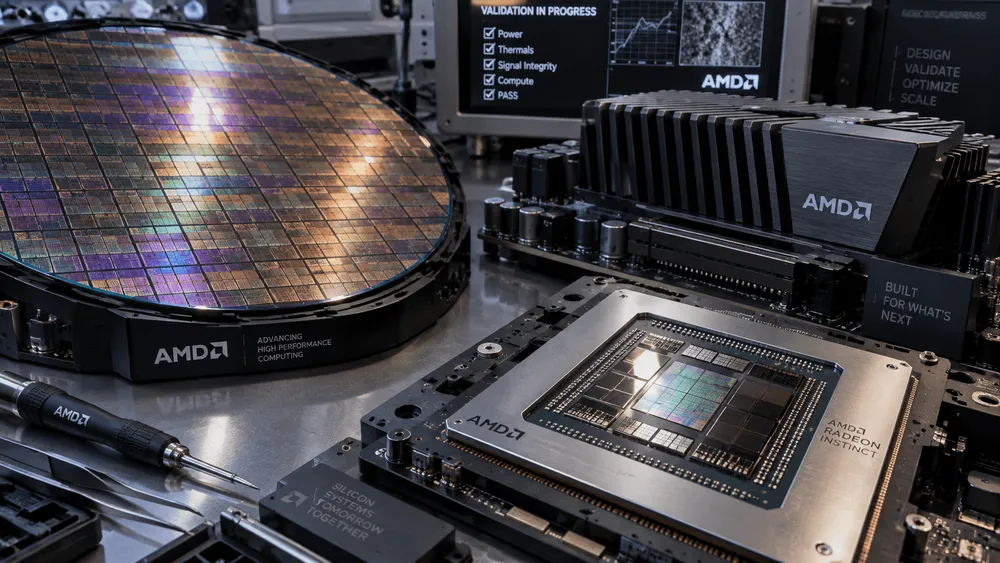
Supply chain sources report that AMD has notified its partners of plans to raise supply prices for its chip products by a uniform 10% starting in the fourth quarter (Q4) of 2026. The affected products include AI accelerators and consumer graphics chips, as well as—unusually—motherboard chipsets. TSMC's revised wafer pricing, as the sole foundry AMD relies on for manufacturing, is now directly shaking the profit structure of this fabless company. Why can't AMD absorb the cost internally instead of passing it downstream, and what kind of chain reaction will this price hike trigger across the DIY PC and broader hardware market?
Why Are Motherboard Chipsets Being Raised Across the Board Too?
According to a report cited by @harukaze5719, the Chinese distribution and supply chain information site "ChannelGate" (视博合聚) revealed that AMD has issued a notice to its board partners—AIB companies and motherboard manufacturers—stating that chip supply prices will rise by approximately 10% starting in Q4 2026. The product categories explicitly named in the notice are data center AI accelerator chips, consumer-facing Radeon graphics processors, and desktop motherboard chipsets.
What has drawn the most attention from industry insiders in this notice is the inclusion of motherboard chipsets in the price hike. While there is precedent for individual GPU or CPU die price revisions driven by demand fluctuations or memory price swings, it is extremely rare for the wholesale price of the chipset itself—the foundation of the platform—to be raised across the board.
The significance of the motherboard chipset price increase becomes clearer when we examine the physical design structure of the AMD AM5 platform.
Motherboard chipset price hikes and rising AM5 platform BOM costs: The AM5 chipset (Promontory 21) is manufactured on TSMC's 6nm process, with two units installed on X670E/X870E boards. Unlike previous standalone GPU/CPU price increases, this roughly 10% chipset hike will further raise the already-inflated motherboard manufacturing BOM costs driven by mandatory USB4 controllers and multilayer PCB designs. In the existing product lines currently supporting the market—such as X670 and B650—as well as the new generation X870 and B850 motherboard families, the chipset die designed by Taiwan's ASMedia, known as "Promontory 21" (PROM21), serves as the core component. This Promontory 21 die is manufactured on TSMC's 6nm process, and on top-tier platforms such as X670E and X870E, two Promontory 21 dies are daisy-chained on the board to secure sufficient lane count and expansion ports.
Motherboard vendors are already facing sharply rising manufacturing costs. Multilayer PCB designs have become standard to maintain signal integrity for the latest interfaces, and manufacturers have continued to reinforce VRM power circuitry and add larger heatsinks to support processor power delivery. Furthermore, the requirement to implement USB4 controller chips in new-generation flagship models has pushed per-board Bill of Materials (BOM) costs even higher than in the previous generation.
Against this backdrop, a roughly 10% increase in the supply price of the two Promontory 21 dies mounted on each board will further erode motherboard manufacturers' profit margins. For major board vendors such as ASUS and MSI, absorbing the increased chipset costs through internal efficiency alone will be difficult, making it inevitable that the added costs will gradually be passed on to wholesale and retail prices.
$30,000 Wafers at 2nm and TSMC's Pricing Power
The reason AMD has been forced to raise wholesale prices for its partners lies in the strong pricing power and shifting cost structure of TSMC (Taiwan Semiconductor Manufacturing Company), the foundry giant on which AMD depends entirely for manufacturing.
The scale of TSMC's price revisions for advanced and mature nodes, and AMD's cost pass-through: TSMC is implementing annual price increases of 3–10% in 2026 for sub-5nm advanced nodes as well as some mature nodes, with wafer prices reaching approximately $18,500 for 5nm and $20,000–$22,000 for 3nm. As a fabless company, AMD cannot resist TSMC's pricing power, which is driven by TSMC's need to fund over $60 billion in capital expenditures and rising electricity costs. As a result, AMD has notified partners of a uniform roughly 10% wholesale price increase for AI chips, GPUs, and chipsets starting in Q4.
Starting in January 2026, TSMC has been implementing annual price increases of 3–10% on its contract manufacturing (wafer) prices for advanced processes classified as sub-5nm (2nm, 3nm, and 4nm/5nm) as well as some mature nodes. Per-wafer price levels for each generation continue to climb, as shown below.
| Process Node | Estimated Wafer Price | Primary Use / Adopting Products | Trends and Cost Drivers |
|---|---|---|---|
| 5nm (N5/N4) | ~$18,500 | Ryzen CCD, Radeon GPU, Instinct | Subject to 3–10% annual price increase; production lines strained |
| 3nm (N3) | $20,000–$22,000 | Next-gen HPC, advanced AI accelerators | High demand concentration; higher costs from increased EUV steps |
| 2nm (N2) | ~$30,000 | Next-gen flagship products | Significant premium over 3nm, reflecting new capital investment |
The biggest reason TSMC continues its aggressive price hikes is the swelling burden of capital expenditure and external costs. TSMC is pouring an astronomical $60–64 billion into its 2026 capital expenditure (Capex) plan, rapidly building out next-generation 2nm fabs and expanding advanced packaging (CoWoS) capacity. In addition, multiple rounds of industrial electricity rate hikes in Taiwan, along with rising labor and operating costs and depreciation expenses tied to launching new overseas fabs—such as Arizona (Fab 21) and Kumamoto (JASM)—are all pushing up TSMC's costs.
TSMC CEO and Chairman C.C. Wei has consistently stated at earnings calls and other venues that the company follows a policy of "value-based pricing," charging customers a price commensurate with the technological value TSMC provides. The company has set a long-term financial target of maintaining a gross margin above 53%, and rather than absorbing rising costs through margin erosion, it has firmly committed to passing those costs on to its semiconductor design customers.
For AMD, a purely fabless company with no semiconductor manufacturing facilities of its own, there is effectively no foundry other than TSMC capable of stably supplying leading-edge processes. Rival Samsung Foundry continues to struggle with yield improvements on advanced processes, while Intel Foundry still needs more time to build out a full-fledged external customer ecosystem for contract manufacturing. With no realistic alternative to switch to, AMD has no choice but to accept TSMC's annual 3–10% price revisions as they are presented—and in order to preserve its own gross margin, passing the added costs on to downstream partners and consumers is the only option available.
CPUs Caught in the Share Battle, While Intel Moves to Defend Profits
Another critically important point in this notice is that desktop client CPUs, including the Ryzen lineup, were notably absent from the list of affected products.
Intel's earlier 10% price hike and AMD's Ryzen pricing strategy: Intel plans to raise PC client processor prices by up to approximately 10% effective October 5, 2026—its third revision within the year—prioritizing gross margin improvement over market share. AMD's decision not to explicitly include Ryzen in this notice appears aimed at protecting its position in the client market share battle. However, since both the CCD and IOD are manufactured by TSMC, Intel's price hike is highly likely to become the trigger for AMD to follow suit with its own CPU price increases.
The reason CPUs were left off the list is not due to any difference in the underlying cost structure. Desktop Ryzen processors use TSMC's 4nm or 5nm process for the CPU Complex Die (CCD) that handles computation, and TSMC's 6nm process for the I/O Die (IOD) that manages various interfaces. In other words, CPU manufacturing costs are also fully exposed to the impact of TSMC's wafer price increases across both sub-5nm and mature nodes.
Nevertheless, the reason AMD has held off on an immediate CPU price hike lies in the fierce market share battle with rival Intel in the PC client market. As AMD works to expand adoption of its latest Ryzen processors and gaming-oriented X3D models in the desktop market, unilaterally raising CPU prices by 10% could undermine its price competitiveness against rival products and cede back the market share it has been gaining. AMD therefore appears to be taking a cautious, wait-and-see approach to CPU pricing.
However, this balance is unlikely to hold for long. Supply chain sources report that Intel, AMD's biggest rival, is also planning to raise PC client processor prices by up to approximately 10% effective October 5, 2026.
If this revision goes through, it will mark Intel's third price increase in 2026. The company implemented an approximately 10% revision in the first quarter and made price adjustments for some consumer and server products in July as well. Intel, which once aggressively competed on price to gain market share, has clearly shifted its management strategy—under pressure from massive foundry division investments and corporate restructuring—to prioritize defending gross margins and improving profitability over maintaining market share.
If rival Intel carries out its planned 10% client CPU price hike in October, it would raise the overall price baseline across the desktop CPU market. For AMD, this would create an environment in which it could raise Ryzen processor prices without losing relative price competitiveness. Supply chain sources believe that AMD's omission of CPUs from this notice is merely a stalling tactic to gauge how Intel's price revision plays out first, and that it is highly likely a roughly 10% price hike will spread to the Ryzen lineup as well, sometime between the latter half of Q4 and the end of the year.
A Chain Reaction of Rising BOM Costs Hits the DIY PC Platform
This chip price increase is not an isolated move affecting a single component. It will bring a layered chain of cost increases across the entire DIY PC market. The graphics card market, in particular, faces a double blow, as the GPU die price hike compounds an already sharp rise in memory prices.
Since the summer of 2026, the semiconductor memory market has prioritized securing production capacity for high-bandwidth memory (HBM) used in AI accelerators, resulting in tight supply of general-purpose DRAM wafers and a sharp rise in trading prices for GDDR6 and GDDR7 memory used in graphics cards. According to information previously reported by ChannelGate, AMD had already adjusted pricing for procurement kits that bundle GPUs with memory—but this new Q4 notice represents an approximately 10% price hike on the graphics processor die itself.
In the manufacturing cost of a graphics card, the GPU die and graphics memory together account for more than half of the total cost. On top of that, component costs for cooling systems, multilayer PCBs, and power circuitry are added, squeezing AIB partners' profit margins to their limits. A 10% price increase on the GPU die itself will be a decisive factor in driving up graphics card retail prices.
Add the motherboard chipset price hike on top of that, and the core components that make up a DIY PC are facing cost increases from every direction, like a tightening net.
データを表で見る
| Notified Price Increase (%) | |
|---|---|
| AI Accelerators | 10 |
| Consumer GPUs | 10 |
| Motherboard Chipsets | 10 |
| Client CPUs | — |
As the chart above shows, the scope of the notice directly covers GPUs, chipsets, and AI accelerators, with only CPUs left pending. However, as already discussed, Intel is planning its own price increase of up to approximately 10% ahead of AMD on October 5, meaning similar upward price pressure is already building in the CPU market as well.
For readers considering building or upgrading a DIY PC, the market environment from this autumn onward will demand more careful judgment than ever before. Retail prices for motherboards and graphics cards are likely to rise in stages as existing inventory lots held by manufacturers and distributors are cleared out and replaced by new-price lots shipped from Q4 onward.
This will be especially true for anyone building a new PC on the AMD AM5 platform: high-end motherboards carrying two Promontory 21 dies (such as X670E and X870E) and mid-range or higher graphics cards will feel the strongest impact from this chain reaction of rising BOM costs. Buyers now face a choice: secure key components while current-price inventory remains in distribution channels, or wait to see how Intel's October price revision plays out—and how AMD responds—before finalizing their build. The realities of semiconductor costs shaped by the relationship between fabless companies and contract foundries are now landing squarely on the choices facing DIY PC builders.