


AMD has raised its suggested retail prices for the Radeon series starting in October, according to the Chinese PC parts distribution information site Bobantang. The Radeon RX 9070 reportedly rises by 700 yuan, while the higher-end RX 9070 XT stays unchanged. A post dated October 8 says prices were revised in global markets, including China, but the original notice issued by AMD has not been verified.
The most notable detail in the reported Chinese price list is that the gap between the RX 9060 XT 16GB and the higher-tier RX 9070 GRE has narrowed to just 100 yuan. However, the RX 9070 GRE has 12GB of video memory, 4GB less than the 16GB version of the RX 9060 XT. With GDDR6 supply shrinking, buyers face a harder decision over whether to prioritize GPU compute performance or memory capacity.
RX 9070 reportedly up 700 yuan, RX 9070 XT unchanged
According to the Bobantang poster "低手一号," AMD revised Radeon series prices from October 1, 2026, raising its fourth-quarter suggested retail price (SEP).
SEP stands for "Suggested E-tail Price." In AMD's Japanese-language materials, it is rendered as "推奨販売価格" (recommended retail price). It is a price guideline from the manufacturer, and differs from the parts procurement prices paid by graphics card makers and from the actual selling prices set by retailers.
The new Chinese prices reported on October 8, and the changes from the third quarter, are as follows.
| Model | Q3 price (estimated) | Reported Q4 price | Increase | Percentage increase |
|---|---|---|---|---|
| RX 9070 XT | 6,999 yuan | 6,999 yuan | Unchanged | 0% |
| RX 9070 | 5,599 yuan | 6,299 yuan | 700 yuan | About 12.5% |
| RX 9070 GRE | 4,599 yuan | 4,999 yuan | 400 yuan | About 8.7% |
| RX 9060 XT 16GB | 4,299 yuan | 4,899 yuan | 600 yuan | About 14.0% |
| RX 9060 XT 8GB | 3,090 yuan | 3,390 yuan | 300 yuan | About 9.7% |
| RX 7650 GRE | 2,599 yuan | 2,999 yuan | 400 yuan | About 15.4% |
| RX 6500 XT | 1,599 yuan | 1,599 yuan | Unchanged | 0% |
Source: a publicly reposted image of Bobantang's October 8 post. Q3 prices were calculated by subtracting the increase from the reported new prices. Percentage increases are based on the estimated old prices, rounded to one decimal place. All figures are in Chinese yuan and do not represent an official AMD price list or prices in Japan.
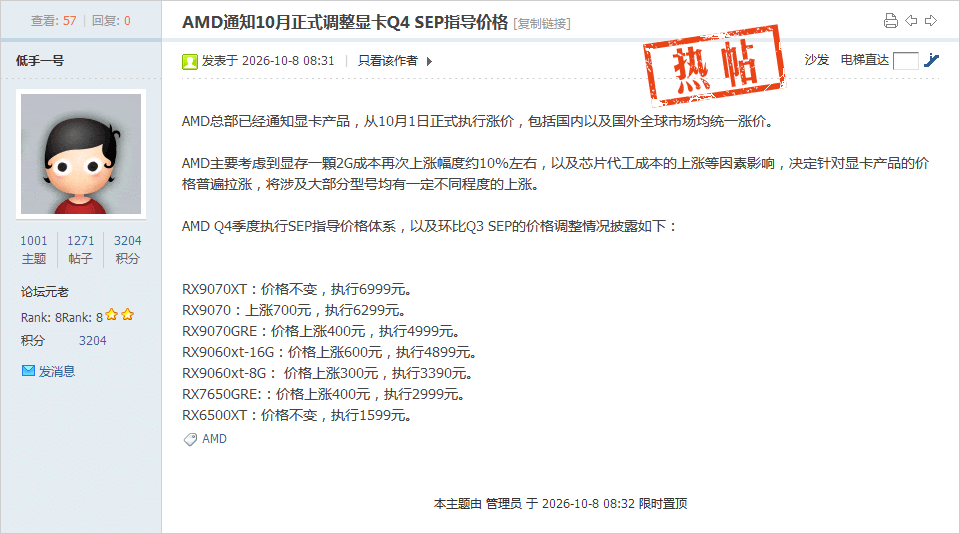
The RX 9070's 700 yuan is the largest increase in absolute terms, but the RX 7650 GRE's roughly 15.4% is the largest percentage increase.
For the RX 9060 XT, the 16GB version rises about 14.0%, while the 8GB version rises only about 9.7%. Models with more memory tend to see larger increases.
Meanwhile, the top-tier RX 9070 XT and the older RX 6500 XT are reportedly unchanged, so not every model was raised uniformly.
GDDR6 production cuts and a shift toward server memory push prices up
Bobantang cited two factors behind the increase: the price of a 2GB video memory chip has risen about 10% again, and semiconductor foundry fees have surged.
The supply structure of the broader memory industry is also changing for GDDR6, which the Radeon series uses.
In a September 30 market analysis, research firm TrendForce noted that memory makers are scaling back GDDR6 production and gradually withdrawing from that market.
It added that supply of the newer GDDR7 is also constrained, because advanced process capacity is being allocated first to products such as server DRAM.
Given these conditions, TrendForce expects graphics DRAM prices to keep rising.
Older memory standards are generally assumed to get cheaper as newer ones spread. That is not always the case.
Even if demand remains for GPUs that use GDDR6, a cut in production by memory makers can cause shortages that push prices up.
In fact, TrendForce explains that some PC makers are reconsidering GDDR6 to hold down component costs. Demand for cheaper memory exists, but on the supply side production is shrinking.
However, TrendForce's research did not examine AMD's individual procurement contracts.
Also, the information that video memory chip prices rose about 10% does not mean the total manufacturing cost of a graphics card increased by the same proportion.
Graphics card prices reflect not only GPU manufacturing costs but also the board, cooling hardware, power circuitry, and each company's profit. The report does not disclose a breakdown of these costs.
For the RX 9060 XT, the 16GB version's increase of 600 yuan is exactly double the 8GB version's 300 yuan. But it cannot be concluded that this is due to memory capacity alone.
The RX 9070 and RX 9070 XT both carry 16GB of GDDR6, yet the former reportedly rises by 700 yuan while the latter is unchanged.
In other words, while higher memory prices are a plausible background factor, they do not explain every model-by-model adjustment. How AMD absorbed cost increases and set prices for each product has not been disclosed.
RX 9060 XT and RX 9070 GRE just 100 yuan apart: which to choose?
The relationship between the RX 9060 XT 16GB and the RX 9070 GRE is what makes this price revision especially tricky for buyers.
In China's fourth-quarter suggested retail prices, the RX 9060 XT 16GB is 4,899 yuan and the RX 9070 GRE is 4,999 yuan.
The difference is just 100 yuan.
Based on estimated third-quarter prices, the gap between the two was 300 yuan, so this revision cuts it to one-third.
At first glance, adding a little to the budget for the higher-tier RX 9070 GRE looks like the better deal. But the two models differ in specifications in ways that cannot be ignored.
Comparing the official AMD specifications for the RX 9060 XT and the official specifications for the RX 9070 GRE gives the following.
| Comparison item | RX 9060 XT 16GB | RX 9070 GRE |
|---|---|---|
| China Q4 SEP (reported) | 4,899 yuan | 4,999 yuan |
| Video memory capacity | 16GB | 12GB |
| Compute units (CUs) | 32 | 48 |
| Memory bus width | 128-bit | 192-bit |
| Typical board power (TBP) | 160W or more | 220W |
Prices are based on Bobantang's October 8 post, and product specifications on AMD's official materials. Power settings and cooling designs may differ by manufacturer and model among actual graphics cards. TBP is also not a measured value of the power constantly drawn during gaming.
The RX 9070 GRE has 16 more compute units than the RX 9060 XT and a wider memory bus.
For buyers who prioritize pure gaming performance, the RX 9070 GRE becomes more attractive once the price gap narrows to 100 yuan.
On the other hand, the RX 9070 GRE's 12GB of video memory is 4GB less than the RX 9060 XT 16GB.
That 4GB difference could matter in games that make heavy use of high-resolution textures, and in tasks that use a lot of video memory.
Moreover, having more compute units does not mean game frame rates rise in the same proportion.
Actual performance differences vary with the game title, resolution, graphics settings, GPU clock speeds, and other factors, so individual benchmark results should be checked.
For buyers who were considering the RX 9060 XT specifically for its 16GB of memory, the RX 9070 GRE is not simply a superior alternative.
Price gap between RX 9060 XT 8GB and 16GB also widens
Within the RX 9060 XT line itself, the price gap by memory capacity is also growing.
Based on the reported prices, the difference between the 8GB and 16GB versions widens from 1,209 yuan in the previous quarter to 1,509 yuan.
Both models have the same 32 compute units, so the main difference is video memory capacity.
Whether the 16GB version is worth the extra budget therefore depends on whether the games or work you use need more than 8GB of memory.
Having 16GB does not make every game faster, and having 8GB does not mean every game will run short of memory.
On the other hand, the 16GB version has advantages if you want to use high-resolution textures in the future or run applications that use a lot of video memory.
Whether the extra 1,509 yuan is worth it should be judged by the memory capacity your own use requires.
Gap between RX 9070 and RX 9070 XT also halves
The price gap between the RX 9070 and RX 9070 XT has changed as well.
At the reported new prices, the RX 9070 is 6,299 yuan and the RX 9070 XT is 6,999 yuan, narrowing the gap to 700 yuan.
That halves the previous 1,400 yuan, so the advantage of choosing the RX 9070 for its lower price is smaller than before.
However, the higher-end RX 9070 XT also consumes more power.
According to AMD's official specifications, the RX 9070 has a TBP of 220W while the RX 9070 XT is 304W, a difference of 84W.
Even if the price gap shrinks, the required power supply capacity and cooling performance do not become the same.
When buying, you need to check not only gaming performance but also the power supply unit and case cooling capacity of the PC you will use.
In Japan, what matters is changes in actual selling prices, not yen conversions of Chinese prices
Bobantang's post explains that this price revision also applies to markets outside China.
However, AMD's official notice has not been verified, and it is not confirmed when, for which models, and by how much prices will rise in Japan.
For example, converting the reported 700 yuan increase for the Chinese RX 9070 into Japanese yen does not mean selling prices in Japan will rise by that amount.
That is because domestic graphics card prices are affected by exchange rates, distribution inventory, retailer pricing, and each board maker's product lineup.
Even products with the same GPU have different prices depending on cooling hardware, power circuitry, clock speeds, and other factors.
When comparing different GPUs, then, rather than simply comparing an expensive factory-overclocked version of a higher-tier model against a budget version of a lower-tier one, it is better to check the actual selling prices of products available at the same time.
Comparing with conditions such as power supply capacity, size that fits the case, and cooling performance included makes it easier to distinguish differences in GPU performance itself from price differences caused by each manufacturer's product design.
What this Chinese price list shows is that adding budget for a higher-tier model does not necessarily improve every performance figure and specification.
In particular, the RX 9060 XT 16GB and RX 9070 GRE are now just 100 yuan apart, yet the higher-tier GRE model has less memory.
If the actual selling prices of the two models also move closer in Japan, the sensible approach is not to simply pick the higher model number, but to first confirm how much video memory you need, then compare gaming performance and power consumption.
What matters in this price hike information is not only the possibility that GPU prices will rise, but that changing price gaps between models mean past ways of choosing may no longer hold.
With memory prices surging and supply constrained, the balance between each model's actual selling price and its specifications is likely to weigh even more heavily on purchase decisions going forward.