

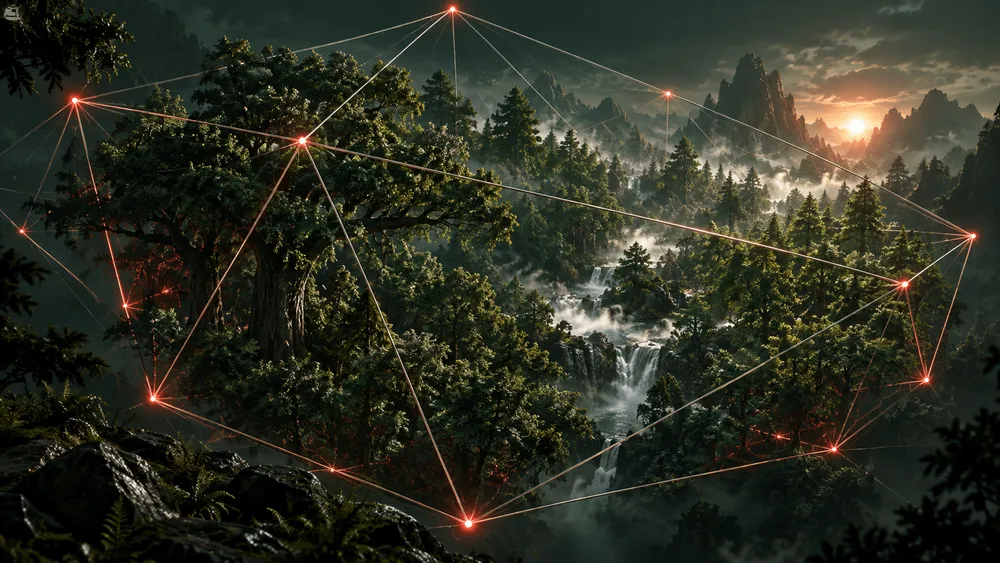
On September 17, 2026, AMD's research team unveiled a demo that individually animates 25,000 plants and ray-traces them at over 60 frames per second (fps) on a Radeon RX 9070 XT. At maximum detail, the plants collectively contain up to 2.8 billion triangles, but after distance-based level-of-detail (LOD) is applied, each frame contains roughly 500 million triangles. The demo ran at 1080p, tracing both a primary ray and a shadow ray per pixel. What made this possible is a research technique that, instead of animating dense triangle meshes every frame, deforms only a coarse "tetrahedral cage" that wraps around the shapes.
According to AMD, handling the same vegetation with a conventional dynamic bottom-level acceleration structure (BLAS) would require up to 80GB just for the bounding volume hierarchy (BVH), plus over 300ms of per-frame update time. The tetrahedral cage method reduced BVH size to about 1.7GB and full BVH update time to about 3.3ms. However, these are figures from AMD's own in-house demo, not independent third-party measurements.
Moving a Coarse Cage Instead of the Triangles
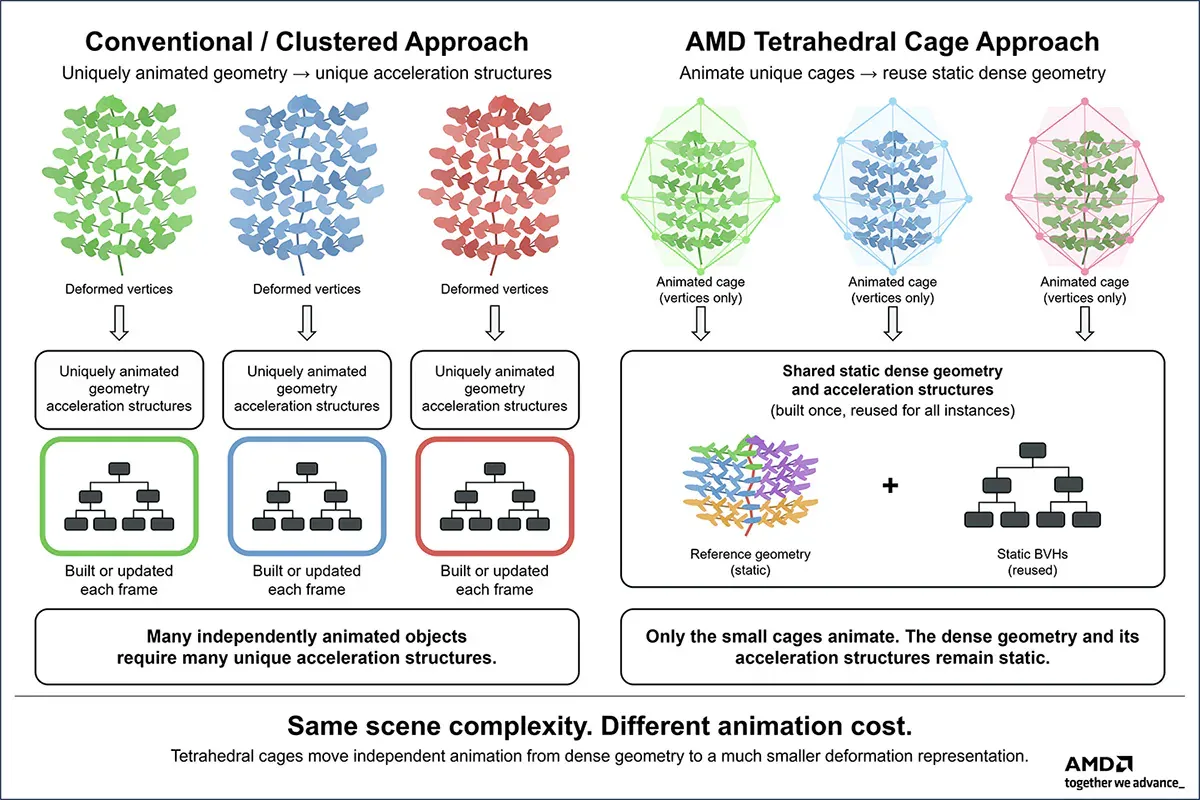
In conventional dynamic ray tracing, every time a mesh deforms, the BLAS used to accelerate ray-intersection tests must be updated or rebuilt. The finer the surface detail and the more independently moving instances there are, the larger the BVH storage and update workload becomes. If a design requires updating every triangle making up a plant's leaves in sync with wind, the preprocessing burden before rendering even begins grows heavy.
The tetrahedral cage method splits a high-density mesh into small fragments during preprocessing and assigns each fragment to a tetrahedron in its rest state. The small BLAS objects containing the triangles stay static and get reused, while at runtime only the low-resolution cage is deformed. When a ray enters a deformed tetrahedron, that ray is transformed back into the local rest-state coordinate space and intersection-tested against the original high-density shape.
This separation lets the number of triangles responsible for visual detail stay unchanged, while the cost of animation and BVH updates scales instead with the number of tetrahedra in the cage. In the paper's comparison, where grass patches were scaled up to as many as 500, total processing time was up to 9 times shorter than the conventional method, depending on cage resolution. However, looking at rendering alone, it was about the same or slightly slower. Most of the benefit comes not from drawing triangles faster, but from reducing the cost of animation and acceleration-structure updates.
Over 80GB and 300ms Show Where the Conventional Method Bottlenecks Before Rendering Even Starts
In the same 25,000-plant vegetation demo, the conventional method's BVH memory reached up to 80GB, versus about 1.7GB for the tetrahedral cage method—a ratio of roughly 47.1 to 1. Both figures refer only to BVH memory, not total application memory.
The 80GB figure is not a total usage measurement actually fitted onto a 16GB GPU; rather, it's the BVH size AMD calculated would be required if the same scene were represented using dense triangle BLAS objects. The 80GB figure is 5 times the 16GB of VRAM on the RX 9070 XT used throughout the peer-reviewed paper's experiments, while 1.7GB is 10.6% of that same capacity.
Time needs to be viewed on a separate scale. At 60fps, the per-frame budget is 16.67ms, and the conventional method's BVH update time of over 300ms exceeds 18 frames' worth. By comparison, the cage method's 3.3ms consumes 19.8% of the frame budget. However, both figures refer only to BVH update time, not the entire frame. The remaining time includes other animation processing, ray traversal, shading, and more. The over-60fps figure AMD presented is a result for the whole demo, but the September 17 explanation did not disclose a breakdown of total frame time.
500 Million and 585 Million Are Different Demos
In the paper's table, the composite scene is listed as 584 million triangles, 770.10MB, and 12.43ms per frame, while the September 17 vegetation demo is described as roughly 500 million post-LOD triangles, 1.7GB of BVH, and about 3.3ms of update time. Because the subjects and metrics differ, these cannot be directly compared as the same measurement.
| Item | Peer-reviewed paper's composite scene | September 17, 2026 vegetation demo |
|---|---|---|
| Scene | Combination of trees, grass patches, and frogs | 25,000 plants |
| Animated triangles | 584 million per Table 3, roughly 585 million per the figure | Roughly 500 million post-LOD, 2.8 billion at maximum LOD |
| Cage scale | 2.8 million tetrahedra | Not disclosed |
| Memory | 770.10MB GPU memory | Roughly 1.7GB BVH memory |
| Time | 0.35ms animation, 9.66ms structure update, 2.42ms rendering, 12.43ms total | Roughly 3.3ms full BVH update; total frame time not disclosed |
| Ray conditions | One primary ray and one shadow ray per pixel | Primary and shadow rays |
The table's 770.10MB refers to GPU memory, while the 1.7GB figure refers to BVH memory—these are not measurements of the same scope. Similarly, 12.43ms is a total that includes shading and sampling, whereas 3.3ms covers only BVH updates. Computing a ratio between them would place different metrics on the same scale improperly.
The body of the paper describes the composite scene as running at "approximately 60fps," while Table 3 records a total of 12.43ms. The triangle count in the figure is also rounded from 584 million to roughly 585 million. Since the source material does not explain the discrepancy between 12.43ms and "approximately 60fps," we should avoid deriving a separate, definitive fps figure from the table's values. The paper is co-authored by Holger Gruen, Carsten Benthin, Michael Kern, and David McAllister, with DOI 10.1145/3820014. It tied for third place for the Wolfgang Straßer Best Paper Award at HPG 2026.
The Tradeoff Between Real-Time Performance and Gap-Free Intersection Testing
The preprocessing step that splits shapes into tetrahedra isn't free. Across the paper's scenes, cutting triangles at boundaries increased triangle counts by 1.3 to 2.3 times and vertex counts by 1.4 to 3.7 times compared to the originals. Even so, because the small BLAS objects don't need to be rebuilt during animation, dynamic scenes can see update-cost savings that outweigh this preprocessing overhead. Making the cage finer brings deformation closer to the original, but at the cost of increased memory and update time.
The hardware-accelerated version that runs in real time on current GPUs slightly overlaps tetrahedron boundaries to make cracks less noticeable, but it does not guarantee intersection testing entirely free of boundary gaps. The paper also describes a software implementation that does guarantee gap-free intersection testing, but it increased GPU memory usage by 2.3 to 3.2 times and rendering time by 19 to 80 times. Strengthening the image-quality guarantee undermines real-time performance.
The technique is well-suited to subjects that deform smoothly while preserving connectivity, such as grass, trees, foliage, and crowds. With a sufficiently fine cage, it could potentially also be used for skeleton-based skinning. Conversely, it's not suited to motion that changes a shape's connectivity, such as explosions, destruction, or severing. It also struggles to reproduce wrinkles in cloth finer than the cage, facial expressions, or joint weights that change abruptly. For large-scale placement of rigid bodies, conventional instancing remains simpler.
Research in Sample Development, Not a Shipping Game Feature
AMD says it is developing a DXR sample and a header-only C++ library. At this stage, it is neither a selectable Radeon feature in a shipping game nor a feature already distributed in a game engine. Whether cage creation, deformation quality tuning, and tolerance for cracks can be integrated into production pipelines remains a question to be verified once the sample is released.
AMD also indicates that it expects the tetrahedral cage method to be usable alongside Clustered Geometry from DirectX Raytracing (DXR) Part 2, as well as Partitioned TLAS, which splits and updates the top-level acceleration structure (TLAS) in parts. Clustered Geometry is a design that handles the acceleration structure for dynamic geometry in small cluster units, making it easier to reuse. However, as of September 8, 2026, Microsoft's specification page v0.38 explicitly states that DXR Part 2 is still under development, with a preview expected sometime in late summer.
What will ultimately determine adoption isn't a single number describing how many triangles a GPU can render. It's whether the desired deformation can be preserved at a given cage coarseness, whether boundary cracks are tolerable, and whether the savings in preprocessing and runtime balance out once production costs are factored in. Only when all of these align does a 500-million-triangle demo move closer to becoming a practical technology.