

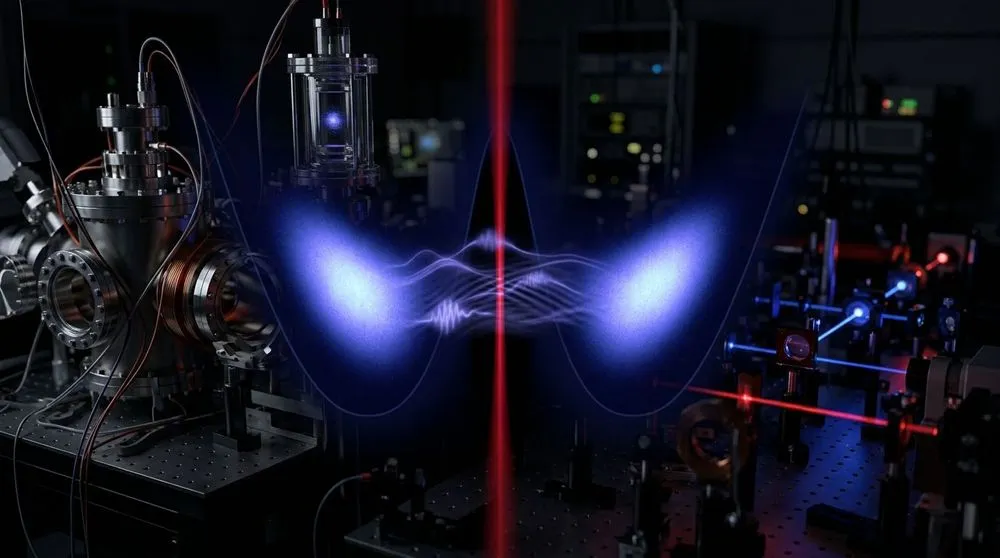
In 2003, Russian theoretical physicist Yu. Kagan and colleagues published a prediction that when sound waves propagating through a Bose-Einstein condensate (BEC) hit a potential barrier, the lower the energy, the more easily they pass through—approaching 100% transmission as energy approaches zero. In ordinary quantum tunneling, the lower a particle's energy, the more exponentially small its probability of passing through a barrier becomes. Sound waves in a BEC behave in exactly the opposite way. This phenomenon was named the "anomalous tunneling effect."
It is theoretically elegant. But for more than 20 years, no one had been able to capture its effects experimentally. On July 31, 2026, a paper published in Communications Physics filled this gap. A research group led by Professor Ippei Danshita of Kindai University and Assistant Professor Daichi Kagamihara of Chuo University used Infleqtion's cloud experiment platform "Oqtant," precisely measuring the frequencies of a BEC's collective excitation modes to observe, for the first time, the indirect traces left by the anomalous tunneling effect.
This achievement has two layers. One is the physical discovery itself. The other is the demonstration of a research methodology in which theoretical researchers operate state-of-the-art experimental equipment via the cloud to verify their own predictions. The latter has the potential to introduce a small crack into the structure of physics, where the division of labor between theory and experiment has become entrenched.
A Pile of "Unverified Predictions" Born from the Division of Labor Between Theory and Experiment
In modern physics, the division of labor between theoretical and experimental researchers has become deeply entrenched. Building state-of-the-art ultracold experimental apparatus requires years of construction of laser optical systems, vacuum systems, and control electronics, along with investments on the order of hundreds of millions of yen. Even when a theoretical researcher wants to verify their own prediction, they cannot get the chance to do so unless they capture the interest of an experimental group and get their idea prioritized within a collaborative research agenda.
Professor Danshita has theoretically studied the anomalous tunneling effect since his student days. In 2005, he published a paper showing that the collective excitation energy of a BEC confined in a double-well potential is closely related to the anomalous tunneling effect. However, experimental verification never materialized. As Professor Danshita states in the press release: "Even predictions from theoretical research that I myself find very interesting often go unverified experimentally because experimental researchers don't take an interest in them."
This situation began to change around 2020. Just as IBM and Google provided cloud access to quantum computers, a movement emerged to offer physical experimental apparatus itself as a cloud service. Oqtant, released by Infleqtion in 2020, is a platform that allows remote control—via a Python API—of a real machine capable of generating and manipulating BECs of rubidium-87 atoms. Users can design the shape of the potential, program its time evolution, and observe the time evolution of the atomic cloud's density distribution. There is no need to physically visit a laboratory.
What Is the Anomalous Tunneling Effect?
To understand the core of the anomalous tunneling effect, it helps first to contrast it with ordinary tunneling.
In ordinary quantum tunneling, when a particle of energy hits a barrier of height , the transmission probability decreases sharply as becomes smaller. The higher and thicker the barrier, the harder it is for the particle to pass through. The operating principles of semiconductor devices and scanning tunneling microscopes are based on this effect.
Sound waves in a BEC—that is, Bogoliubov excitations (quasiparticles in which collective fluctuations within the condensate behave like particles)—exhibit the opposite property. The lower the energy, the more easily they transmit through the barrier, and in the limit as energy approaches zero, the transmission probability converges to 1. This perfect transmission is the essence of the anomalous tunneling effect.
Why does this happen? Kagan and colleagues' initial explanation attributed it to a virtual resonance level arising from the decrease in condensate density near the barrier. In 2008, it was shown that the root of this perfect transmission lies in the fact that the wave function of low-energy Bogoliubov sound waves coincides with the wave function of the condensate itself. From this perspective, the anomalous tunneling effect is not unique to BECs but is a universal property common to Nambu-Goldstone modes, which appear in association with the spontaneous breaking of continuous symmetry. In 2012, Kato, Watabe, and Ohashi theoretically showed that perfect transmission also occurs for spin waves in Heisenberg ferromagnets, corroborating this universality.
| Item | Ordinary Tunneling Effect | Anomalous Tunneling Effect |
|---|---|---|
| Energy dependence of transmission probability | Decreases as energy decreases | Increases as energy decreases |
| Transmission probability in low-energy limit | Approaches 0 | Approaches 1 (perfect transmission) |
| Subject | Quantum-mechanical tunneling of a single particle | Sound waves in a BEC (Bogoliubov excitations) |
| Universality | General consequence of quantum mechanics | Universal property of Nambu-Goldstone modes |
| Experimental verification status | Numerous, since the 1960s | First indirect observation in this study (2026) |
What Was Done with Oqtant
The problem the research group faced was how to experimentally detect the anomalous tunneling effect. The most straightforward method would be to directly measure the transmission probability by sending a BEC's sound waves against a barrier, but this measurement was difficult given Oqtant's specifications.
So the research group chose a different path. Building on the theoretical framework Professor Danshita had established in 2005, they theoretically derived that the frequency of a BEC's collective excitation modes in a double-well potential indirectly reflects the anomalous tunneling effect.
Specifically, a sheet-like barrier is placed at the center of a bowl-shaped potential to create a double-well potential, and the BEC is gently shaken to excite collective excitations. While varying the height of the barrier, the frequencies of the excited oscillation modes are measured. According to theoretical calculations, when the anomalous tunneling effect is present, as the barrier is raised, the frequencies of two adjacent collective excitation modes with neighboring energies approach each other and eventually merge. Moreover, the lower-energy mode requires a greater barrier height for this merging to occur. This tendency—"lower modes being less affected by the barrier"—is the indirect signature of the anomalous tunneling effect.
Oqtant's specifications are as follows. Rubidium-87 atoms are confined in a cigar-shaped harmonic potential, with a transverse oscillation frequency of 400 Hz and an axial frequency of 42 Hz. The atoms are cooled to about 90 nK (roughly 0.4 times the critical temperature of about 225 nK) through evaporative cooling, producing a BEC composed of about 8,300 atoms. After the BEC is generated, its time evolution can be captured as density distribution images for up to 80–100 ms.
In the experiment, unwanted dipole oscillations were suppressed 2–3 ms after BEC generation, the central barrier was raised over 8 ms, and a perturbing potential was applied between 15–17 ms to excite collective excitations. The perturbation was then removed and the time evolution of the atomic cloud's density distribution was measured to extract oscillation frequencies. This protocol was repeated while varying the barrier height.
Experimental Results Reveal the Signature of "Lower Modes Caring Less About the Wall"
The measured results qualitatively agreed with the theoretical predictions. For the second and third collective excitation modes, the measured frequencies agreed well with theoretical calculations. As the barrier was raised, the frequencies of these two modes were clearly observed to approach each other.
For the lowest-energy mode, although there was a substantial quantitative discrepancy from the theoretical value, the same qualitative trend was observed: the frequency decreased as the barrier was raised.
What is decisive as a signature of the anomalous tunneling effect is a comparison of the barrier heights at which merging occurs. The merging barrier heights obtained from the experiment were approximately 3.58 kHz for the lowest mode and approximately 1.01 kHz for the second and third modes. The inequality holds—that is, the merging barrier height for the lowest mode is greater than that for the second and third modes. This means that lower-energy modes are less affected by the barrier, providing indirect evidence for the existence of the anomalous tunneling effect.
The research group carefully characterizes this as "indirect evidence." They did not directly measure the transmission probability itself; they only captured the effect of the anomalous tunneling effect through the proxy indicator of frequency shifts in collective excitations. This qualification is important.
Theoretical Researchers Doing Experiments
This is the world's first academic result using Oqtant to be published as a peer-reviewed paper. This fact demonstrates both the maturity of cloud experiment platforms and the feasibility of their use by theoretical researchers.
In conventional cloud quantum services (such as IBM's and Google's quantum computers), users design quantum circuits and obtain execution results, but they do not manipulate a physical system itself. Oqtant is closer to "experiment" in the sense that users design the shape of a real ultracold atomic gas's potential as it varies over time and can directly observe its dynamics. Users define potentials in a Python Jupyter Notebook, submit jobs to a queue, and retrieve results. Work that would otherwise require years and hundreds of millions of yen to set up a laboratory has been replaced by creating an account and writing a few lines of code.
Noah J. Fitch of Infleqtion (Director of Applied Quantum Sensing) states in the press release: "One of our missions is to broaden access to research and technology related to 'quantum,'" and "this research demonstrates what becomes possible when this remote access model is deployed on the ground."
Remaining Questions and Next Steps
This study has clear limitations.
First, the frequency of the lowest-energy mode deviates significantly from the theoretical value. The research group points to finite-temperature effects as a possible cause. The BEC in Oqtant exists at a finite temperature of about 90 nK, roughly 0.4 times the critical temperature. Describing this temperature effect theoretically would require simulations based on the Zaremba-Nikuni-Griffin equations, which were not carried out in this study.
Second, direct measurement of the transmission coefficient has not yet been achieved. This study remains an indirect observation via the proxy indicator of collective excitation frequencies. The research group states that a direct measurement of the transmission coefficient in a standard one-dimensional scattering setup is within reach of current cold-atom experimental technology, and lists this as a future task.
Third, there is the prospect of experimentally verifying the anomalous tunneling effect in systems other than BECs. Theoretically, the same phenomenon is predicted to occur in spin waves of Heisenberg ferromagnets and, more generally, in Nambu-Goldstone modes. In April 2026, a theoretical paper was also published showing that the anomalous tunneling effect is a universal low-energy theorem for Nambu-Goldstone modes. Experimental verification in these systems may proceed alongside the expansion of cloud experiment platforms.
The theoretical framework Professor Danshita published in 2005 had waited more than 20 years for experimental verification. The fact that this verification was realized not through laboratory equipment on-site but through an atomic gas on a server across the ocean suggests that the very definition of "experiment" in physics may be shifting.