

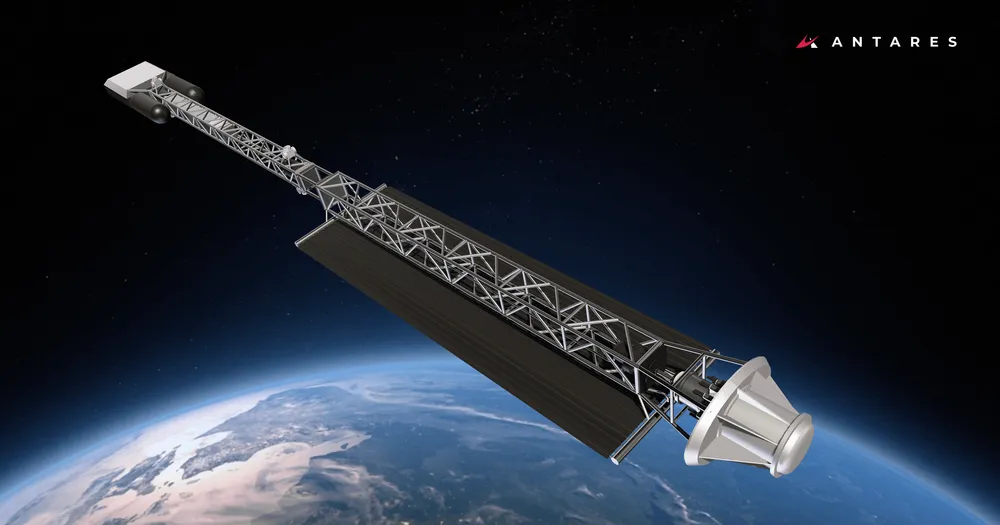
On September 11, 2026, Antares announced that it had been selected for a $161 million "Strategic Breakthrough" award from the U.S. Department of the Air Force's Office of the Assistant Secretary for Space Acquisition and Integration, to demonstrate a space nuclear reactor. The plan is to demonstrate the space-oriented "R1-S" on the ground, then integrate it into a spacecraft and move toward flight qualification before launch. A concrete program is now under way to carry the company's work on ground-based microreactors over to power sources for use in space. However, sustaining a nuclear reaction, delivering electric power, and operating in space each require separate verification.
Criticality, power generation and flight are separate milestones
What Antares has already achieved is initial criticality of its experimental reactor, "Mark-0." On June 4, the U.S. Department of Energy (DOE) announced a successful zero-power criticality demonstration at Idaho National Laboratory (INL). The test confirms that a fission chain reaction can be sustained at a low power level without generating electricity, and it was the first criticality achieved under DOE's Reactor Pilot Program.
The next reactor, "Mark-1," is meant to generate power. In 2027, the company plans to combine the reactor with a closed-cycle Brayton power system that uses nitrogen, and to run it for more than six months. A closed cycle means the working gas circulates within the system. According to the development plan Antares has presented previously, it will use the same INL test facility as Mark-0 and verify the full chain through to converting the reactor's heat into electricity.
The reactor named in the new space-focused award, however, is R1-S. Separating the published schedule and government policy goals by actor gives the following picture.
| Subject / actor | Timing | Confirmed milestone and status |
|---|---|---|
| Antares Mark-0 | June 4, 2026 | Achieved zero-power criticality on the ground. Not a power-generation demonstration |
| Antares Mark-1 | Planned for 2027 | Integration with a power conversion system and a test run of more than six months planned |
| Antares R1-S | No specific date in this announcement | Ground demonstration with nuclear reaction and integration into a spacecraft, aiming for flight qualification |
| NASA lunar reactor | Policy goal by 2030 | Ready for launch. Not the same as beginning operation on the Moon |
| U.S. military space reactor | Policy goal by 2031 | Aims to deploy a medium-power reactor in space, contingent on funding |
Sources: Antares award announcement, DOE criticality announcement, Executive Order 14369, NSTM-3, Section 2. This reflects information published as of September 12, 2026; the government targets do not indicate any delivery deadline specific to Antares.
Mark-0's criticality, Mark-1's power-generation test and R1-S's flight qualification are distinct milestones, and the government's deployment goals are not Antares-specific deadlines. The 2027 Mark-1 test therefore cannot be read as the R1-S launch schedule. Likewise, the $161 million is the announced value of this program, not a sign that the full amount has been paid out. The announcement does not describe payment terms or a cost breakdown.
Bringing a ground reactor design to space
Antares's move into space reflects a consistent aim: to leverage technology it is developing for ground reactors. The U.S. government's SBIR award record lists a separate 2024 research contract worth $1,217,133. That plan was to adapt the ground-based R1 for space and speed up development by using the existing design. It also states the idea of using the same manufacturing line as the ground reactors and lowering costs through volume production.
This can be read as a strategy to reduce the burden of developing a dedicated space reactor from scratch. But the record does not show how much cheaper this commonality actually made things, or how much it shortened development. The earlier research funding and the current award should also be treated as covering different contracts.
The ground verification sequence is also useful for thinking about this transfer. In a February 2026 technical explainer, Antares laid out an approach of verifying, in order, heat transport, the reactor's nuclear characteristics, and full-power operation with a power conversion system connected. The part that carries heat from the core to the heat exchanger can be checked even with an electrically heated test rig that uses no nuclear fuel. According to the company, it carried out this heat-transport test in 2025 at NASA's Marshall Space Flight Center.
With Mark-0, the company measures the strength and control behavior of the nuclear reaction and checks the simulations used in design. With Mark-1, the reactor producing heat and the power system receiving it run together, so verification expands to how changes in one affect operation of the other. Reaching criticality is progress toward power generation, but it does not substitute for demonstrating a working power system.
Being able to repeatedly test control systems and heat transport on the ground adds knowledge that space-oriented development can also use. On the other hand, this announcement does not explain which components R1-S will share and what will be changed.
Greater freedom in power, and the difficulty of rejecting heat
The applications Antares lists for the Space Force include spacecraft maneuvering, high-load computing and directed-energy systems. All reflect expectations of being able to use large amounts of power continuously. They are not announcements of specific payloads or of demonstrated performance.
The way a reactor can help with propulsion can be understood from NASA's explanation of nuclear electric propulsion. The reactor's heat generates electricity, and that power ionizes and accelerates a gaseous propellant to move the spacecraft. The advantage is having a power source that does not depend on sunlight. Even with power available, propellant is still needed, so a spacecraft cannot maneuver without limit.
Furthermore, a smaller reactor does not necessarily mean the whole spacecraft will be compact. Along with the equipment that converts heat to electricity, designers must also build radiators that shed heat into space.
NASA's separately researched MARVL illustrates this problem concretely. The concept divides the radiator for a large nuclear electric propulsion system into components that robots would assemble in space. It aims to ease the constraint of fitting the entire radiator inside the rocket's nose fairing, giving spacecraft designers more freedom.
MARVL is separate from R1-S, and its size and assembly approach cannot be applied to Antares's spacecraft. Even so, it shows that evaluating a space power source must include not only the reactor's performance but also heat handling and stowage at launch. Because the output, mass and radiator specifications of R1-S have not been disclosed, it is still too early to estimate the capabilities of the finished spacecraft in numbers.
Government deadlines versus Antares's flight plans
Executive Order 14369, dated December 18, 2025, calls for the use of nuclear reactors on the Moon and in orbit, and sets a goal of having a lunar reactor "ready for launch by 2030." NSTM-3, issued in April 2026, likewise separates NASA's lunar reactor development from the military's space reactor program. For the military, it aims for space deployment by 2031, contingent on available funding.
In this announcement, Antares referred to a space reactor launch "as early as 2028" as part of the policy background. However, the reactor-related provisions of the executive order that the company cites do not specify a 2028 Antares launch. And reading a lunar reactor being "ready for launch" as "operating on the Moon" would skip the transport and installation steps required.
According to NASA, the only fission reactor the United States has flown in space is SNAP-10A in 1965. That history should be kept distinct from power sources that use radioactive isotopes. Filling that long gap carries great significance, but that significance should be assessed separately from how mature any individual program is.
How far the 2027 Mark-1 operation with a connected power system runs, and what R1-S carries over from ground demonstration to spacecraft integration, will be the results that show whether the award can be turned into a power source usable in space. If power generation and the design of the whole spacecraft can be demonstrated, missions that need power without depending on sunlight would gain a new option.