

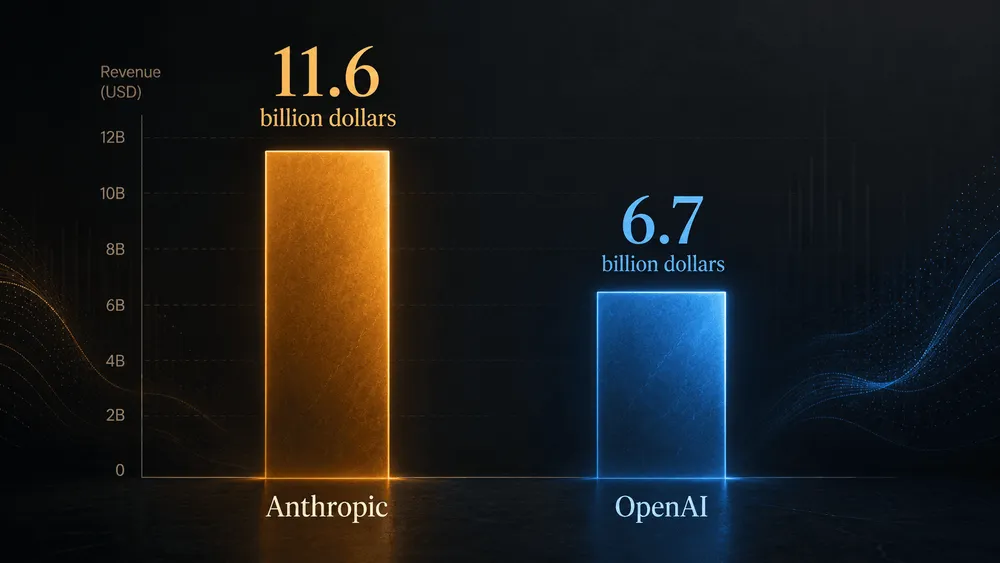
Anthropic has surpassed OpenAI in quarterly revenue for the first time. According to the Wall Street Journal (WSJ), Q2 2026 revenue came in at $11.6 billion for Anthropic and $6.7 billion for OpenAI. Anthropic's revenue more than doubled from Q1, while OpenAI's grew 18%—a gap in growth rates that reshuffled the revenue rankings.
However, the $11.6 billion versus $6.7 billion figures cannot simply be translated into a difference in competitiveness or market share. Both companies are privately held, and these numbers are not drawn from audited public financial statements but from reporting based on investor materials and information from people familiar with the matter. There are also differences in what counts as revenue and in the profitability metrics each company uses. While the revenue ranking has flipped, the gap in the numbers does not directly reflect a gap in business scale.
$11.6 Billion vs. $6.7 Billion: Diverging Growth Rates
According to the WSJ, OpenAI's Q2 revenue was $6.7 billion, up 18% from $5.7 billion in Q1. That's growth, but Anthropic's growth rate far exceeded it. Anthropic is reported to have grown from $4.73 billion in Q1 to $11.6 billion, more than doubling.
Anthropic's Q2 figure is also consistent with the "over $11.5 billion" preliminary revenue figure reported by Bloomberg. Bloomberg put the same-quarter revenue from a year earlier at $787 million, indicating a large year-over-year increase as well. That said, both figures are media-reported numbers for privately held companies, not officially disclosed quarterly earnings.
| Company | Q1 2026 | Q2 2026 | Reported change through Q2 |
|---|---|---|---|
| Anthropic | $4.73 billion | $11.6 billion | More than doubled from Q1; WSJ reports it surpassed OpenAI for the first time |
| OpenAI | $5.7 billion | $6.7 billion | Up 18% quarter-over-quarter, per WSJ |
While both companies grew revenue in the same quarter, what created the gap wasn't whether revenue grew, but how fast it grew. Still, what this table shows is a comparison of each company's reported figures—not a comparison of revenue measured under the same accounting scope.
Enterprise and Developer Sales, Including Claude Code
In February 2026, Anthropic announced that its run-rate revenue had reached $14 billion. Run-rate revenue is a metric that annualizes recent short-term performance, and it is not the same thing as quarterly revenue, which reflects revenue recognized over a three-month period. The company cites Claude Code, its API, and Claude for Work as its three main revenue channels.
Among these, Claude Code's run-rate revenue exceeded $2.5 billion. According to Anthropic, enterprise use of Claude Code accounts for more than half of that product's revenue, and more than 500 customers each spend over $1 million annually. This sales mix—combining enterprise use for code generation and development work with developer usage embedded via the API—is contributing to revenue growth.
OpenAI has also been expanding its enterprise business. As of March 31, OpenAI reported monthly revenue of $2 billion, with enterprise sales accounting for more than 40% of that. At the same point in time, however, consumer sales still made up more than half of total revenue. The enterprise share Anthropic cited applies specifically within Claude Code, while OpenAI's 40%-plus figure applies to its overall company revenue. These two figures cannot be used to compare the companies' overall enterprise sales ratios.
Revenue Scope and Profit Metrics Don't Align
Calling this reversal a reversal in profitability would require accounting assumptions that simply aren't aligned. In investor materials compared by the WSJ in April, Anthropic reportedly counts sales made through cloud partners as revenue, while OpenAI reportedly does not count such sales the same way. Whether or not cloud-channel sales are included changes how much revenue shows up for the same underlying customer usage.
There are also differences in how profit is presented. In the materials compared, Anthropic reportedly uses EBITDA (earnings before interest, taxes, depreciation, and amortization) as its benchmark, while OpenAI uses EBIT (earnings before interest and taxes). Both companies presented figures with and without model training costs included, meaning even the profit numbers can't be lined up under a single, consistent definition.
The WSJ reported that Anthropic turned a small operating profit, and Bloomberg similarly reported a positive adjusted operating income. This does not mean GAAP net income in the sense used by public companies. The revenue ranking and the question of which costs get subtracted before arriving at a profit figure are two separate matters.
Post-GPT-5.6 Numbers Will Be Tested in Q3
Q2 ended on June 30. OpenAI began general availability of GPT-5.6 on July 9, and its price cuts—20% for Terra and 80% for Luna—were noted in an update dated July 30. Both came after Q2 ended, so the effects of the launch and the price changes are not reflected in the $6.7 billion figure reported for Q2.
According to the WSJ, OpenAI told investors that growth had reaccelerated in Q3. However, no comparable quarterly revenue figure has been disclosed yet. Until Q3 numbers are released, it will be impossible to confirm how GPT-5.6 and the price changes affected revenue composition and growth rates.
For the next comparison, we'll need not just revenue figures but also clarity on how much cloud-partner sales are included and how model training costs are reflected in profit metrics. Only once post-GPT-5.6 quarterly revenue is reported under a shared accounting scope will it be possible to judge whether this reversal holds.