

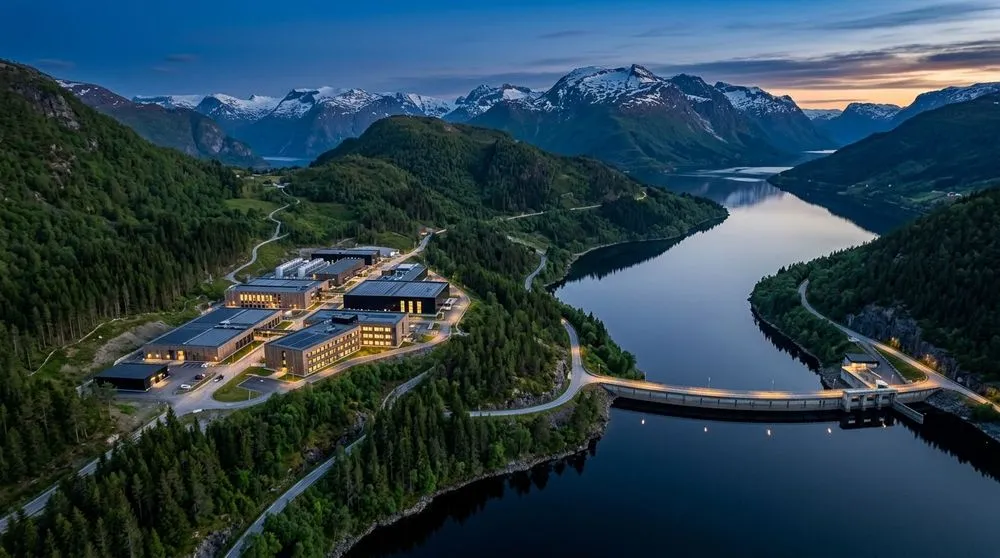
In Norway's hydropower-rich interior, electrical infrastructure originally built for Bitcoin mining is now being repurposed into clusters for training large language models. On August 4, 2026, Bloomberg reported, citing people familiar with the matter, that Anthropic, the maker of Claude, has signed a roughly $10 billion compute deal with Volta Infra Holdings, an emerging AI cloud company. The contract runs for six years. Volta itself announced on the same day a $10 billion deal with an unnamed major AI lab, and the reporting identified that counterparty as Anthropic. Reuters said it could not independently confirm the report, and Anthropic declined to comment.
The deal centers on a Norwegian site operated by Bitdeer Technologies with a capacity of 133 megawatts. It will be equipped with NVIDIA's latest AI architecture, Vera Rubin. Volta belongs to NVIDIA's Cloud Partner program and positions itself as a seller of dedicated GPU-based cloud infrastructure. That a company less than a year old could secure a commitment of this scale reflects the triple bottleneck AI labs now face: power, capital, and chips.
Why Giant Labs Are Turning to Emerging Clouds Amid a Compute Crunch
Training and inference for large-scale models have become something close to a scramble for power contracts and data center real estate. Conventional wisdom once centered on major cloud providers (AWS, Google Cloud, Microsoft Azure) or companies' own massive campuses. OpenAI, Google, and Meta are pursuing gigawatt-scale plans either independently or through partnerships, and Anthropic itself has run multiple parallel tracks—expanded investment and usage with Amazon, a compute deal with SpaceX (via the xAI-affiliated Colossus), and arrangements involving Google/Broadcom and AMD. Under the SpaceX deal, Anthropic is reportedly using compute at Colossus 1 near Memphis for roughly $1.25 billion per month through around 2029, an example of already locking down blocks exceeding 300 megawatts in one move.
Even so, demand growth tends to outpace supply. Lead times for the latest GPUs remain long, and grid connection approvals plus transmission upgrades take years. As a result, "neoclouds" outside the established hyperscalers, along with power-equipped sites repurposed from crypto mining, have become sources of readily available capacity. CoreWeave is an earlier example of this trend, and Volta is a later entrant that puts financial engineering front and center.
The question here becomes simple: who provides access to cutting-edge chips, where, through what financing, and by when? Volta's answer combines several elements—securing power through a network of former infrastructure investors, bringing in NVIDIA and Dell, arranging financing facilities to help customers purchase chips, and converting existing mining sites into AI-ready facilities.
How a Team of Ex-Brookfield Executives Reached a $2.4 Billion Valuation in Six Months
Volta Infra was founded in early 2026 by Ricard Boada (CEO) and Sofia Gumuzio, both formerly of Brookfield Asset Management's infrastructure division. Around the same announcement, the company disclosed roughly $300 million raised across seed and Series A rounds, reaching a $2.4 billion valuation. The round was co-led by Andreessen Horowitz and Altimeter Capital, with participation from NVIDIA and Michael Dell. The company also said it has partnered with asset manager Azora to arrange a roughly $5 billion financing facility that helps customers secure expensive AI chips ahead of time.
In an interview, Boada said there is a "massive gap in the market" created by a structure in which only large corporations with thick balance sheets can afford the upfront costs of cutting-edge chips. Volta's pitch isn't simply renting out racks. It offers an integrated package—structuring power contracts, financing construction and procurement, and connecting into the NVIDIA ecosystem—designed to lower the barriers to entry for labs and growth-stage companies. Reportedly, a16z, while cautious about investing in neoclouds broadly, was drawn to the founding team's track record in project finance and securing power.
The Norway deal is the first instance of this model in action. In partnership with Bitdeer, Volta will use sites the company owns or is developing to provide 133 megawatts based on Vera Rubin. Reports point to the Tydal site, where operations are expected to lean toward low-carbon practices given the reliance on hydropower. Delivery is planned in two phases, with some accounts pointing to a target completion around March 2027. Volta says it has already secured roughly 1 gigawatt of power for near-term delivery, and is eyeing expansion into locations such as Texas and Wyoming, with multi-gigawatt scale targeted by 2030. Bloomberg-affiliated commentary notes that 1 gigawatt is roughly equivalent to the power consumption of 750,000 U.S. households.
For NVIDIA, Volta represents another sales channel—as a Cloud Partner—for driving demand for its own GPUs. The structure in which the same company is both investor and supplier has recurred across other AI infrastructure deals. Criticism already exists within the industry regarding this "web of interdependence," in which losses could be amplified if demand falls short of expectations. The Volta deal becomes a new node in that same web.
| Item | Conventional Main Route | This Volta Route (Reported) |
|---|---|---|
| Supplier | Major clouds, in-house data centers | Neocloud roughly 7 months old + mining-derived data center |
| Approximate deal size | Ranges from billions to hundreds of billions of dollars | 6 years, roughly $10 billion |
| Power/site | Centered on in-house development or hyperscaler sites | 133MW in Norway (Bitdeer, hydropower-based) |
| Chips | Mixed generations, competitive procurement | NVIDIA Vera Rubin front and center |
| Financing | Self-funded, major-bank credit, some dedicated financing | VC at $2.4B valuation + roughly $5B customer facility |
| Confirmation status | Often announced directly by parties involved | Volta announced with unnamed lab; Anthropic identified via anonymous sources |
For Anthropic, this deal adds a relatively fast-to-launch European block to its existing portfolio spanning Amazon, SpaceX, and Google-affiliated arrangements. It can be read as a move to diversify away from dependence on any single vendor or region while pursuing early access to next-generation GPUs. That said, the $10 billion figure represents a six-year usage commitment, and the actual timing of cash outflows, utilization rates, and cost per unit of performance have not been disclosed. There are indications that Bitdeer's stock reacted sharply following the announcement, but long-term utilization rates and power prices will ultimately determine profitability.
Power and Chip Financing Now Sit Alongside Model Performance as Competitive Battlegrounds
Lining up the numbers reveals just how aggressive this move is. Volta's enterprise value stood at $2.4 billion at the time of fundraising. The customer financing facility totals roughly $5 billion. A single contract runs roughly $10 billion over six years. The first site delivers 133 megawatts, with roughly 1 gigawatt of power secured for near-term needs. Reports of the SpaceX route separately locking in several hundred megawatts suggest that Anthropic's compute strategy isn't built around "one giant deal," but rather resembles "stacking multiple mid-to-large deals over time."
On the technical side, real-world performance, cooling, networking, and failure rates for the Vera Rubin generation will be the metrics that matter once operations begin. On the financial side, schemes that use chips as something close to collateral remain exposed to interest rate risk and residual value risk. Geographically, while Norway's cold climate and renewable energy offer advantages for cooling and emissions, constraints around Europe's electricity markets, permitting, and international data transfer rules will factor into operating costs. Whether Volta's announced pipeline across North America and Europe can convert into "usable power" on schedule will be the next inflection point to watch.
Many questions remain unresolved. Anthropic has not officially confirmed the counterparty, and details such as exclusivity terms, minimum usage commitments, cancellation clauses, and the actual GPU count remain unclear. It's also unknown how the 133 megawatts will be divided for training versus how it will coexist with inference workloads. Whether power quality (stability, redundancy) from Bitdeer's converted mining infrastructure can meet lab-grade SLAs will be tested during the delivery phase. And if demand slows, how far the investment-supply-usage cycle centered on NVIDIA can withstand the strain is not a question limited to Volta alone.
Securing compute has become, no less than research papers on model architecture, a practical matter that determines competitive outcomes. The very fact that a company founded only months ago can attach a $10 billion label to its deal speaks to the pace of the AI industry in 2026—and to the reality that power, finance, and semiconductors have become links in a single chain. The true price of this deal will ultimately be determined by the effective cost per flop once operations begin, and by the timing of Anthropic's next model release.