

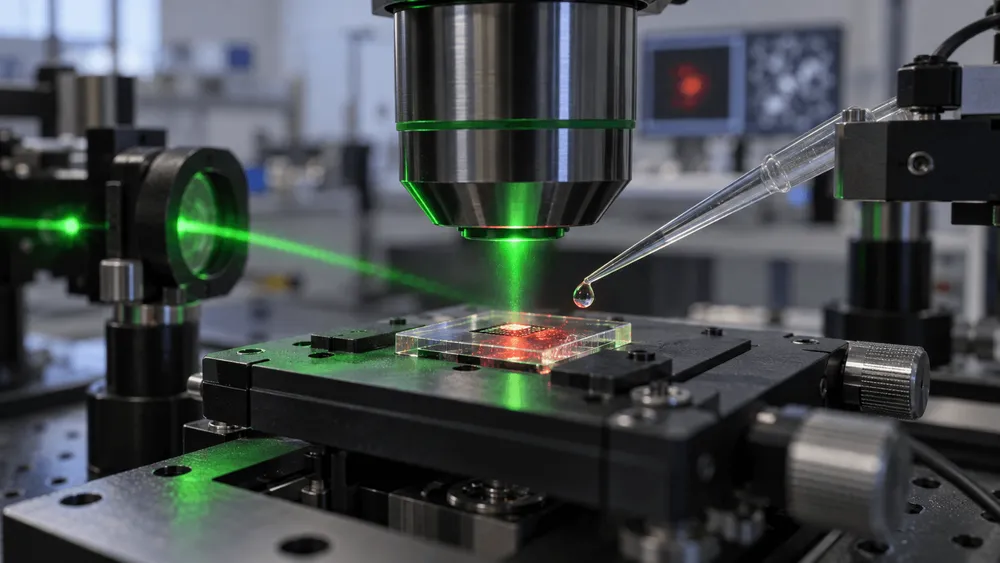
On September 16, the Johns Hopkins University Applied Physics Laboratory (APL) announced research aimed at building a portable nuclear magnetic resonance (NMR) device that can identify chemical and biological threats in the field. A prototype that measures magnetic fields using a quantum sensor engineered into diamond is already working.
However, it does not yet have the resolution needed to identify molecules in liquid samples, and the device is not yet small enough to carry. What matters in this announcement is not that a device capable of identifying hazardous substances has been completed. It is that APL is trying to improve resolution with "nanocontainers" that keep molecules near the sensor for longer.
From a prototype that measures magnetic fields to a device that identifies substances
NMR is a technique that investigates molecular structure by aligning the "spin" of atomic nuclei in a magnetic field and reading their response. It is widely used in chemical analysis, but obtaining a sufficient signal from a small sample requires a high-performance magnet and large equipment.
APL is developing a method that places a magnetic field sensor right next to the sample and reads information from a tiny amount of material. The ultimate goal, it says, is a device about the size of a laptop.
The sensor uses nitrogen-vacancy centers in diamond, known as NV centers. This is a structure in which one of the carbon atoms making up the diamond is replaced by a nitrogen atom, with a vacancy, a missing atom, next to it.
When green light is shone on an NV center, it emits red fluorescence, and its spin state can be read from changes in the brightness. The system detects the extremely weak magnetic fields produced by atomic nuclei in a nearby sample and reads them as an NMR signal.
APL's research team has built a prototype that reads out the spin of NV centers and measures magnetic fields.
However, this was not an experiment that identified what an unknown liquid contains. APL itself explains that identifying chemical substances in a tiny liquid sample requires still higher resolution.
The sample scale of "tens to hundreds of atoms" mentioned in the announcement is likewise not a performance figure showing that chemical agents or pathogens have been identified at such quantities.
Why confine the liquid?
Molecules in a liquid are constantly moving.
The range over which an NV center can sense is extremely narrow, so even if a signal is obtained from a molecule, that molecule may drift away from the sensor before the measurement ends. If molecules keep being replaced by others, the time available to gather a signal from any one molecule becomes short, making it difficult to capture the fine differences in the spectrum needed to tell similar substances apart.
Making the sensor itself smaller cannot suppress this molecular motion.
So Isaiah Gray and colleagues at APL are trying to build tiny "nanocontainers" on the diamond surface to hold the liquid. The aim is to keep the nuclear spins near the NV center for longer and increase the signal available for measurement.
According to APL, confining the liquid sample could improve NMR sensitivity and precision by about an order of magnitude. The research team compared multiple container geometries in simulations and chose a design expected to deliver the required sensitivity.
However, the nanocontainers are still being fabricated, and this improvement is not a measured value. APL has also not disclosed the absolute baseline for comparison, the types of samples, measurement times, or margins of error.
The idea of suppressing the motion of liquid molecules has precedents.
In a 2022 paper in Nano Letters, Kristina Liu and colleagues at the Technical University of Munich held liquid molecules in the tiny pores of a metal-organic framework built on diamond. By restricting molecular diffusion, they succeeded in capturing NMR signals that could not be detected when molecules moved freely.
However, the materials, samples, and equipment used in that experiment differ from the nanocontainers APL is now developing. Success in earlier research does not guarantee the same performance from APL's device.
Where this stands against earlier liquid NMR research
Research on measuring tiny amounts of liquid with NV centers was under way before APL's announcement.
In 2017, P. Kehayias and colleagues etched fine grooves into a diamond surface and detected an NMR signal from about one picoliter of solution. The method increased the contact area between sensor and sample to pick up more signal.
In 2018, Dominik Bucher and colleagues combined multiple NV centers with synchronized readout and observed features of liquid-sample spectra, such as chemical shifts related to molecular structure.
The 2022 study by Liu and colleagues pointed toward observing signals for longer by suppressing molecular movement.
Obtaining an NMR signal from a tiny liquid sample, resolving a spectrum finely, and keeping molecules near the observation site are separate technical challenges.
APL aims to combine these techniques and develop them into a device that can identify hazardous substances in the field. However, the announcement alone does not allow us to say that a smaller device can now identify threats more accurately than earlier research.
Realizing a portable device takes more than shrinking the magnet. The light source, the detector that reads the fluorescence, and the mechanism for introducing and discharging samples must also be integrated.
Between a chip that can measure magnetic fields in the lab and a device that can be taken into the field to identify unknown samples lie engineering challenges in handling samples, not just measurement performance.
Magnetic field measurement demonstrated; threat identification still ahead
Sorting APL's September 16 announcement and the 2022 study by Liu and colleagues into results already measured and goals still ahead makes the current stage of development easier to see.
The table below is not a direct comparison of performance figures. Because the research groups and samples differ, it is meant to show how far each result has progressed.
| Stage | Published evidence | Status in APL's current device |
|---|---|---|
| Measuring magnetic fields | APL has operated a prototype that reads NV-center spin and measures magnetic fields | Measured |
| Holding liquid | APL chose the nanocontainer geometry by calculation and is fabricating it. A separate research team held liquid in tiny pores and detected NMR signals in 2022 | Not yet measured in APL's nanocontainers |
| Identifying molecules | APL lists the resolution needed to identify chemical substances in tiny liquid samples as the next challenge | Not demonstrated |
| Determining threats | APL cites on-site identification of chemical and biological threats as a future use | Not demonstrated |
At present, APL has demonstrated magnetic field measurement but has not reached the point of identifying hazardous substances.
Even if earlier research has obtained NMR signals from tiny liquid samples, "detecting a magnetic field" and "identifying an unknown substance" have not been linked in APL's prototype.
APL envisions eventually using the technology in the field to judge whether something is hazardous and whether ordinary protective equipment is enough or chemical protective suits are needed.
To do so, however, spectra obtained from unknown samples must be correctly tied to actual chemical substances or biological species.
For chemicals, it must be tested whether harmless substances with very similar structures can be distinguished from harmful ones.
For biological samples too, distinguishing between the harmless and dangerous bacteria that APL cites as examples requires showing which components to measure and how much must be present for identification.
Samples collected from soil, water, or air also contain components other than the target substance. Use in the field will require investigating conditions that include sample collection and pretreatment, along with how often the device misses threats or raises false alarms.
APL has not disclosed detection limits for each target, the time required for a determination, or accuracy rates.
What NMR reads directly is the signal produced by atomic nuclei in the sample. The instrument does not return names such as "nerve agent" or "pathogen" on its own.
In samples containing multiple substances, signals from the individual components may overlap. Even if molecular features can be captured, tests will be needed to establish what the decision criteria are and under what conditions misidentification occurs before those features can be linked to the classifications required in the field.
If both chemical and biological samples are to be targeted, collection methods and pretreatment suited to each must also be established.
Gray explains that what is needed in the field is not the same precise analysis as in a laboratory, but information that can determine whether there is danger and what protective equipment is required.
For this use, it may be possible to limit the targets to identify and the accuracy required. Whether performance is actually sufficient for that purpose, however, must be confirmed through tests using real samples.
Being able to detect a signal from a small amount of sample does not by itself reveal how many hazardous substances would be missed, or how often harmless ones would be wrongly judged dangerous.
If the nanocontainers that hold the liquid are to be used repeatedly in the field, how to remove the sample remaining after measurement also needs to be considered. APL's announcement does not describe cleaning or replacement methods, or reproducibility over repeated measurements.
Portability also cannot be judged by the size of the sensor alone. What matters is whether the entire device, including the power supply, optics, and sample-handling mechanism, can operate stably in the field and produce consistent results from small samples.
First, can a liquid NMR spectrum actually be measured with a chip incorporating the nanocontainers? Next, can similar substances be distinguished within a mixed sample?
If results show that, the portable NMR that APL is aiming for could be judged a step closer to a device usable for protective decisions in the field.