

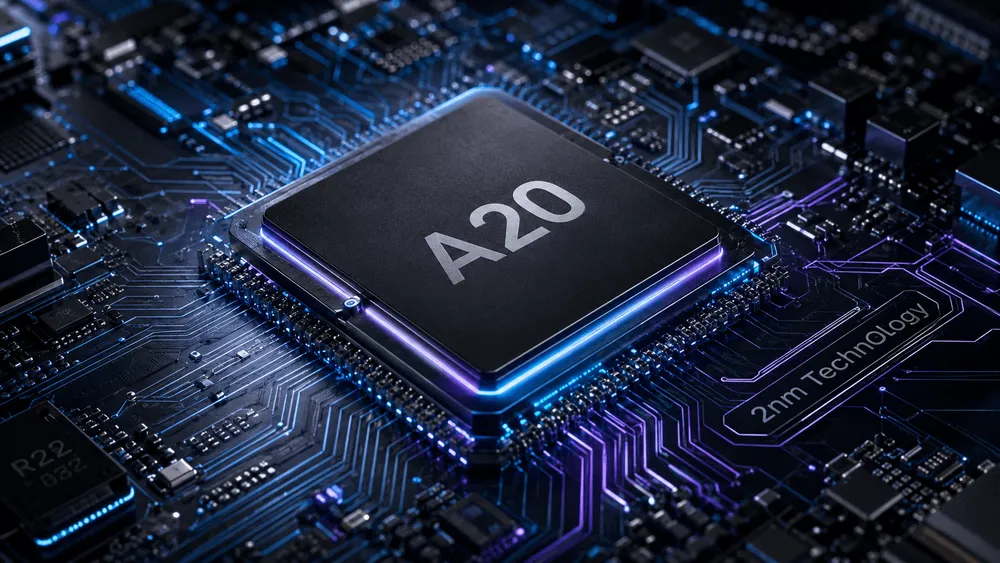
The semiconductor miniaturization process that has driven improvements in smartphone performance is approaching its physical limits. The next-generation silicon that Apple is developing for the 2026 iPhone 18 series and a foldable iPhone—the "A20" chip family—represents a critical milestone in breaking through this technical barrier. The A20 chip will be manufactured using TSMC's first-generation 2nm process (N2). Given that the A18 chip currently used in the iPhone 16 series and others employs the second-generation 3nm process (N3E), this marks a fundamental architectural overhaul.
With the introduction of TSMC's 2nm process, the density of transistor implementation within the chip will improve further. As a result, the A20 chip is expected to achieve an extremely high level of power efficiency, boosting processing performance by up to 15% compared to the previous generation while reducing power consumption by roughly 30%. Within the limited chassis size and battery capacity of a smartphone, the benefits of this miniaturization are essential for maximizing computational resources.
However, transitioning to a cutting-edge manufacturing process simultaneously triggers a surge in manufacturing costs. TSMC is reportedly raising wafer unit prices by at least 50% compared to the 3nm process, citing the enormous costs involved in 2nm process manufacturing and capital investment. This dramatic cost increase has serious implications for smartphone makers' pricing strategies. The conventional approach of uniformly equipping the entire lineup with the latest chip is becoming financially unsustainable, further accelerating the stratification of products based on processor performance.
The DRAM Supply Shortage and the Packaging Technology Wall
In addition to the cost increase from adopting cutting-edge processes, Apple faces another significant challenge that is shaking the entire semiconductor supply chain: a severe DRAM shortage. Currently, cloud providers and large language model (LLM) developers are accelerating their stockpiling of high-bandwidth memory (HBM) and large-capacity DRAM for AI servers, causing memory component supply to become critically tight across the global electronics manufacturing ecosystem.
This DRAM shortage has directly affected the design of the iPhone 18 series. Originally, the A20 chip was planned to make a complete transition from the conventional "InFO (Integrated Fan-Out)" packaging technology to the more advanced "WMCM (Wafer-Level Multi-Chip Module)." WMCM employs a modular approach that flexibly combines small, specialized components called chiplets. This was supposed to enable flexible die configurations tailored to a device's target audience—for example, increasing the number of GPU cores in higher-end models while prioritizing CPU efficiency in mass-market models.
However, according to the latest leaked information, it now appears highly likely that the A20 chip for the base model iPhone 18 will forgo WMCM adoption and continue using the older InFO packaging. The WMCM manufacturing process requires an extremely sophisticated and complex level of coordination with memory suppliers, but given the current market environment where AI companies are monopolizing resources, it was determined that the hurdles to stable supply were too high for the base model, which assumes mass production on the scale of tens of millions of units. This decision demonstrates that even Apple, with its robust supply chain and vertical integration mechanisms, cannot escape the effects of macro-level fluctuations in the semiconductor market.
How Will Apple Overcome These Constraints to Deliver a Next-Generation AI Experience?
Given this situation, where compromises in packaging technology at the hardware level have become unavoidable, the question arises as to how Apple will provide a uniform next-generation user experience—particularly the advanced "Apple Intelligence" features reportedly set to launch with iOS 27—across all devices. On-device AI processing depends more heavily on main memory bandwidth and capacity than on processor computing power. Running inference for language models ranging from hundreds of millions to billions of parameters in a local device environment without latency requires both high-speed memory access and ample working space.
The base model iPhone 18, which continues to use InFO packaging, will lag behind the Pro models in terms of chip-level memory integration. This architectural difference in hardware raises concerns about potential bottlenecks, particularly when running large-scale AI models locally. Apple is being forced to resolve these conflicting challenges—component constraints versus the demands of new features—through a system-wide redesign.
Architectural Optimization Through Limited WMCM Adoption and Memory Enhancement
Apple is addressing this complex challenge by adopting different approaches for the high-end and base models. First, the "A20 Pro" chip, which will be equipped in the iPhone 18 Pro and iPhone 18 Pro Max (or iPhone Ultra), will introduce WMCM packaging as originally planned. The greatest advantage of WMCM lies in its ability to directly integrate the SoC (System on a Chip) and DRAM at the wafer level, without going through an interposer or substrate. This minimizes the physical distance between the processor and memory to the absolute limit, preventing signal degradation while dramatically improving thermal management efficiency. As a result, memory bandwidth expands significantly, delivering performance that surpasses the limits of conventional architecture in demanding AI tasks and high-end gaming.
Meanwhile, for the base model iPhone 18, which will forgo WMCM adoption, Apple is taking a brute-force approach of dramatically increasing physical memory capacity to secure AI performance. According to reports from securities analysts, the iPhone 18 is expected to come standard with 12GB of RAM. Considering that the current iPhone 15 base model has 6GB and the iPhone 16 has 8GB, this represents a memory boost of 50% to 100% at once. This capacity even surpasses some MacBook models, reflecting a design philosophy of compensating for the communication bandwidth constraints of InFO packaging by providing an expansive working memory space, ensuring that iOS 27's Apple Intelligence can run locally without delay.
Furthermore, to address the increasing complexity of these manufacturing processes and component procurement, Apple is shifting to a strategy that alters the product release schedule itself. Traditionally, all models were released simultaneously in the fall, but for the iPhone 18 generation, Apple will bring the high-priced, high-margin iPhone 18 Pro, iPhone 18 Pro Max, and the new foldable iPhone to market first in the fall of 2026. Then, the base model iPhone 18, iPhone 18e, and iPhone Air 2 (tentative name)—which have the largest manufacturing volume and are most sensitive to cost impacts—will be released six months later in the spring of 2027, in what is called a "split launch." This approach aims to wait for improved yields on the cutting-edge 2nm process while spreading out the procurement period for the tight DRAM supply, thereby controlling risk across the entire supply chain.
Evolution of the Entire Device: Variable Aperture Camera and Next-Generation Communication Modem
In addition to the overhaul of the A20 chip, the iPhone 18 Pro series will also make a major leap in hardware interface design. A prime example of this is the introduction of a "Variable Aperture" lens for the main camera. Until now, smartphone cameras have predominantly used fixed apertures, relying heavily on software-based image processing (computational photography). With the addition of a physical variable aperture, users will be able to directly control the amount of light captured by the sensor at the hardware level, enabling suppression of overexposure and fine adjustment of optical depth of field (bokeh). There are also rumors of the adoption of a new three-layer stacked image sensor developed by Samsung, which is expected to expand dynamic range and reduce noise in low-light conditions.
In the communications domain, Apple's in-house developed next-generation "C2" 5G modem will be equipped. The C2 modem will enhance support for millimeter-wave (mmWave) 5G connectivity while also newly implementing 5G satellite communication functionality based on the "NR-NTN (New Radio Non-Terrestrial Networks)" standard. This is expected to enable full internet access via satellite even in remote areas without cellular signal, going beyond the existing Emergency SOS feature. Apple is reportedly planning to open this satellite communication functionality via API not only to native apps like "Maps" and "Photos" but also to third-party apps, aiming to provide infrastructure that fundamentally overturns the concept of mobile networks.
On the display front, the iPhone 18 Pro series will adopt "LTPO+" technology, further reducing screen power consumption. Additionally, the "Dynamic Island" at the top of the screen will shrink by approximately 35% from its current size due to the miniaturization of the front camera and Face ID components, expanding the display area. As for body colors, a deep purple-tinged "Dark Cherry," corresponding to Pantone color code "6076," is reportedly being tested as a special color, further differentiating the device's appearance.
These power-saving and miniaturization improvements to the display and hardware components are not independent updates aimed simply at improving the device's appearance. They represent a necessary engineering effort to offset, at the system level, the power consumed by the computational capabilities of the 2nm-based A20 chip and the large-capacity 12GB DRAM, keeping everything within the strict limits of thermal design.
Apple is taking a design approach that integrates the robust local processing capability of the "A20" architecture with the "C2" satellite communication network, which does not rely on carrier infrastructure. As a result, the iPhone is transforming into an autonomous edge computing node capable of maintaining advanced AI inference and communication traffic processing even in environments physically disconnected from existing cellular networks and cloud servers. The hardware configuration of the iPhone 18 series, rebuilt under the intense constraints of soaring semiconductor miniaturization costs and a global DRAM supply shortage, presents the entire industry with a new standard for the "standalone autonomy" required of next-generation personal AI devices.