

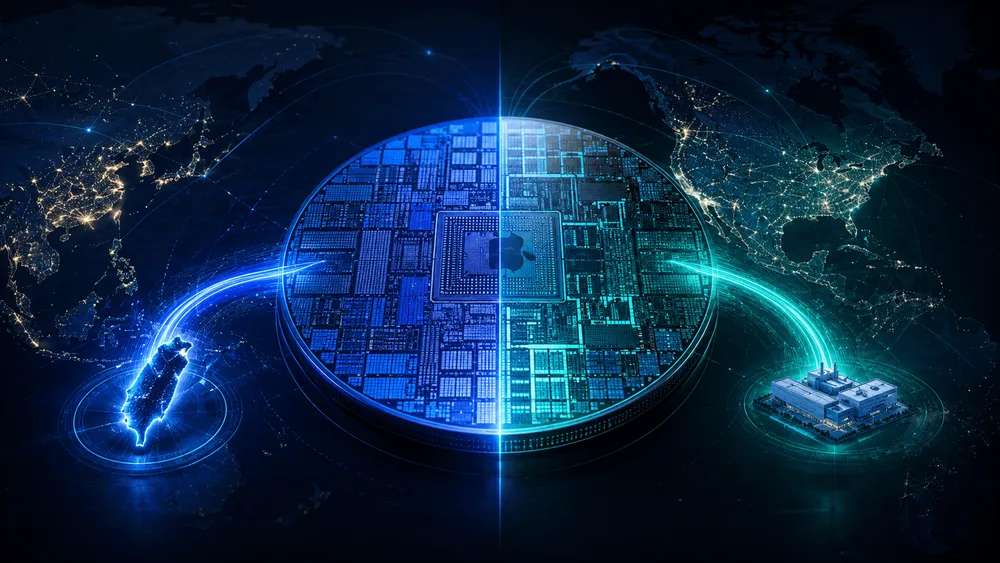
Apple has begun reconsidering its heavy reliance on TSMC (Taiwan Semiconductor Manufacturing Company) as its sole chip supplier. As demand for AI-oriented advanced chips surges, geopolitical risk surrounding Taiwan has become a constraint on business operations. Apple is now moving to bring Intel—which the U.S. government is helping to rebuild through capital investment—on board as a second manufacturing base. The preliminary agreement, reported by WSJ on May 8, 2026, marks the starting point for a redesign of Apple's chip manufacturing network.
A procurement decision to ease concentration on TSMC comes to the forefront
On May 8, 2026, The Wall Street Journal (WSJ) reported that Apple and Intel had reached a preliminary agreement concerning future chip manufacturing. Reuters and CNBC followed up on the report, noting that discussions had continued for over a year before reaching this preliminary stage in recent months. Bloomberg had reported on the talks at a discussion stage as of May 4 that same year, and this latest report is an extension of that earlier coverage.
In August 2025, the U.S. government invested $8.9 billion in Intel, acquiring approximately a 10% equity stake. According to Reuters, the Trump administration reportedly proposed that Tim Cook adopt Intel during a meeting at the White House. Commerce Secretary Howard Lutnick has also met with Cook multiple times over the past year.
A U.S. government official was quoted as saying, "We want to help Intel, and we have been helping Intel" and "We've been trying to grow Intel's business." Apple's procurement decision incorporates both commercial contract considerations and industrial policy dimensions.
Apple ships more than 200 million iPhones annually and also uses its self-designed chips in Mac and iPad products. Its advanced chip manufacturing is highly dependent on TSMC, and as demand for AI-related semiconductors grows, securing access to leading-edge production lines has become a strategic resource.
The essence of these discussions is not about replacing TSMC. What Apple aims to achieve is securing a second domestic pathway for advanced manufacturing within the United States, diversifying supply sources to reduce the risk of concentration in Taiwan.
The balance of power has reversed from Apple's 2006 adoption of Intel
In 2006, Apple moved the processors in its Macs from PowerPC to Intel-made CPUs. At that time, Intel was the dominant supplier of central processing units (CPUs) for PCs, and Apple was in the position of purchasing completed processors. Starting in 2020, Apple transitioned to its own self-designed Apple silicon, and by 2023, the era of Intel processors in Macs had effectively come to an end.
| Item | 2006 Relationship | Relationship Anticipated Under the 2026 Preliminary Agreement |
|---|---|---|
| Apple's Role | Adopter of Intel-made CPUs | Designer of its own chips |
| Intel's Role | Designer and seller of CPUs | Foundry manufacturing Apple-designed chips |
| Leadership | Intel's product roadmap | Apple's design and product planning |
| Key Issues | Mac performance and compatibility | Yield, delivery schedules, supply diversification |
Apple's 2020 shift to Apple silicon marked a turning point at which Apple took control of chip design leadership. Even if Intel re-enters Apple's supply chain, this is not about Intel CPUs returning to the Mac. Rather, the arrangement envisioned involves manufacturing some of Apple's M-series chips—designed by Apple—on Intel's production lines. Although the names of both companies are the same as they were, the underlying dynamics are nearly reversed from what they were 17 years ago.
In a relationship where Apple holds design control, the capabilities required of Intel also change. A foundry refers to a business that manufactures semiconductors designed by customers on a contract basis. This differs in operational focus from a business that sells its own CPUs, with the contract centering on protecting design assets, maintaining verification tools, and managing yield during mass production.
Tim Cook was previously reported to have told TSMC founder Morris Chang that "Intel doesn't understand how foundries work." The current discussions are also a case built on the premise that Apple is now reconsidering that earlier assessment.
18A and PDK have driven Apple's technical evaluation
Intel 18A is an advanced 2nm-class process that marks Intel's first implementation of GAA (Gate-All-Around) transistors. Intel calls this implementation RibbonFET, and cites improved current control and reduced leakage power during miniaturization as its main advantages. This 18A process, which entered mass production in mid-2025, is regarded as a 2nm-class technology. The reason Apple has included Intel as a candidate lies in the 2nm-class performance and power efficiency offered by 18A.
Gate-All-Around is a structure in which the gate surrounds the current-carrying channel from all sides. In conventional FinFET designs, the gate controls a fin-shaped channel from multiple surfaces, but as miniaturization advances, suppressing leakage current becomes increasingly difficult.
With GAA, the channel can be controlled strongly from all directions. For the same power consumption, performance improves; for the same performance, power consumption can be reduced. In chips for smartphones and laptops, this power efficiency directly affects battery life and heat generation.
According to reports as of November 2025, the yield rate for 18A stood at 60–65%, with a target of reaching 70% by the end of the year. Yield is a metric indicating how many chips meeting specifications can be obtained from a single wafer. Even if a high-performance circuit can be designed, low yield rates drive up costs and destabilize shipment volumes. In Apple's product planning, manufacturing stability is weighed as heavily as process performance.
Apple has reportedly signed a non-disclosure agreement and already received the PDK (Process Design Kit) 0.9.1GA for 18AP. A PDK is a development kit that compiles the design rules, standard cells, wiring models, and verification conditions needed for semiconductor designers to create circuits for a specific process. Design teams use the PDK to verify whether existing circuits will function on Intel's production lines and whether power consumption and area fall within expected ranges. If PDK delivery is already underway at the preliminary agreement stage, the discussions have moved beyond an expression of intent into technical evaluation.
A 15% surge in Intel's stock reflects expectations of landing a major customer
Following the May 8, 2026 report of the preliminary agreement, Intel's stock surged approximately 15%. Apple's stock also rose about 1.7%, with the market treating this deal as a major positive development for Intel. For Apple, this represents an expansion of supply chain options, but for Intel, it is a customer deal that could significantly affect the credibility of its advanced foundry business.
Around May 6, 2026, multiple media outlets reported that Intel's stock had reached its highest level in over 55 years. Reports cited figures both in the $113 range and the $126 range, likely reflecting differences in the timing of trades or the data sources cited. The year-to-date gain for 2026 was also reported in a range of 170–190%, with a reported 114% increase in April alone. The preliminary agreement with Apple added further fuel to a reassessment of Intel that was already underway.
In September 2025, NVIDIA invested $5 billion in Intel. In April 2026, SoftBank invested $2 billion, and Intel bought back a 49% stake in its Fab 34 in Ireland for $14.2 billion. President Trump posted on Truth Social that the rise in Intel's stock had "made the U.S. over $30 billion in the past 90 days." With government investment, strategic capital injections, and the reconsolidation of manufacturing assets all converging, Intel's turnaround narrative has become a major theme in capital markets as well.
Three signals for judging the transition to a mass-production contract
There are three signals for judging the transition from a preliminary agreement to a mass-production contract. First, specific mentions in Intel's investor materials, filings with the U.S. Securities and Exchange Commission (SEC), and its next earnings call. If contract scale and manufacturing start dates are explicitly disclosed, the certainty of the deal rises a notch.
Second, mass-production data for 18A. The reported yield figure of 60–65% as of November 2025 indicates a process still in the midst of improvement. In advanced processes, there is a large gap between success with test chips and success in mass production at the scale of tens of millions of units. For Intel to supply some M-series chips in 2027, it will need to raise yield and capacity from late 2026 through early 2027.
Third, the timing of product announcements. According to existing reports, base M-series chips using 18A are expected to ship between Q2 and Q3 of 2027. Reports suggest that base M-series chips are the leading candidates, with a view that the transition of higher-performance M Pro, M Max, and iPhone A-series chips may not occur until 2028 or later. Whether the process starts at the MacBook Air level or the iPad level will shape how seriously Apple's commitment should be read.
The preliminary agreement between Apple and Intel is not a revival of the past Mac CPU deal, but rather a turning point toward de-TSMC-ifying Apple silicon's manufacturing network. While the U.S. government's 10% stake reflects the political backdrop, the essence of the matter comes down to numbers on the production floor.
Whether Intel 18A can maintain a yield rate above 70% from 2026 into 2027—this will be the first litmus test of the viability of advanced domestic manufacturing in the United States.