

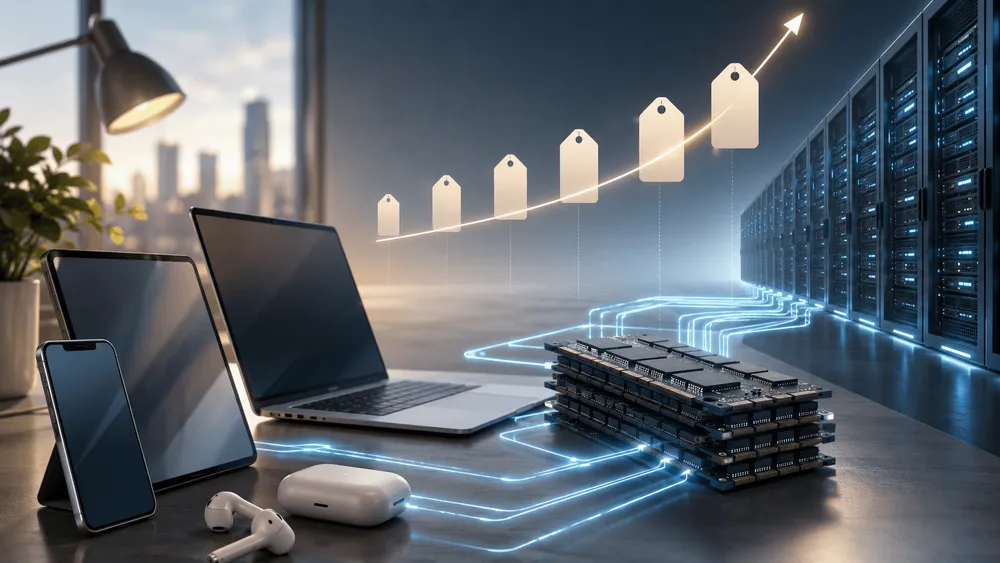
The assumptions underlying Apple's product pricing are being pushed upward by the investment race in AI infrastructure. In an interview with The Wall Street Journal[1], CEO Tim Cook said that price increases stemming from rising memory and storage costs are "unavoidable." According to the WSJ, Apple has tried to shield customers from price hikes, but the scale of the increases being passed on by component suppliers has grown so large that the situation has become unsustainable.
The interview did not specify which products would see price increases or when. Still, this statement goes beyond signaling a single, isolated price adjustment. It reflects a moment in which consumer devices like the iPhone, iPad, and Mac have entered the same market pressure zone as the component scramble occurring in AI data centers. Apple's earnings remain strong, but as memory prices rise, there is less room to maintain the same capacities at the same price points.
The Focus of the Remarks Shifted From "Rising Costs" to "Price Pass-Through"
In its fiscal 2026 second-quarter earnings[2] announced on April 30, Apple reported revenue of $111.2 billion, up 17% year-over-year, and diluted earnings per share of $2.01, up 22%. iPhone posted record revenue for the March quarter, and Services revenue also hit an all-time high. This isn't a case of demand collapsing and forcing price hikes. Behind strong sales, rising component costs have begun to squeeze the profit structure.
During the April earnings call, Cook suggested that rising memory costs would have a greater impact on Apple's business going forward. What changed in the June WSJ interview was the emphasis. In April, he spoke about the impact on the business; this time, he made a concrete statement about pricing: that price increases are unavoidable.
This doesn't mean Apple will immediately rewrite its price list across all products. The actual impact will vary by product depending on inventory, long-term contracts, regional exchange rates and taxes, and launch timing. Even so, now that Cook has explicitly acknowledged the possibility of price increases, the standard memory and storage configurations—not just the base price—will become a more important thing to watch at the next product announcement.
AI-Driven Memory Demand Is Spilling Over Into Consumer Devices
Rising memory prices aren't a problem unique to Apple. Micron Technology reported revenue of $23.86 billion in its fiscal 2026 second quarter, a sharp increase from $8.053 billion in the same period a year earlier, with GAAP gross margin reaching 74.4%. CEO Sanjay Mehrotra attributed the record results to strong demand and industrywide supply tightness, stating that in the AI era, memory has become a strategic asset for customers. Guidance for the third quarter points to revenue of around $33.5 billion and gross margin of roughly 81%, suggesting the tight market will continue.
Data centers supporting AI training and inference require massive quantities of DRAM, NAND, HBM, and enterprise SSDs. While these aren't exactly the same components used in consumer smartphones and PCs, manufacturing lines, capital allocation, and supply contracts are all interconnected within the same memory industry. As high-margin AI demand intensifies, suppliers are more inclined to shift production capacity and negotiating leverage in that direction.
Device makers are left with two choices: maintain existing prices while cutting into margins, or change pricing, standard capacities, and premium configurations. Apple, with its high gross margins and strong brand, has some room to absorb the impact in the short term. But given that Cook has called the situation unsustainable, it appears that absorption alone is no longer enough.
Mac Mini Configuration Changes Foreshadow How Price Increases Will Appear
Within Apple's lineup, the pressure is already showing up as changes in configuration rather than in the price list itself. In May, The Verge reported that the cheapest Mac mini configuration had risen to $799, and that the previous $599, 256GB storage configuration had disappeared from Apple's online store. As of now, the M4 configuration on the Mac mini purchase page starts at 512GB of storage.
This is harder to read than a simple price hike. From the user's perspective, while the entry-level price goes up, the standard storage capacity also increases. When the low-capacity, low-price entry point disappears, the product experience improves, but the minimum spending required at purchase rises. In a period of surging memory and storage costs, this kind of "disappearing entry point" functions as an effective price increase.
The same pattern applies to the Mac Studio. In the current lineup, the base configuration includes 36GB of unified memory for the M4 Max and 96GB for the M3 Ultra, with the M4 Max configurable up to 64GB. The Verge also reported that Apple discontinued the 512GB RAM configuration in March. Pro-oriented Macs that carry high-capacity memory are more exposed to price and supply conditions in the memory market.
In Apple Silicon, the CPU, GPU, and Neural Engine share unified memory. For on-device AI, development, video production, and local LLM use cases, memory capacity directly determines the scope of what can be accomplished. Rising memory costs are not only a component cost issue but also a factor that shapes a product's capability and price tier. Which capacity Apple sets as standard, and where it draws the line for premium pricing, changes how the product itself can be used.
The Next iPhone's Pricing Will Reflect the Consumer Burden of the AI Boom
Attention now turns to the iPhone. Apple typically unveils its new iPhone lineup each fall. Since Cook did not tell the WSJ which products would see price increases or when, it's not possible to treat a price increase for the next iPhone as a foregone conclusion. Still, the iPhone is Apple's single largest revenue driver, and it's also the product where standard memory and storage capacities are most visible to consumers.
Apple has several levers available: raising the suggested retail price, reducing the number of low-capacity models, raising the entry-level price by increasing standard capacity, or adjusting regional pricing to account for exchange rates and taxes. Whichever method is used, the entry-level price consumers pay is likely to rise. It will be important to look not just at the headline price, but also at the capacity of the cheapest model, the gap with higher-end models, and storage upgrade fees.
What makes this difficult for Apple is that the more it promotes AI features, the more valuable on-device memory becomes. Apple positions the Mac mini as an Apple Intelligence–capable product, and in Apple Silicon, the CPU, GPU, and Neural Engine share unified memory. Cloud AI demand is pushing up memory prices, while on-device AI is simultaneously raising the importance of memory capacity. AI is both a selling point for Apple's new features and a factor driving up the cost of Apple's products.
The Cost of AI Infrastructure Has Reached the Price Tags on Consumer Devices
The shift signaled by these remarks extends beyond Apple's pricing policy. What matters more is that investment in AI data centers has begun to clearly spill over into the pricing of consumer devices. Until now, the scramble for components driven by AI infrastructure has largely been discussed in terms of GPUs, HBM, data center power, and server-grade SSDs. Cook's remarks show that this pressure is now connected to the purchase prices of the iPhone and Mac as well.
Apple has stronger procurement power and greater negotiating leverage over its supply chain than most other companies. If even Apple says price increases are unavoidable, the pressure on smaller PC makers, smartphone makers, and peripheral manufacturers is likely even greater. As Micron's earnings show, AI demand is a tailwind that's boosting profits for memory makers. For device makers and consumers, that same tailwind comes back around as rising costs.
The key question now is how Apple will present these price increases: through explicit price revisions, through the elimination of low-price configurations, or by steering customers toward higher memory and storage tiers. The cost of the AI boom is no longer something borne solely by data center companies. The pricing of the next iPhone and Mac lineup will be the first major indicator of just how far that burden has reached consumers.