

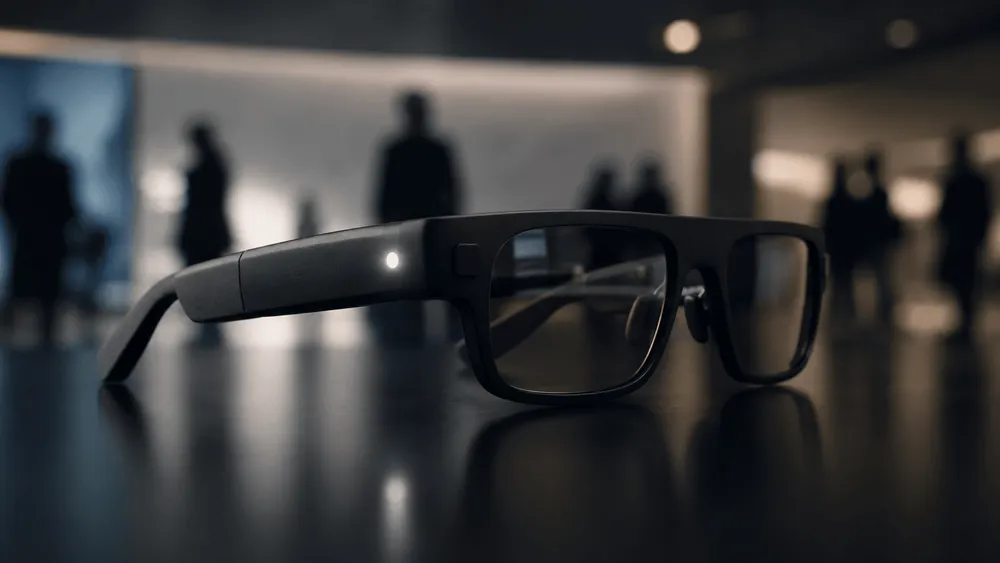
Apple has pushed back the launch target for its first smart glasses to late 2027, planning to unveil them at the Worldwide Developers Conference (WWDC) in June 2027, according to a report by Bloomberg's Mark Gurman. The previous schedule reportedly called for an announcement by the end of 2026 and a launch in early 2027. One reason for the delay is that Apple is still working out both the technology and the sales strategy needed to ease concerns about camera-equipped AI glasses. Apple faces the challenge of combining, in a single product, a design that protects user data with a mechanism that lets people on the other side of the lens confirm whether they're being recorded.
The codename is reportedly "N50." However, Apple has not announced either the product's existence or its schedule. The specifications and options under consideration are based on Bloomberg's reporting from sources familiar with internal plans.
Keep the camera, or limit it to AI's eyes only?
Apple is said to have tested three different design approaches. One option drops the camera entirely, focusing on voice AI, calls, and music playback. Another keeps the camera but bans photo and video capture, limiting it to input for Siri to recognize objects and locations. A third retains full capture functionality while building in stronger protections than current products offer.
| Option Considered | What You Gain | What You Lose / Remaining Challenges |
|---|---|---|
| No camera | Easier to avoid the anxiety of constantly pointing a lens at surroundings | Loses visual AI and first-person point-of-view recording |
| AI-input-only camera | Hands-free object/location recognition | Hard for others to tell from appearance that it can't record |
| Full-capture camera | Combines photo/video with visual AI | Requires explaining recording indicators, tamper-resistance, and video processing |
Bloomberg believes Apple will most likely end up combining a fully capable camera with strong protective measures. This is not a finalized specification. Even so, comparing the three options makes the product's core difficulty clear. Removing the camera lowers social resistance but sacrifices both the AI that understands the surrounding environment and hands-free photography—one of the use cases that has driven interest in smart glasses. Even with an AI-only camera, if there's no way for a third party to visually confirm from the outside that it "can't record," the psychological problem remains.
It's also reported that the first generation won't include an in-lens display, instead centering on Siri combined with voice input/output and a camera. With this configuration, the competition would be closer to Ray-Ban Meta than to immersive headsets. Without a screen, the product's value proposition concentrates entirely on voice AI and image capture, making it difficult to launch while leaving the camera's role ambiguous.
On-device processing alone doesn't ease the anxiety of being recorded
Apple's publicly stated privacy design offers a starting point for protecting smart glasses users' data. Apple Intelligence handles what processing it can on-device, and when larger computations are needed, it sends only the data required for the request to Private Cloud Compute. Apple states that it does not retain the transmitted data and that not even Apple itself can access it. Bloomberg also reported that Apple's smart glasses will likely prioritize on-device processing and may avoid features like facial recognition, continuous environmental analysis, or using footage of users to train AI.
However, on-device processing only answers the question of "who processes the footage." What the person standing in front of the camera wants to know is "am I being recorded right now," "will this be saved," and "can recording continue even after I've asked it to stop." Even if data never reaches the cloud, if it's saved to the device without the subject's knowledge and later shared, the concerns of the person being filmed don't go away.
Apple has already implemented a mechanism for signaling status to the surrounding environment in Apple Vision Pro. The front-facing EyeSight display flashes once when a photo is taken, and blinks continuously while video is being recorded or the wearer's field of view is being shared. This is separate from the green and orange dots that appear in the user's own field of view—it's a design specifically meant to notify people looking at the wearer.
Meta also, in July 2026, described an update for its AI glasses that disables the camera if physical tampering or destruction of the recording LED is detected. The second generation already includes a feature that halts recording if the LED is covered, with the white LED blinking briefly for photos and continuously throughout video recording. At the same time, Meta's usage guidelines ask wearers to stop recording if someone objects, to power off the device in settings like exam rooms, changing rooms, or restrooms, and to announce recording verbally or with a gesture beforehand. Even when hardware prevents tampering, the operation of consent still depends on the wearer's behavior.
Meta holds 69.2%, and Samsung has already announced a product
While Apple spends time on privacy design, the market keeps moving. According to IDC, global smart glasses shipments reached approximately 2.25 million units in Q1 2026, up 167% year-over-year. Display-less products alone shipped nearly as many units in a single quarter as the entire category did throughout all of 2024. Meta's market share stands at 69.2%, while the second-place RayNeo trails at just 3.4%.
IDC forecasts that display-less smart glasses will reach roughly 13.6 million units for full-year 2026 and grow to 27.3 million units by 2030, a compound annual growth rate of 18.9%. The average selling price is expected to fall from about $376 in 2026 to about $229 by 2030—meaning that as camera-equipped AI glasses shift from niche enthusiast devices toward everyday items, it will become harder for the people around wearers to simply avoid them.
Samsung also announced its "Intelligent Eyewear," developed jointly with Google, Gentle Monster, and Warby Parker, on July 22, 2026. Its built-in camera feeds the wearer's field of view to AI, enabling view-sharing during calls and first-person video recording. Samsung has explicitly stated that recording functionality varies by app and service, and is also subject to the laws and consent requirements of each market.
Regulators, too, are starting to move. On May 20, 2026, the Texas Attorney General opened an investigation into Meta AI Glasses' privacy disclosures, recording practices, and handling of facial geometry data, issuing a civil investigative demand. This is not a finding of illegality. Still, it signals that questions like when the camera is active, what state the LED is in, and who can view the footage have become subjects of scrutiny that can't simply be addressed with post-launch explanations.
The lesson AirTag left behind: notify the person being tracked
Apple has prior experience expanding protective measures after a convenient small device was misused. With AirTag, unwanted tracking became a problem, and Apple and Google jointly created an industry specification called "Detecting Unwanted Location Trackers." It was implemented in iOS 17.5 and Android 6.0 and later in 2024, enabling warnings to be sent not to the device's owner, but to the phone of a person who has been traveling alongside an unfamiliar tracking device.
There is no equivalent industry specification for smart glasses yet. But the direction that AirTag's countermeasures pointed toward is clear: rather than relying on the person misusing a device to read the terms of service, it's more effective to give the affected person an independent signal and a means of disabling the device. First, a recording indicator that only lights up during capture needs tamper resistance. Beyond that, there needs to be a status indicator that distinguishes between AI analysis and saved recordings, along with APIs that restrict how far apps can reach into camera access. Records that let users later verify retention periods and whether footage was used for training are also worth considering.
If Apple unveils this at WWDC 2027, the rules for developers will be just as much a part of the product as the hardware. How far will Apple open up the camera API, and will it allow background capture? Will the recording indicator be tied to the OS or dedicated hardware circuitry so it can't be bypassed by apps or modifications? And beyond that, will a person who has a camera pointed at them be able to understand their status just by looking at the device? Whether the late-2027 timeline becomes reality will depend on whether Apple can present these as verifiable specifications rather than marketing claims.