

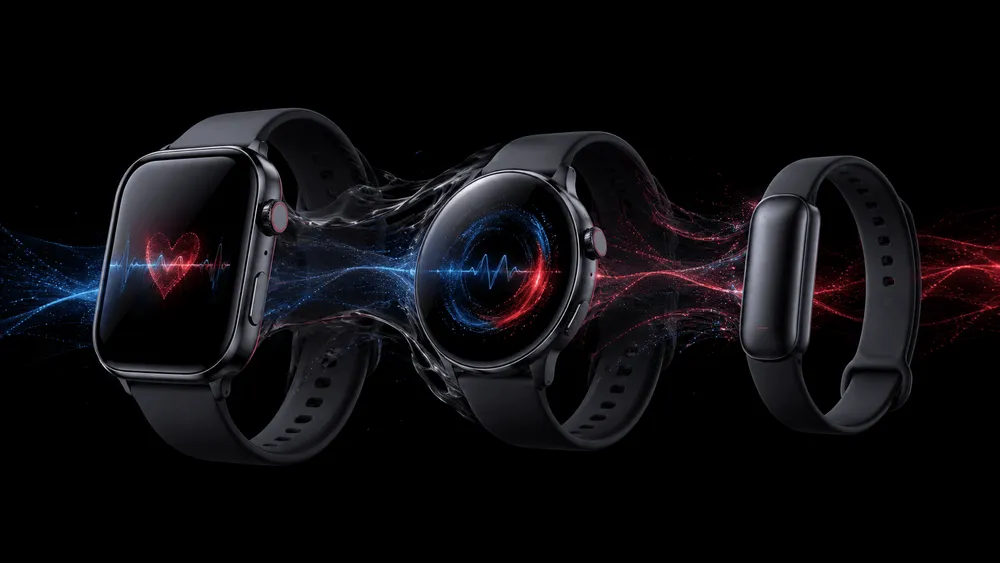
Bloomberg reports that Apple is broadly reconsidering the Apple Watch internally, potentially overturning the fundamental premise of its current product lineup as a screen-equipped wristwatch. Under consideration are round displays, a new device without a screen, different display technologies, and multiple sizes. Price points both above the Ultra and Hermès tiers and below the current SE are also said to be candidates.
However, none of this has been finalized as shipping specifications. According to Bloomberg, a round display is just one option among several and is unlikely to reach the market. Even if a redesign does happen, it would be years away, and no product names or prices have been revealed. The same goes for sensor configurations and band compatibility.
The Apple Watch has evolved by layering health features onto its display and notifications, while consolidating communication and safety features onto the wrist. This latest concept extends beyond simply refreshing that integrated device—it also encompasses ways of capturing health data that don't assume the user is constantly looking at a screen. Given the design of current models and the assumptions built into watchOS, the implications go beyond just the shape of the case.
A Round Display Would Also Require Rethinking watchOS Fundamentals
The current Apple Watch Series 11 uses rectangular cases in 42mm and 46mm sizes. The 42mm model has a display area of 989 square mm, while the 46mm model has 1220 square mm, with both measuring 9.7mm thick. Apple touts sleep scores, up to 24 hours of battery life, Ion-X glass scratch resistance, and 5G as key features of the Series 11.
The strategy of expanding display area has been clear since the Series 10. The 2024 Series 10 moved to 42mm and 46mm sizes, boasting up to 9% more display area than the Series 9 and up to 30% more than the Series 4 through 6. Apple has refined its approach to fitting information within a rectangular format by combining a thinner profile, rounded corners, and a wider aspect ratio.
The higher-end Apple Watch Ultra 3 follows the same trajectory. Its 49mm x 44mm x 12mm case houses a display area of 1245 square mm, with a claimed battery life of up to 42 hours—or up to 72 hours in low power mode. It features the S10 chip, 64GB of storage, and supports both 5G and satellite communication. Among Apple Watch models, this one caters to users who prioritize a large display and extended battery life.
Adopting a round display would require rethinking not just how the screen looks, but also the design of watch faces, text layout, complications, and tap zones. The Dial, Infographic, and List layouts that Apple presented in its watchOS 10 design documentation are all built around the assumption of a specific screen shape and size. Shifting to a round display area would mean rebuilding from the ground up—deciding where to place information—rather than simply scaling existing apps.
Apple's developer documentation for watchOS 27 describes UI that adapts to peripherals and screen sizes. However, the watchOS 27 documentation Apple has published is at the Beta 4 stage and doesn't finalize the shipping specifications for the official release. Whether a round-display prototype will actually make it to production remains undetermined, but if it does, the scope of software-side migration would be substantial.
Removing the Screen Would Change the Wrist Experience
The screenless device Bloomberg reported on suggests Apple may be considering a health accessory distinct from the current Apple Watch. However, Apple has not announced any screenless product, and there's no basis for assuming it would adopt the same design as WHOOP or Oura. The comparison we can draw is limited to what functions screenless products currently prioritize.
WHOOP markets its lack of a screen as a defining feature, with the WHOOP 5.0 emphasizing over 14 days of battery life and always-on sensors. Rather than handling in-the-moment notifications via a display, it's a product built around long-term wear that continuously collects data for later review. When you remove the assumption of screen-watching time, factors like wearing comfort, charging frequency, and data continuity tend to matter more for product value than notification usability.
The ring-shaped Oura Ring 4 also describes sensors and continuous data collection for measuring blood oxygen during sleep, 24-hour heart rate and heart rate variability, and temperature trends. Since a wristwatch and a ring differ in both wear location and operation method, their features can't be compared one-to-one. Still, it's clear that screenless health devices tend to center on accumulating data across daily life and sleep, rather than on checking brief notifications.
If Apple does bring a screenless device to market, its meaning would differ depending on whether it's positioned as a replacement for the current Watch or as a separate accessory that feeds data to an iPhone or Watch. In the former case, the question becomes how to compensate for notifications, apps, and calls. In the latter, the design considerations would center on sensor capacity, battery life, and which device displays the data.
A Concept for Restructuring from High-End to Budget Tiers
Bloomberg reported that Apple is considering price points both above the Ultra and Hermès tiers and below the SE. If true, this suggests Apple is planning to expand its Apple Watch product lineup based on use case and price, rather than simply updating a single design. A screen-equipped wristwatch and a screenless health accessory require different components and are used differently. As price tiers multiply, decisions must also be made about which features go into which products.
The current high-end models already differentiate themselves through how features are layered. The Ultra 3 emphasizes long battery life and satellite communication, while the Series 11 features a thinner case and highlights sleep scores and 5G. If a new price tier is added to this mix, it will reveal whether differentiation comes solely from case material and display size, or from differences in sensors, connectivity, and battery.
This concept also connects to the software handling health data. Bloomberg reported that Apple has a long-term plan for a major overhaul of the Health app under Eddy Cue, aligned with the new AI-powered Siri and advanced health tracking. Apple's documentation for watchOS 27 lists Apple Intelligence, Foundation Models, and HealthKit together, with examples showing Foundation Models used for summary displays, workout feedback, and smart replies. Apple has not yet indicated how the Health app overhaul and the capabilities outlined in this development framework will be divided among specific products.
As health data grows, so does the need for a system that presents it in a way users can understand. Information you check instantly on a watch face differs from information you'd want aggregated in the iPhone's Health app to track changes over time. Where AI-powered Siri and related software generate daily summaries, and which device displays them, will shape the character of these products just as much as whether they have a screen at all.
Separating Years-Away Candidates from Near-Term Updates
This redesign speculation doesn't mean the next Apple Watch will feature a round display or a screenless device. Bloomberg reported that these plans aren't finalized and, even if realized, would be years away. According to Bloomberg, the Series 12 and Ultra 4 expected in fall 2026 won't involve major design changes, focusing instead on chip performance and health/fitness feature updates. We need to keep near-term iterative updates separate from redesign candidates that are years out.
What we should verify first are the shipping specifications. If Apple announces new sizes or display shapes, it will become clear how well existing watch faces and apps adapt, whether band compatibility changes, and whether display area or battery life takes priority. The Ultra 3's claimed up to 42 hours and the Series 11's up to 24 hours are figures based on Apple's own testing conditions—they don't serve as material for preemptively comparing real-world usage time against future models.
If a screenless device does emerge, what matters more than the sensor count is understanding what data gets collected, at what frequency, and where it's interpreted and displayed. Is the Apple Watch redesign about changing what's shown on the wrist, or about expanding the entry points for collecting health data? The answer will show up not in the shape revealed at launch, but in how roles are divided between software and sensors.