


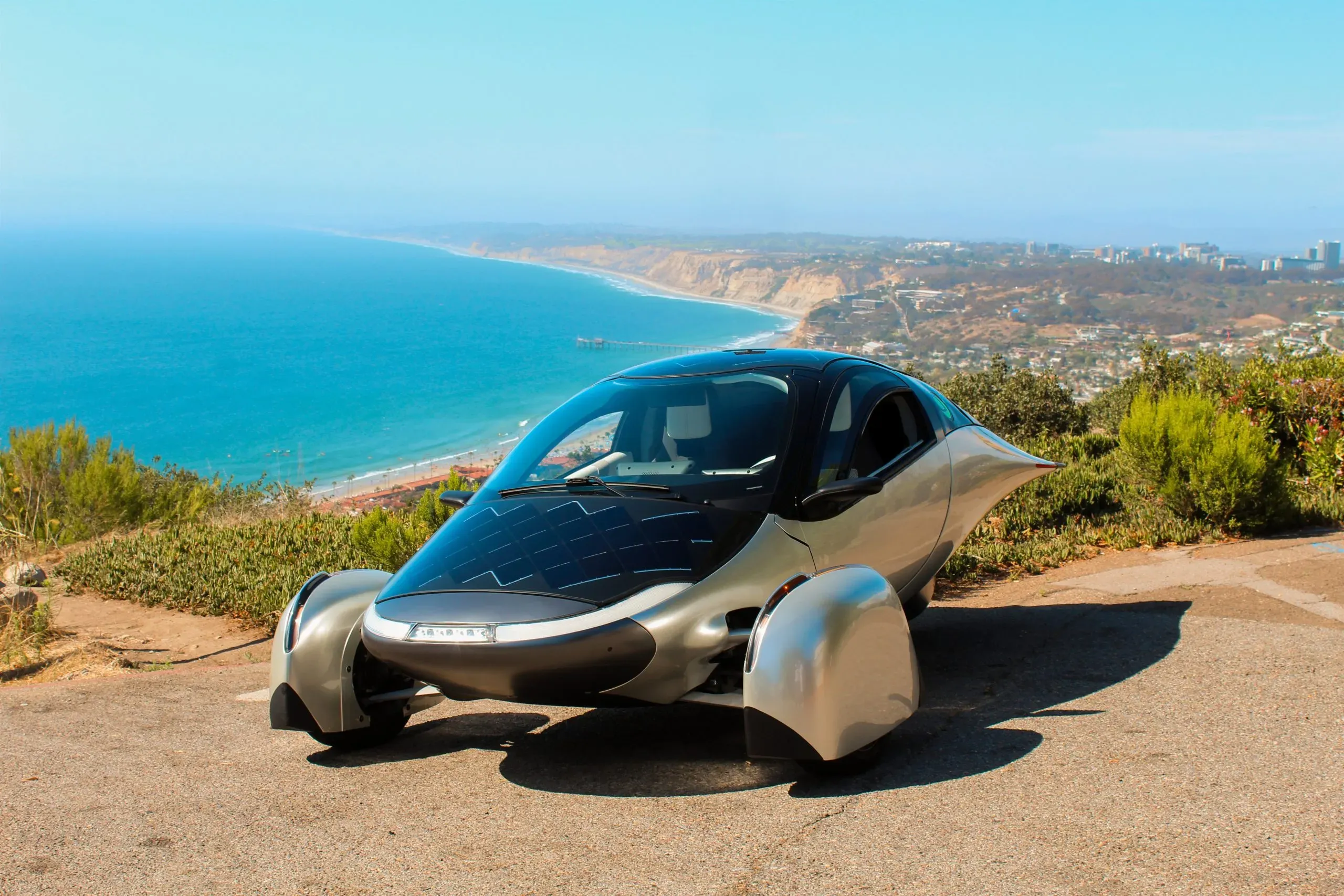
On August 27, 2026, California-based Aptera Motors released a test report from TÜV Rheinland showing that its solar-integrated electric vehicle test unit delivered 4.2332 kWh to the battery over one stationary day. The measurement captured power after conversion losses, not the rated output of the onboard panels. While this exceeds Aptera's long-standing target of 4.0 kWh per day, the accompanying figure of "approximately 42 miles (about 68 km)" is not a distance the vehicle actually drove. The measured power generation and the unverified range estimate—based on a target efficiency figure—need to be read as two separate things.
4.2332 kWh Measured at the Battery Input
TÜV Rheinland Italia conducted a three-day on-site witnessed test from July 6-8 at Aptera's facility in Carlsbad, California. The subject was a single test vehicle called the "APTERA ATLAS 1," equipped with seven solar cell strings across four locations from the hood to the rear hatch. According to figures provided by Aptera, the combined rated output of all strings is 815.9 Wp.
The measurement used TÜV Rheinland's calibrated power analyzer along with voltage and current sensors, simultaneously recording the seven strings and the vehicle's high-voltage lines. This setup could track both the DC power generated by the panels and the power that actually reached the battery through the charge controller. Comparing the combined string output to the high-voltage line on day one revealed a conversion loss of about 9.6% in the electronics.
Because the measurement was taken at the battery input, the result reflects the real-world capability of the onboard system. Simply adding up the panels' rated output wouldn't capture losses from curved mounting surfaces or onboard electronics. This test treated the panels, charge controller, and battery as a single power-generation system, and even with a fixed orientation, more than 4.0 kWh actually reached the storage side.
The 4.0 kWh figure is a daily target under favorable conditions that Aptera has cited previously. The company has combined this with a target efficiency of 100 Wh/mile to describe "up to approximately 40 miles of solar range." This test confirmed, for the whole vehicle system, whether the power generation reaches 4.0 kWh—one of the two figures underlying that calculation.
The report estimated the expanded uncertainty for DC energy measurement at ±1.3%, based on a 12-hour integration period at a 95% confidence level. With the measurement instrument's margin of error disclosed, the confirmation of power generation doesn't rely on the manufacturer's onboard display. However, the pass/fail determination in the test was against the 4.0 kWh specification requested by the client, which is a different role from certifying the vehicle's overall performance.
The 42-Mile Figure Is Not an Actual Driving Result
What TÜV Rheinland actually measured was 4233.2 Wh delivered to the battery. The approximately 42-mile figure is an estimate obtained by applying Aptera's target efficiency of 100 Wh/mile. The calculation—4233.2 Wh divided by 100 Wh/mile—yields 42.332 miles, which Aptera rounded to approximately 42 miles in its announcement. The scope of the test report's contract did not include actually driving the vehicle to verify efficiency or range.
Given the limited area available for solar panels on a vehicle body, achieving longer range requires not only increasing power generation but also minimizing the energy the vehicle consumes per mile traveled. Therefore, while the 4.2332 kWh measurement is a verified achievement for the solar system, confirming the 42-mile figure would require the production vehicle to actually achieve 100 Wh/mile.
Applying the same conversion to days two and three yields 44.026 miles for 4402.6 Wh and 47.542 miles for 4754.2 Wh. The approximately 44-mile and 47-mile figures shown in Aptera's announcement are also estimates derived from the same formula, not results from actual driving. Even though TÜV Rheinland measured power generation down to fractions of a watt-hour, this doesn't mean the accuracy of the distance conversion has improved.
Aptera itself has noted in disclaimers the possibility that the production vehicle may not achieve 100 Wh/mile. The approximately 42-mile figure links two separate performance metrics—power generation and vehicle efficiency—and what the third party measured this time was only the former.
Three Days of Results Shaped by Orientation and Hatch Position
The three-day test deliberately varied conditions, so these were not identical repeated trials. Looking at the measurements together shows that power generation isn't determined by weather alone.
| Date & Conditions | Horizontal Solar Irradiance | Battery Input | Estimated Range at 100 Wh/mile |
|---|---|---|---|
| July 6, hatch closed, fixed orientation | 5709 Wh/m² | 4233.2 Wh | ~42 miles |
| July 7, hatch closed, orientation adjusted during day | 5779 Wh/m² | 4402.6 Wh | ~44 miles |
| July 8, hatch open, orientation adjusted | 5446 Wh/m² | 4754.2 Wh | ~47 miles |
On day three, horizontal solar irradiance was the lowest of the three days, yet battery input was the highest. This suggests that opening the rear hatch toward the sun and adjusting the vehicle's orientation had an effect that outweighed the difference in irradiance. However, continuously opening the hatch and adjusting orientation differs from how a vehicle would normally be parked from morning to evening.
Day two had the highest irradiance of the three days, making it impossible to isolate the effect of orientation adjustment alone from the difference with day one. On day three, both hatch angle and orientation were changed simultaneously, so it remains unclear how much each factor contributed to the increased power generation. While the three conditions illustrate different usage scenarios, they weren't designed as a controlled experiment for comparing the contribution of each individual adjustment.
Furthermore, the report covered a single test vehicle selected by Aptera. While TÜV Rheinland stated an expanded uncertainty of ±1.3% for DC energy measurement (12-hour integration, 95% confidence level), this doesn't guarantee that this one vehicle represents a production batch. The contract was for an on-site witnessing service, not a test that certifies the vehicle, its components, or regulatory compliance.
The sunny July conditions of Southern California are also a factor. Along with shadows, temperature, and parking orientation, solar irradiance varies by region and season, so the peak results from these three days cannot simply be extrapolated to year-round daily use. Judging real-world practicality would require data combining region- and season-specific power generation with actual driving efficiency from production vehicles.
Beyond 4.2332 kWh: The Funding Needed for Production
Alongside its technical verification, Aptera placed an order on August 4 for bodies and chassis for its first 40 production vehicles. The company states it has roughly 50,000 reservation holders, though reservations don't constitute confirmed orders and aren't a figure that reflects vehicles delivered to customers.
Ordering bodies and chassis is a concrete step toward transitioning to a vehicle with production specifications. Still, the fact that parts were ordered for 40 units doesn't indicate that 40 complete vehicles have been assembled or are ready for delivery to customers. If the design changes from the test vehicle measured in this report to the production vehicle, both the solar panel output and vehicle efficiency will need to be re-verified.
The funding gap is substantial. As of June 30, cash and cash equivalents stood at $10.1 million, and the company estimates it needs an additional $40-45 million before it can begin initial low-volume production. The 4.2332 kWh figure measured here represents technical progress in that the solar power generation system reached its targeted performance. However, whether the production vehicle can achieve both this level of power generation and 100 Wh/mile efficiency simultaneously is a question that can only be confirmed once funding is secured and production-spec vehicles are available.
Aptera's vision of "powering daily commutes with solar energy" has cleared one benchmark on the power-generation side. The next criteria for judgment are three-fold: power generation that can be reproduced across different seasons and regions, actual driving efficiency of production vehicles, and the funding needed to complete the first 40 units. Once these are in place, the 42-mile figure will move from a calculated conversion toward a daily driving distance that users can actually expect.