


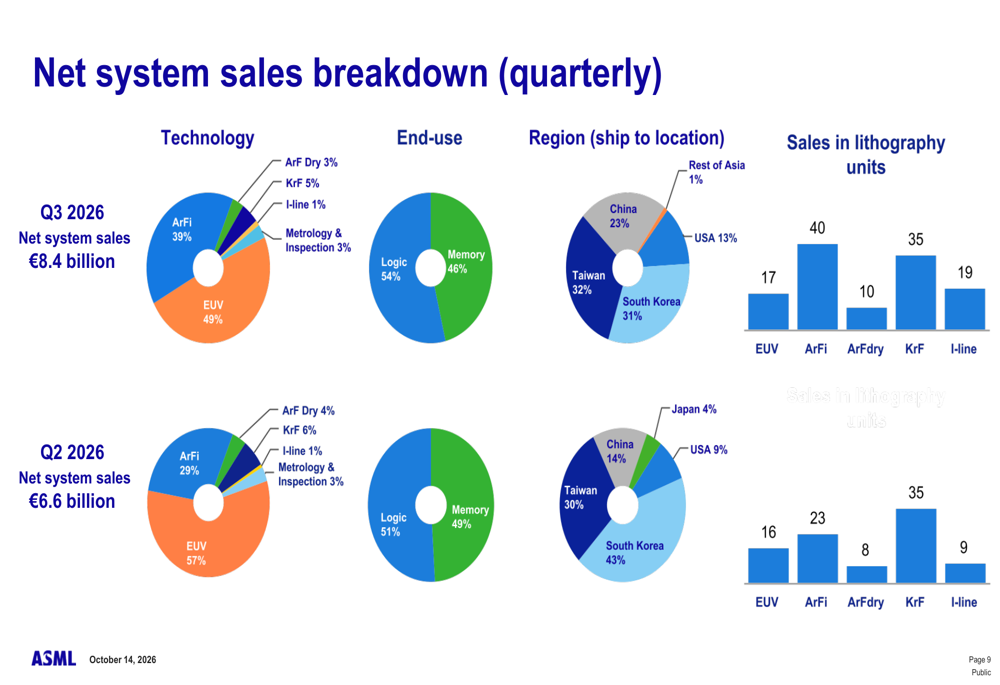
ASML's semiconductor equipment sales to China recovered sharply in the third quarter of 2026. According to results published on October 14, China's share of equipment sales rose from 14% in the previous quarter to 23%, and sales estimated from the published data increased about 2.1-fold. However, China sales are still down from a year earlier, so it would be premature to conclude that ASML's dependence on China is growing again.
How much did the China rebound contribute to ASML's overall results? Converting the regional sales breakdown into actual amounts shows that China played a large role in the latest quarter-on-quarter increase, while growth versus a year earlier was driven by markets outside China.
China sales rise about 2.1-fold, accounting for 56% of the increase in equipment sales
The 23% figure for China shows its share of equipment sales revenue, not the number of machines sold. Regions are also classified by where the equipment is shipped, not by the nationality of the customer.
ASML's equipment sales in Q3 2026 were €8,373.2 million, up about 28% from €6,564.8 million in the previous quarter. In other words, China's share rose even as global equipment sales grew.
Based on ASML's financial statements (page 6) and a reproduced image of the earnings presentation slide (page 9), China equipment sales can be estimated as follows.
| Metric | Q2 2026 | Q3 2026 |
|---|---|---|
| Global equipment sales | €6,564.8 million | €8,373.2 million |
| China share of sales | 14% | 23% |
| China equipment sales (estimate) | approx. €0.92 billion | approx. €1.93 billion |
The China estimates were calculated by multiplying each quarter's global equipment sales by China's share. By this calculation, China sales rose about 110% from the previous quarter, or roughly 2.1-fold. Because regional shares are published as whole-number percentages, the results contain rounding error. They are not country-level sales figures published directly by ASML.
Even more notable is how much China contributed to ASML's overall sales growth.
Based on the published data, the increase in China equipment sales accounts for about 56% of the increase in global equipment sales.
Specifically, global equipment sales rose about €1.81 billion from the previous quarter, while the increase in China came to about €1.01 billion. This was calculated by converting both quarters' sales to millions of euros: (8,373.2 × 23% − 6,564.8 × 14%) ÷ (8,373.2 − 6,564.8).
China accounted for just under a quarter of Q3 equipment sales, but more than half of the quarter-on-quarter increase. The China market clearly underpinned much of the growth in equipment sales. However, this contribution is also an estimate based on published shares, and does not show China's contribution to growth in total company sales or orders.
Down about 17% year on year, while sales outside China roughly doubled
Compared with the same quarter a year earlier, however, China equipment sales have actually declined.
China's share of sales in Q3 2025 was 42%. Based on the earnings presentation from that time (page 8) and equipment sales of €5,553.8 million in the financial statements, China sales are estimated at about €2.33 billion.
By comparison, China sales in Q3 2026 of about €1.93 billion represent a decline of roughly 17% from a year earlier.
In other words, it is not contradictory that China sales "surged from the previous quarter" yet "fell from a year earlier." The previous quarter's sales were low, so the rate of recovery was large, but sales have not reached the level of a year ago.
China's share of sales has also fallen from 42% a year earlier to 23%. A rise in the share in the latest quarter does not mean ASML is again increasing its dependence on the Chinese market.
What stands out in the year-on-year comparison is instead growth in markets outside China.
Subtracting estimated China sales from global equipment sales, sales to regions outside China almost doubled, from about €3.22 billion in Q3 2025 to about €6.45 billion in Q3 2026.
ASML's overall equipment sales rose about 51% year on year, because growth outside China far exceeded the decline in China sales.
By region in Q3 2026, Taiwan accounted for 32%, South Korea for 31% and the United States for 13%. These three regions alone made up 76% of equipment sales.
The sharp recovery in China is an important development, but understanding ASML's overall growth requires looking at trends in other major markets, led by Taiwan and South Korea.
China's full-year outlook is about 20%: how does it differ from the quarter's 23%?
In a transcript of a video interview released alongside the results, ASML Chief Financial Officer Roger Dassen said China is expected to account for about 20% of the company's business in full-year 2026.
However, this roughly 20% figure and the 23% for Q3 are calculated on different bases.
The full-year outlook of about 20% includes not only sales of new semiconductor manufacturing equipment but also revenue from servicing and upgrading installed equipment. The Q3 figure of 23%, by contrast, is the regional share of equipment sales only.
In other words, the two differ not only in time period but also in the scope of business covered. The fact that China's share of Q3 equipment sales was 23% does not mean China business for the full year is running above the company's forecast. Nor is it grounds for predicting that the equipment sales share will fall to 20% in coming quarters.
In fact, ASML's total net sales of €11,662 million in Q3 2026 include €3,288.8 million in installed base management (service and upgrade) sales. The regional breakdown of equipment sales alone, excluding this revenue, cannot accurately show China's share of overall business.
It would also be inappropriate to back out Q4 China equipment sales from the full-year outlook of about 20%.
ASML had also indicated that China would account for about 20% of full-year sales in its prepared remarks for the July 2026 earnings call.
At that time, the company said demand in China was increasing mainly for logic chips made with mature manufacturing processes. This is useful context for understanding the latest China recovery, but it is not information that establishes that the Q3 increase was driven by specific customers or chip applications.
AI demand outpaces equipment supply, with capacity expansion planned through 2028
While China sales have recovered, demand for chipmaking equipment is strengthening across ASML overall, driven by growing AI-related investment.
In its October 14 earnings announcement, the company said customers are raising their equipment demand outlooks on the back of AI-related investment.
Chief Executive Officer Christophe Fouquet said current production plans are not enough to fully meet customer demand in 2027 and 2028.
To respond to rising demand, ASML plans to expand production capacity for low-NA EUV lithography systems and immersion DUV lithography systems.
The company plans to raise 2027 capacity by 30% from 2026, and has been considering a further 30% increase for 2028. In light of the current demand outlook, it is also exploring increases beyond these plans.
ASML also intends to help customers expand chip production capacity not only by supplying more new lithography systems but also through upgrades that raise the productivity of installed equipment.
These moves show that growing capital spending, centered on AI chips, is pushing up demand for ASML's equipment.
One caution, however, is that the recovery in China equipment sales cannot be directly linked to growing AI-related demand.
The 23% figure for China is only a regional share of equipment sales; it does not reveal which types of lithography systems were shipped or what chips they will be used to make. Strong AI-related demand across ASML does not mean the rise in China sales was directly caused by AI-related investment.
ASML has also described the risk that export controls could restrict shipments of equipment that has already been ordered. There is likewise no basis for taking the rise in China sales as evidence that export controls have been eased.
If China's share changes in future results, it will be important to check how actual amounts changed by combining the share with global equipment sales, not just looking at the percentage. The regional share of equipment sales alone should also continue to be distinguished from the outlook for China business as a whole, which includes servicing and upgrades.
In these results, China sales recovered strongly from the previous quarter, while markets outside China supported ASML's growth compared with a year earlier. Whether the China recovery will last, or other major markets such as Taiwan and South Korea will continue to drive growth, remains to be seen. Following both trends should give a more accurate picture of which markets' demand supports ASML's business.