


On November 12, 2026, Dutch semiconductor company Axelera AI announced details of Titania, its third-generation architecture for large-scale AI inference. Titania uses a chiplet design, which combines multiple semiconductor dies, and the company also unveiled "AX8," a 4U air-cooled reference server with 1TB of accelerator memory. Mass production is scheduled for the third quarter of 2027. The goal is to let operators run large conversational AI models while making use of existing data center power and cooling infrastructure. For practical deployment, what matters is not only whether the memory can hold a large model, but also whether the system can deliver fast enough responses in real-world use.
Eight 128GB chip packages make up a 1TB air-cooled server
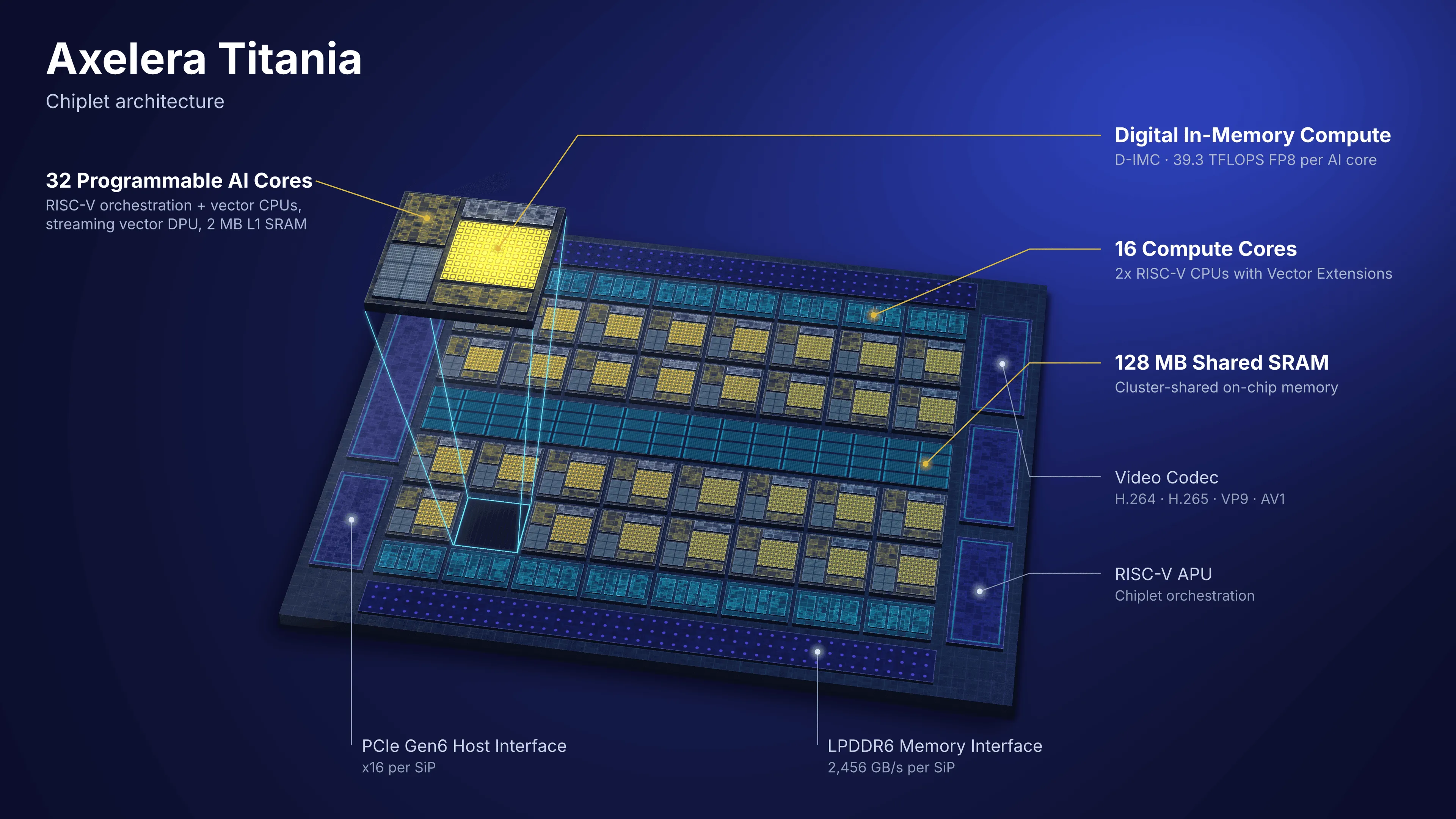
Titania combines two chiplets and 128GB of LPDDR6 memory in a single package. This package is called a SiP (System in Package), and the AX8 carries eight of them. The server as a whole has 1TB of accelerator memory and is designed to deliver 20 PFLOPS of FP8 compute and a combined memory bandwidth of 19.6TB/s.
Axelera AI designed the AX8 as a standard 4U air-cooled server with an expected typical power consumption of 5–6kW. For rack configurations, the company envisions two AX8 units in a 15kW rack and five in a 30kW air-cooled rack. The main specifications announced are summarized below.
| Item | Configuration / Capacity | Power / Installation Conditions |
|---|---|---|
| SiP | 2 chiplets, 128GB LPDDR6 memory | 8 installed in the AX8 |
| AX8 reference server | 1TB accelerator memory, 20 PFLOPS FP8 compute, 19.6TB/s combined memory bandwidth | Standard 4U, air-cooled, typical power consumption 5–6kW |
| Rack configurations | 2 or 5 AX8 units | 2 units in a 15kW rack, 5 units in a 30kW air-cooled rack |
Design values and assumed configurations announced by Axelera AI on November 12, 2026. The memory bandwidth of 19.6TB/s and compute performance of 20 PFLOPS are figures for the AX8 as a whole.
What stands out in this announcement is that the company has given concrete power consumption and rack installation conditions for an AI inference server with as much as 1TB of memory. Operators now have more of the information they need to judge not just whether a large model can run, but whether the system can be installed in an existing data center.
Chinese outlet IT之家 reported that Titania has a design power of 400W and FP8 compute of 2.5 PFLOPS. It also reported 128MB of shared SRAM and 32 RISC-V cores. However, these are reported figures for the Titania chip itself, and they refer to a different scope than the AX8's total power consumption of 5–6kW and 20 PFLOPS of compute. When estimating how many units to deploy, the baseline should be the power draw of the whole server and the rack capacity conditions, not the single chip.
Besides PCIe cards, Axelera AI also plans a configuration with eight OAM modules mounted on an OCP (Open Compute Project)-compliant UBB baseboard. The company intends to offer both air-cooled and liquid-cooled inference servers through OEM partners. A 4U air-cooled design is an option that should be easier to fit into existing facilities, but how much infrastructure upgrading it can actually avoid will depend on each customer's power supply capacity and cooling equipment.
LPDDR6 memory for models with 1.6 trillion parameters
According to Axelera AI, the AX8 can hold a 1.6-trillion-parameter AI model at FP4 precision in a single unit while also reserving memory capacity for the KV cache. A key part of its approach to such large models is the MoE (Mixture of Experts) architecture.
MoE prepares multiple processing units that act as experts, and selects only some of them to compute depending on the input. Even if the model has a very large total parameter count, only a fraction of the parameters is used to process each token. For sparse MoE models in particular, it is important to keep a large number of weights in memory while efficiently reading out only the parts that are needed. For this reason, Axelera AI's design emphasizes securing large memory capacity and using bandwidth efficiently, not just peak memory bandwidth.
For memory, the company chose LPDDR6 rather than high-bandwidth memory (HBM). Axelera AI says the aim is to reduce memory power consumption and to lessen dependence on HBM supply and advanced packaging technology. The compute architecture uses digital in-memory computing, which performs calculations within memory, and now adds floating-point support. By placing many small compute cores and optimizing data movement, the design aims to run inference efficiently while holding the weights of large models.
So how much capacity would actually be needed to store a 1.6-trillion-parameter model in 1TB of memory? If all weights are stored in 4 bits, the required capacity can be calculated simply.
In other words, storing all 1.6 trillion parameters at 4 bits requires roughly 800GB. This is a simple calculation by our editorial team and does not include additional data such as quantization scales, the KV cache, or the working space needed to run the model.
Therefore, the roughly 200GB left after subtracting the 800GB of weights from the nominal 1TB cannot simply be used as-is for the KV cache and other purposes. The memory actually required varies with the model's structure, the quantization method, the input context length, and the number of users served simultaneously. KV cache capacity becomes especially important when handling long contexts or responding to many users at once. The 1TB specification suggests that large models may fit, but it alone does not guarantee actual response speed or inference accuracy.
Migration support from Europa, with customer deployments planned by early 2028
Axelera AI also emphasizes software compatibility with its existing products when introducing Titania. The company said it will use the same development environment, the "Voyager SDK" and "AxeleraScript," across its three generations: Metis, Europa, and Titania. It is also designing a Titania PCIe card that can replace the "Axelera Server 250p," which carries four Europa chips. This is meant to let models developed for Europa move to Titania in 2028 without being re-ported.
The company is also expanding its capabilities for running large models. Titania is planned to support three types of parallelism: tensor parallelism, expert parallelism, and pipeline parallelism. Tensor parallelism distributes computation across multiple processing units, and expert parallelism divides the expert portions of an MoE model among them. Pipeline parallelism, meanwhile, assigns the model's processing stages to multiple devices. By combining these, the company aims to run large models distributed across multiple accelerators.
It also plans to support inference optimizations such as speculative decoding, KV cache offloading, and disaggregation of processing stages. Speculative decoding speeds up output by predicting tokens ahead and verifying them. KV cache offloading moves part of the cache to other memory areas to adjust how much accelerator-side memory is used. With such features, the company aims to enable flexible inference processing according to model size and usage conditions.
Support beyond language models is also planned. Titania is expected to handle 8K video decoding with H.265 and AV1, and 4K video encoding, on the chip. This reflects a vision of running multimodal AI that handles language, audio, and images, along with live video processing, in the same system. The company is looking beyond large language model inference toward real-time AI processing that includes video.
Titania's development plan has become more concrete since it was first announced. The official announcement on March 6, 2025 targeted deployment in 2028, while the latest announcement sets out plans to start mass production in the third quarter of 2027 and roll out to customers by early 2028. Axelera AI also says customer commitments exceed $300 million in total. However, the terms of these contracts and the timing of revenue recognition have not been disclosed.
Projected gains of up to 7x power efficiency and up to 20x lower TCO
Axelera AI projects that Titania can improve throughput per watt by up to 7x and total cost of ownership (TCO) by up to 20x compared with state-of-the-art data center servers. TCO covers not only hardware purchase costs but also the power, cooling, maintenance, and other expenses required for operation.
However, the announcement does not specify the comparison systems, the specific AI models, the processing conditions, or the number of simultaneous users used for these projections. The cost breakdown used to calculate TCO has not been disclosed either, so it is impossible to judge how much cost reduction real deployments would achieve. Product pricing, firm OEM delivery dates, and third-party verification of inference performance are also unavailable. The figures of up to 7x and up to 20x are, at this stage, the company's projections rather than performance confirmed by measurement.
Evangelos Eleftheriou, Axelera AI's CTO, explained that the already-shipping Europa can use 88% of its memory bandwidth for token generation. This figure reflects the company's design philosophy of using memory bandwidth efficiently, but it describes Europa silicon and is not a measured result for Titania. Whether Titania can achieve similar bandwidth utilization, and how much that would contribute to actual response speed and throughput, will have to await future verification.
The company plans a detailed technical presentation on Titania at SC26, a supercomputing event to be held in Chicago from November 15 to 19. For companies considering adoption, it will be important to compare inference performance under the same AI model, context length, and number of simultaneous users. In particular, they will need to evaluate time to first response, token generation speed, total server power consumption, and deployment and operating costs together.
Titania's defining feature is a design that secures the memory capacity needed for large AI models while operating as a standard air-cooled server. If it delivers the announced specifications on real hardware and combines practical response speed with cost efficiency, it could become a new option for running large-scale AI inference in existing data centers.