

In January 1941, a single plant began operations in Freeport, Texas. Built by Dow Chemical, the facility burned oyster shells to produce lime, which it mixed with seawater to precipitate magnesium. Producing one ton of magnesium required processing more than 800 tons of seawater. By 1942, this plant supplied 84% of total U.S. magnesium production, underpinning Allied aircraft manufacturing. In April 2025, the American Chemical Society (ACS) designated this technology a National Historic Chemical Landmark.
Eighty-five years later, a new study has taken on the same challenge—extracting magnesium from seawater—with a completely different approach. A team led by Professor T. Alan Hatton (chemical engineering) and Professor Kripa Varanasi (mechanical engineering) at MIT has developed an electrochemical system that uses the redox reaction of a bismuth electrode to locally shift the pH of seawater, "fishing out" magnesium ions selectively. The paper was published in ACS Energy Letters on August 12, 2026 (DOI: 10.1021/acsenergylett.6c01659).
China's Grip on the Supply Chain, and the Ocean as a "Near-Infinite" Deposit
Magnesium, the lightest structural metal at roughly two-thirds the density of aluminum, is used widely—from automotive lightweighting and aerospace to refractory materials, agriculture, and health supplements, the last of which has seen surging demand in recent years. According to the USGS's (U.S. Geological Survey) 2026 Mineral Commodity Summaries, global magnesium metal production in 2025 was approximately 1.1 million tons, of which China accounted for about 950,000 tons (roughly 86%). Mining from magnesite deposits concentrated in Liaoning Province comes with landscape destruction and air pollution.
Meanwhile, seawater contains dissolved magnesium ions at a concentration of about 1,280 mg/L, with total ocean reserves estimated at roughly tons. Compared to the 13 billion tons of confirmed land-based magnesite resources, this is effectively an inexhaustible resource. The challenge has been how to extract these dilute ions economically and, above all, selectively.
Eighty-Five Years of Reliance on Lime and Hydrochloric Acid
The traditional seawater magnesium extraction method established by Dow consists of three steps. First, lime () is added to seawater to precipitate . Next, this is treated with hydrochloric acid () to convert it into . Finally, molten salt electrolysis yields metallic magnesium. This process consumes large quantities of lime and hydrochloric acid and requires management of byproducts.
Electrochemical alternatives have also long been explored. When electrolysis is performed in seawater, generated near the cathode reacts with to precipitate . In principle, this requires no chemical reagents, but two obstacles have stood in the way. One is the difficulty of separating from , which is present in seawater at roughly eight times the concentration of magnesium. The other is the high cost of the ion-exchange membranes needed to achieve this separation. Furthermore, an unresolved problem remained: scale (mineral film) accumulating on the cathode surface impedes electron transfer, halting the reaction.
Bismuth's pH Swing Achieves Selectivity Without a Membrane
The Hatton and Varanasi team overcame this barrier not through membrane engineering but through the chemistry of the electrode material itself. They focused on bismuth (Bi), which, when subjected to an oxidizing potential, forms bismuth oxychloride (BiOCl) while releasing protons (); when the polarity is switched to reduction, it reabsorbs protons and generates hydroxide ions (). In other words, simply reversing the direction of the applied voltage causes the surrounding liquid to swing back and forth between acidic and alkaline. This "pH swing" is the heart of the technology.
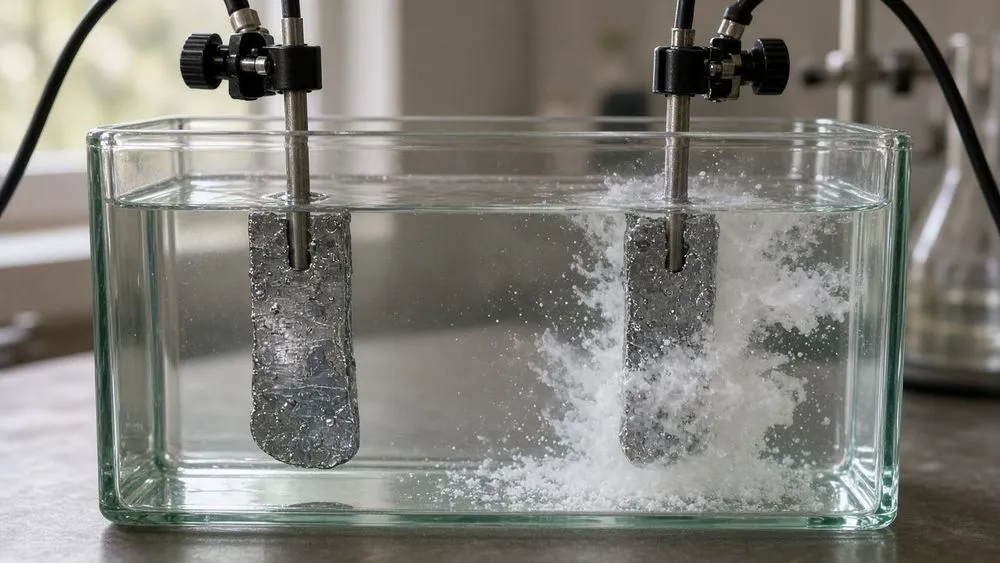
The cell built by the research team consists of a thin bismuth electrode sheet sandwiched between two flow channels, separated by a membrane. Real seawater flows through one channel and an electrolyte solution through the other, with an electric field applied across them. When the bismuth electrode generates , the in the seawater adsorbs and precipitates on the electrode surface as . The team then reverses the polarity of the field and switches the solutions flowing through the channels, dissolving the and recovering it as a concentrated solution. No externally added acid or base is required.
By repeating this pH swing, the magnesium concentration in seawater was enriched eightfold, and the ratio of to reached 20 to 1. The research team states that this selectivity is the highest yet reported among electrochemical membrane systems.
| Item | Conventional Lime Precipitation | Existing Electrochemical Membrane Method | This Study (Bismuth Electrode Method) |
|---|---|---|---|
| Chemical additives | Lime + HCl required | Not required (relies on membrane) | Not required |
| Expensive ion-exchange membrane | Not required | Required | Not required |
| Mg/Na selectivity | Depends on precipitation conditions | Depends on membrane performance | 20:1 (demonstrated in this experiment) |
| Operating voltage | N/A | Around several V | Under 600 mV |
| Estimated cost () | Chemical + energy costs | Membrane cost is rate-limiting | Approx. $107/ton (estimate) |
| Scale issue | Requires precipitation tank management | Membrane fouling | Avoids scale accumulation on electrode surface |
Low-Voltage Operation at 600 Millivolts, Surviving Hundreds of Hours of Continuous Use
The pH swing at the bismuth electrode operates at a low voltage of under 600 mV—less than half the theoretical voltage required for water electrolysis (1.23 V)—which is advantageous in terms of energy consumption. The team further confirmed that no voltage increase or performance degradation occurs even during continuous cycling over hundreds of hours. The fact that inactivation due to scale (mineral film) accumulation is unlikely to occur is also an advantage over prior direct electrolysis approaches.
On the cost front, the team's estimate puts production cost at approximately $107 per ton. Referring to 2026 market prices, this compares to $575–655/ton in the U.S. (Gulf Coast FOB), $445–520/ton in Europe (Rotterdam FOB), and $120–148/ton in China (Qingdao FOB). Even against China's market price—the cheapest of the three—this study's estimated figure is lower. However, the research team itself acknowledges that this figure does not include downstream processing steps such as drying, and total costs at an actual plant could rise.
Why an Electrode Developed for CO₂ Removal Also Works for Mineral Recovery
This bismuth electrode pH-swing technology was originally developed for the purpose of removing from seawater. In 2023, the Hatton and Varanasi team reported in Energy & Environmental Science a system that combines bismuth and silver electrodes to electrochemically capture from seawater (DOI: 10.1039/D2EE03804H). In that earlier study, 87% of dissolved inorganic carbon was removed at an energy cost of 122 kJ/mol.
The same electrode chemistry has now expanded its application from capture for climate action to magnesium recovery for industrial minerals. In an interview with TechXplore, Professor Varanasi stated, "By turning seawater itself into a source of magnesium, this technology can enable domestic production and make our supply chains for critical materials more robust"—moving toward a blue economy in which the ocean becomes a platform for producing the critical materials industry needs.
A Competing Technology Opens Another Path to Tackling Scale
Electrochemical magnesium recovery from seawater is a field of active competition beyond this study alone. In 2026, a method using a cathode with a hierarchical microstructured array of NiFeCo alloy—which dynamically exfoliates scale through shear force generated by the coalescence and sliding of hydrogen bubbles—was reported in Chemical Engineering Journal (DOI: 10.1016/j.cej.2026.174082). This method extracted at 99.5% purity over 1,000 hours of continuous electrolysis, consuming 2.67 kWh/kg of energy.
| This Study (Bismuth Electrode) | NiFeCo Hierarchical Cathode (2026) | |
|---|---|---|
| Extracted product | Concentrated solution | powder |
| Purity | Mg/Na = 20:1 | 99.5% |
| Energy | Under 600 mV (voltage) | 2.67 kWh/kg |
| Continuous operation | Hundreds of hours | 1,000 hours |
| Scale countermeasure | Avoided via pH swing | Exfoliated via bubble shear force |
| Membrane | One (for channel separation) | Not required |
The two may be complementary rather than competing. The bismuth electrode method directly yields a solution, connecting directly to metallic magnesium production, while the NiFeCo method is suited to applications requiring large quantities of high-purity powder.
Remaining Questions
Several hurdles remain before this research can reach practical application. First, how should the costs of downstream processing (drying, purification, transport)—not included in the cost estimate—be evaluated? Second, the effects of biofouling in real ocean environments, and of trace impurities in seawater (boron, calcium, etc.) on long-term operation, remain unverified. Third, the eightfold concentration and 20:1 selectivity reported in the paper were achieved at laboratory scale; whether the same performance can be maintained at industrial-scale flow rates awaits future demonstration testing.
Although the concentration of magnesium in seawater is dilute at just 1,280 mg/L, the total quantity exceeds land-based deposits by more than 100,000-fold. A pathway for extracting this "dilute yet vast" resource selectively, at low voltage, and without reliance on chemical reagents has now been concretely demonstrated for the first time, via a bismuth electrode. The next question is how far this pathway can be widened.