

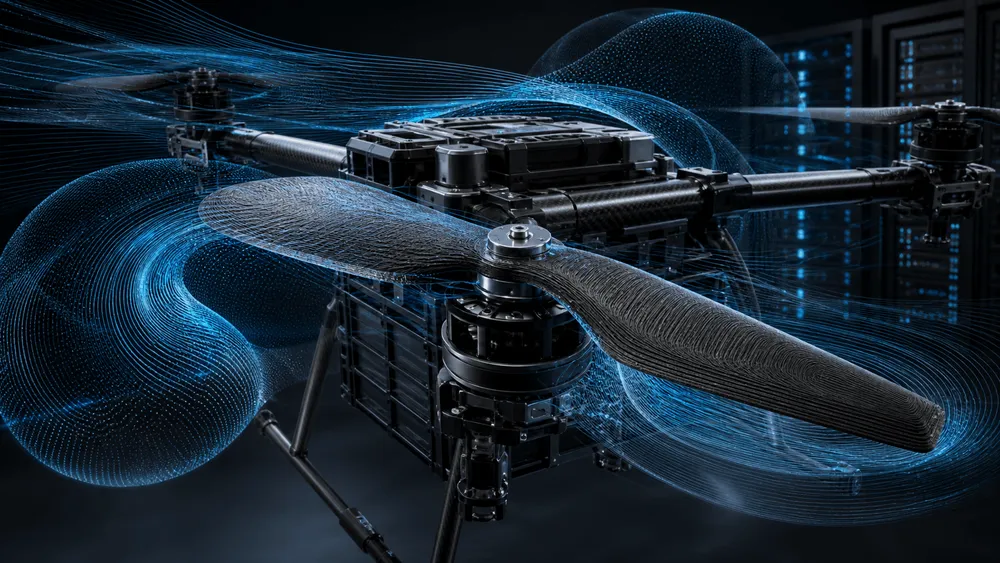
BQP and drone maker Modovolo have adopted a quantum-inspired evolutionary algorithm for exploring shapes in 3D-printed propellers. The two companies' CEOs revealed this on July 24, 2026. What's running here isn't a quantum computer, but a classical algorithm that narrows down candidates on existing high-performance computing (HPC) infrastructure. Rather than a practical application using quantum computers, this is an attempt to change "which shape to analyze next" in computationally intensive aerodynamic design.
Modovolo 3D-prints propellers through a patent-pending process, but according to CTO Arion Mangio, the company had been struggling to improve performance. Changes in width, thickness, and curvature affect not only thrust and power consumption but also structural strength and manufacturability. As the number of candidates increases, the number of fluid dynamics analyses required balloons, meaning how one navigates the design space determines development speed. BQP's role is to restructure this search order using a quantum-inspired probabilistic model.
Shape Exploration Without Quantum Machines
BQP's commercially available BQPhy Optimization Solver doesn't require a quantum processor. It runs on existing HPC equipped with CPUs and GPUs, entering as an optimization layer outside computational fluid dynamics (CFD) and finite element analysis (FEA). BQPhy selects candidate shapes, existing solvers calculate aerodynamics and structure, and the next candidates are generated based on those results. This architecture allows companies to swap out the search engine without discarding their accumulated meshes and physics models.
This separation clarifies the distinction from claims like "we simulated propellers using quantum computing." According to BQP's product page, what's currently commercially available is the Optimization Solver, which uses Quantum-Inspired Evolutionary Optimization (QIEO). The Physics-Based Solver, which directly solves fluid dynamics and structural problems, and the Data-Driven Solver, which combines AI, are both still in research and development. What entered practical use through this collaboration is the part that selects which shapes to run through computation from among vast numbers of candidates—not the physics computation itself.
The combination with 3D printing is also significant. Even when candidates include thicknesses and curvatures difficult to achieve with conventional machining methods, additive manufacturing makes it easier to move to prototyping. However, being printable and being flight-worthy are not synonymous. Shapes selected through analysis only translate into aircraft performance after undergoing thrust stand measurements and durability testing.
2 to the Power of m Is Not the Number of Simultaneous CFD Runs
QIEO is a population-based metaheuristic that borrows mathematical representations from qubits, superposition, and rotation gates. In BQPhy research published in the peer-reviewed journal APL Quantum on April 9, 2026, each qubit-like variable is initialized so that 0 and 1 each have a 50% probability. From there, candidates are sampled, fitness is calculated, and probabilities are updated toward better candidates using rotation rules. This operation repeats until a stopping condition is met.
m qubit-like variables can probabilistically represent a state space of 2^m. However, this doesn't mean CFD is run simultaneously for all 2^m candidates. The actual procedure involves candidate extraction and individual fitness evaluation. The advantage is that computational budget can be concentrated on promising areas while maintaining a candidate distribution that includes distant regions—rather than exhaustive computation.
Genetic algorithms also update multiple candidates generation by generation, but use selection, crossover, and mutation. QIEO differs in that it rotates values corresponding to probability amplitudes to sample the next generation. Both are probabilistic search methods and neither automatically guarantees a global optimum. Comparison design—including initial values, variable encoding, and stopping conditions—determines both speed differences and solution quality.
What the Peer-Reviewed Paper Actually Confirms
The published comparison values come not from propeller optimization but from magnetic lattice optimization. For a 10×10 lattice, QIEO took 75.29 seconds, genetic algorithm (GA) took 164.05 seconds, and simulated annealing (SA) took 376.05 seconds. For a 50×50 lattice, the figures were 25,600.182 seconds, 46,576.803 seconds, and 585,946.318 seconds respectively, with QIEO achieving objective function values close to GA's in less time.
This result confirms that BQPhy's search engine runs on standard HPC and was faster than GA on at least one discrete optimization problem. However, the settings differed: QIEO used a population size of 20 with up to 100 iterations, GA used a population size of 200 with up to 100 generations, and SA used up to 10,000 iterations. The paper explains it adopted settings common in the literature, but this isn't a comparison where each method evaluated the same number of candidates. Additionally, the paper is co-authored by Virginia Tech and BQP, with BQP-affiliated authors participating in the method's analysis and writing.
Magnetic lattices and propellers differ both in the computational load of a single objective function evaluation and in the relationships between variables. The computation time reduction of roughly half seen in magnetic lattices cannot be directly applied to aerodynamic design. What's needed for propeller cases are figures showing, using the same CFD model, the same computer, and the same stopping criteria, how many high-fidelity analyses were required to reach what level of performance compared to alternatives like GA.
Numbers That Need Filling In With Real Aircraft
Both companies explained that BQP's method supports Modovolo's propeller design. However, they haven't disclosed the number of candidates explored, computation time compared to conventional methods, or the resulting shapes' thrust, efficiency, and noise levels. Improvements in flight time and payload capacity are mentioned as directional goals, but improvement rates and test conditions haven't been shown. This progress represents introduction into the design process, not quantitative verification of aircraft performance.
Modovolo's official product page describes the Lift Quadcopter-X as a "near-launch model" approaching commercial deployment. Whether propellers incorporating quantum-inspired search will make it into the production specification is not currently specified. For 3D-printed parts, even identical shapes can vary in strength and aerodynamics depending on material, layer orientation, and surface roughness, making it necessary to separate evaluation of the design algorithm from evaluation of the manufacturing process.
What determines practical utility is power consumption per unit thrust and flight time, measured using the same motor, battery, and payload conditions. If manufacturing time, unit cost, and fatigue life are further disclosed, one could judge whether search speed has translated into product cost benefits. While it's certain that design exploration has changed without waiting for quantum hardware, whether the BQP-Modovolo collaboration has actually moved the needle in drone performance competition can only be said once those comparison values are reproduced in real aircraft testing.