


On October 30, 2026, at the EU-Canada summit in Montreal, Canada became the 39th participating state of the European High Performance Computing Joint Undertaking (EuroHPC JU). Prime Minister Mark Carney highlighted access to JUPITER, Europe's first exascale supercomputer, as a benefit of joining. However, a look at the EuroHPC JU access rules suggests that what newly opens up is more likely the computing resources of the AI Factories and AI Gigafactories than JUPITER itself. The access rules for supercomputers procured after 2020 have long covered associated countries of Horizon Europe, and Canada has been associated with that program since 2024. That said, how much computing capacity Canada can actually use will depend on its contribution and the allocation of usage time, neither of which has been announced yet.
Canada Becomes the 39th Participating State; Prime Minister Says Six Months of Computing Could Finish in a Day
At the summit, the EU and Canada launched the "Alliance for the Future" to strengthen their comprehensive partnership. As part of this, Canada decided to join the EuroHPC JU, an organization in which the EU and participating states contribute funding to jointly procure and operate supercomputers and AI computing infrastructure. The summit's joint statement positions Canada's participation as a step toward stronger cooperation in high-performance computing, and the European Commission says Canada will be able to use European high-performance computing (HPC), AI, and quantum computing resources on the same terms as other participating states.
In a speech after the summit, Carney said that for Canadian researchers, participation means "access to JUPITER." He also explained that a calculation that takes six months on Canada's largest research supercomputer could be completed in a day on JUPITER. However, the Canadian system used for comparison, the nature of the calculation, and the conditions of the performance evaluation were not disclosed. The "six months to one day" figure should therefore be treated as the prime minister's statement, not as the result of a general computing performance comparison.
Non-EU countries that joined the EuroHPC JU before Canada include the United Kingdom, Albania, Moldova, and Switzerland. Switzerland became the 38th participating state on November 11, 2025, and Canada followed. Notably, however, users in Switzerland and Albania were already able to use European supercomputers as Horizon 2020 associated countries before formally joining the EuroHPC JU. In other words, formal participation in the EuroHPC JU and eligibility to use its resources do not necessarily happen at the same time.
JUPITER May Have Been Available Before Joining; How AI Gigafactories Differ
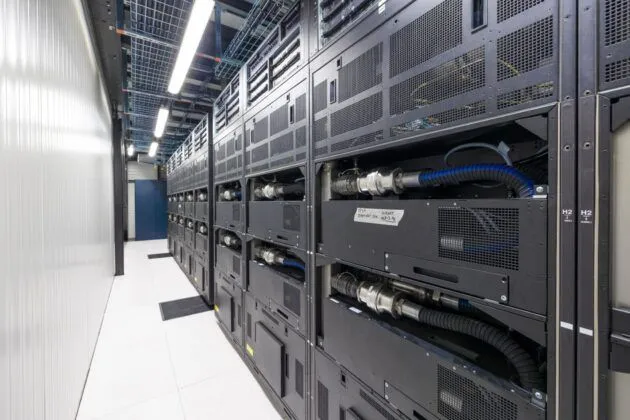
Not all of the computing resources of EuroHPC JU supercomputers are allocated through open calls. According to the access rules, the EU's share of usage time managed by the EuroHPC JU is 35% of total capacity for petascale systems and up to 50% for pre-exascale and exascale systems. This time is allocated to research institutions and companies through calls and is currently free of charge. To judge whether Canadian researchers can use JUPITER, one therefore needs to check whether Canada meets the eligibility requirements for the EU share.
Those requirements differ depending on when the supercomputer was procured. For systems procured after 2020, the access rules make researchers and companies based in EU member states, EuroHPC JU participating states, or associated countries of the Digital Europe Programme or Horizon Europe eligible for the EU share. The key point is that even countries that are not formal EuroHPC JU participants can gain eligibility if they are associated with relevant EU research and digital policy programs.
The procurement contract for JUPITER was signed in October 2023, and it first appeared in the TOP500 world supercomputer ranking in June 2025, placing fourth. The access rules for systems procured after 2020 therefore apply. Meanwhile, on July 3, 2024, Canada signed an association agreement limited to Pillar II of Horizon Europe. Read literally, the rules would mean that Canadian researchers and companies were already eligible to use JUPITER before Canada formally joined the EuroHPC JU.
For AI computing infrastructure, eligibility conditions vary by service and call. The AI Factories FAQ describes applicants to science calls as research institutions and companies based in EU member states or Horizon 2020 associated countries. However, the actual call terms also cover organizations based in associated countries of the Digital Europe Programme or Horizon Europe for supercomputers procured after 2020. Canadian researchers may therefore have been eligible for AI Factories' science computing resources before formal participation as well.
The published call terms for industrial use likewise include a condition covering organizations in Horizon Europe associated countries for systems procured after 2020. In light of this, it cannot be asserted that access to AI Factories was first granted now. By contrast, the call text for AI Gigafactories says that, together with AI Factories, they will provide AI computing resources and related services to public bodies and private users residing in EuroHPC JU participating states. In addition, usage time at AI Gigafactories is to be jointly procured by the EuroHPC JU and some participating states.
Comparing these rules, the computing resources for which eligibility is most likely to newly expand through Canada's formal participation are those of the AI Gigafactories. However, Canada's association with Horizon Europe is limited to Pillar II, and it is not stated whether this form counts as an "associated country" under the EuroHPC JU access rules. It is also unclear whether the AI Factories FAQ will be revised. Moreover, the AI Gigafactories have not yet been selected and no usage time has been set for Canada, so for now one must distinguish between the possibility of eligibility and actually securing computing resources.
JUPITER Offers About 6.5 Times the Combined Performance of Canada's Listed Systems
To gauge JUPITER's scale, we can compare the June 2026 TOP500 figures. JUPITER Booster's HPL performance reaches 1,000.00 petaFLOPS. The combined total of Canada's 17 systems on the same list is 153.01 petaFLOPS. JUPITER Booster alone is thus about 6.54 times, or roughly 6.5 times, the combined performance of Canada's listed systems. However, this compares HPL benchmark performance and does not support Carney's statement that six months of computing could be finished in a day.
In the same TOP500, the combined HPL performance of Japan's 44 systems is 1,517.87 petaFLOPS, about 1.5 times JUPITER Booster alone. Japan is not a EuroHPC JU participating state but is advancing cooperation with Europe in high-performance computing. On June 11, 2025, the EuroHPC JU and the RIKEN Center for Computational Science (R-CCS) signed a letter of intent to enable European researchers to use the supercomputer Fugaku under the HANAMI project framework. It shows that even without formal participation, there are paths to mutual use of computing resources through individual cooperation frameworks.
However, TOP500 figures do not show the full picture of each country's computing resources. HPL performance does not match performance in AI model training or inference, and commercial GPU clusters not registered in the ranking are not counted. Even if Canadian researchers can use JUPITER, they cannot freely use the system's total capacity. On exascale systems, up to 50% of capacity is offered through EU-share calls, and that time must be shared with researchers and companies from other participating and associated countries.
Information needed to judge how much computing resource Canada will actually secure has not yet been published. None of the European Commission news item, the EU-Canada joint statement, the Canadian prime minister's office background material, or the EuroHPC JU announcement gives concrete figures on Canada's contribution, the allocation of usage time, or the start date for access. It therefore cannot be concluded that Canadian researchers have newly secured a certain amount of computing resources through this participation.
The call for AI Gigafactories opened on July 30, 2026, and up to seven sites are expected to be selected in early 2027. Because usage time is to be jointly procured by the EuroHPC JU and some participating states, whether Canada joins this arrangement will matter. Even if it does, it will be difficult to estimate the scale actually available to researchers and companies until the usage time and conditions allocated to Canada are published.
Early 2027 Selection Is the Focus: How Much Will Canada's Computing Resources Grow?
The view that participation mainly opens up AI Gigafactory resources comes with an important caveat. The biggest issue is that Canada's association with Horizon Europe is limited to Pillar II. If the EuroHPC JU access rules did not recognize this limited association as qualifying, Canadian researchers would not have been eligible to use JUPITER before formal participation. In that case, JUPITER access would also be newly granted by this participation, and Carney's explanation would be valid under the rules as well.
The European Commission says Canada has been associated with Horizon Europe since 2024 and does not address how the scope of association affects eligibility. An interpretation that Canada already met the EuroHPC JU eligibility requirements is therefore plausible, but no document has been presented that confirms how an association limited to Pillar II is treated. Until this is clarified, it cannot be determined whether JUPITER access was already permitted or became possible only through this participation.
For the AI Gigafactories, too, formal participation does not immediately secure computing resources. The call text states that facilities must be located in EU member states and that public funding comes from the EU and member states. Only some participating states take part in the joint procurement of usage time, so not all participating states will necessarily receive the same amount. If Canada does not join the joint procurement, or if its contribution is small, the computing resources it can actually use may be limited.
There is also caution about how much cooperation with Europe will strengthen Canada's AI computing infrastructure. Anton Leicht of the Carnegie Endowment for International Peace told Politico that cooperation on computing is one of the clear, short-term steps middle powers can take together on AI, but said it "barely reduces" real dependence on the United States at present. With the US continuing to build gigawatt-scale computing clusters, cooperation that does not involve a major expansion of computing resources is unlikely to change that dependence significantly.
The Canadian government is also building domestic AI computing infrastructure separately from its international partnerships. On April 15, 2026, it opened a call under the Sovereign AI Compute Infrastructure Program (SCIP) to build large public AI supercomputers. The question of what Canada can newly use through EuroHPC JU participation should therefore be considered separately from the question of how much Canada's overall computing resources grow and how far its dependence on the US declines.
Three pieces of information to be published will be important for judging the practical effect of this participation. First, the EuroHPC JU or the Canadian government needs to state clearly whether Canadian researchers were eligible to use supercomputers procured after 2020 before formal participation. If it is confirmed that they were not eligible to apply, JUPITER would be among the resources newly available through this participation.
Second, in the early 2027 AI Gigafactory selection, will Canada join the joint procurement of usage time, and will an allocation be set for Canadian residents? If neither participation in the joint procurement nor an allocation is confirmed, the view that participation newly secures AI Gigafactory resources weakens. Third, the size of Canada's contribution matters; if it is zero or merely symbolic, the practical effect of expanded access may be limited.
For now, the focus is on the results of the early 2027 AI Gigafactory selection and whether Canada's contribution and usage-time allocation are made public. If Canada joins the joint procurement and secures a concrete share, European AI computing resources could become an option for research, development, and industrial use alongside the infrastructure being built domestically under SCIP. To judge its real value, however, one must look beyond the institutional status of formal participation and confirm how much computing capacity is available and on what terms.