


On June 22, 2026, CATL unveiled its "Tener Sodium" grid-scale energy storage system using sodium-ion batteries in Munich, announcing that deliveries would begin in China in September and international deliveries would start in June 2027. Meanwhile, Netherlands-based Alfen, which is rolling out 5GWh in Europe, wrote in its August 18 first-half earnings materials that it does "not expect the first sodium-ion deployment before the second half of 2027." According to IEA (International Energy Agency) figures, sodium-ion cells have a maximum energy density of 175Wh/kg, falling short of LFP's (lithium iron phosphate) 205Wh/kg. A battery that loses on density is nonetheless moving into LFP's territory—LFP accounted for over 90% of the 307GWh of new storage capacity installed globally in 2025—with a staggered gap appearing between announcement and actual deployment. The reasons this battery is being adopted, and the meaning of the gap between announcement and real-world operation, lie within a research history dating back to 1976 and the wild swings in lithium prices since 2022.
Announced in June, Delivered in September, Europe in H2 2027
CATL's English-language release describes its delivery plan as follows: "In China, formal delivery of the first sodium-ion energy storage system will officially begin this September, with cumulative shipments expected to reach 1GWh by the end of 2026. International deliveries are scheduled to begin in June 2027" (CATL official release, June 22, 2026). A little over three weeks later, on July 16, Alfen and CATL announced a memorandum of understanding to deploy 5GWh of Tener Sodium in Europe. CATL cited the purpose of this partnership as accumulating local operational experience with sodium batteries on European grids and optimizing product compliance with European grid codes. On July 21, CATL officially announced a strategic cooperation agreement with Solarpro for 2GWh destined for Central and Eastern Europe.
Lining up the dates reveals that the timing expressions differ across sources. CnEVPost, Caixin, and JETRO describe the European rollout as "starting from 2027," while Electrek wrote "deployment expected to begin in 2027." Alfen itself stated explicitly in its August 18 earnings materials that it does not expect the first deployment before the second half of 2027 (Alfen H1 earnings, August 18, 2026). Neither CATL's nor Alfen's primary sources explain the reason for this six-month-to-one-year discrepancy.
Counting the period on a date basis, from July 29, 2021, when CATL announced its first-generation sodium-ion battery, to September 2026, the scheduled first delivery for grid-scale storage, comes to approximately 5 years and 2 months when using end-of-month as the calculation basis (this would be closer to 5 years and 1 month if delivery occurs in early September). From the Tener Sodium announcement (June 2026) to the scheduled start of international delivery (June 2027) is 12 months on the same basis. What Alfen's earnings materials state is only a lower bound—"we do not expect the first deployment before the second half of 2027"—with no upper bound indicated in the primary source. From the announcement to this lower bound is at least 13 months, and as of September 6, 2026, the actual deployment timing remains unconfirmed.
| Date | Event | Category | Source |
|---|---|---|---|
| 1976 | Earliest intercalation-type sodium compounds reported | Research | Oxford Open Materials Science (2023 review) |
| 1980 | Delmas et al. report layered oxide cathode NaMeO2 | Research | Same review |
| 1991 | Sony commercializes lithium-ion battery (LiCoO2 cathode and carbon anode) | Commercialization | Battery Design |
| 2000 | Stevens and Dahn report glucose-derived hard carbon anode (~300mAh/g) | Research | Same review |
| 2011 | UK's Faradion founded | Company | Same review |
| July 29, 2021 | CATL announces first-generation sodium-ion battery and AB pack (cell: 160Wh/kg) | Announcement | CATL official |
| November 2022 | China's lithium carbonate price peaks above 600,000 yuan/t | Price | SMM |
| April 21, 2025 | CATL announces Naxtra (175Wh/kg, over 10,000 cycles) | Announcement | CATL official |
| May 29, 2025 | Lithium carbonate futures hit year-to-date low of 58,860 yuan/t | Price | SMM |
| April 27, 2026 | CATL and HyperStrong sign 3-year, 60GWh supply contract | Contract | CATL official |
| May 2026 | Environmental assessment document for 40GWh expansion at Fuding (5 billion yuan) made public | Capacity | Ningde municipal environmental authority document (CnEVPost, battery-news) |
| June 22, 2026 | Tener Sodium announced. China delivery in September, 1GWh by year-end, international delivery June 2027 | Announcement | CATL official |
| July 16, 2026 | Alfen and CATL sign MOU for 5GWh in Europe | Contract | Alfen official |
| July 21, 2026 | Contract with Solarpro for 2GWh of Tener Sodium | Contract | CnEVPost |
| August 18, 2026 | Alfen states it does not expect first deployment before H2 2027 | Outlook | Alfen H1 earnings |
"Announcement," "contract," and "outlook" in the table are distinct categories, and none of the rows represents the start of actual operation. From the 1976 research starting point to the planned 2026 initial delivery is 50 years; from the commercial product announcement to grid-scale delivery is 5 years and 2 months; and from the grid-scale product announcement to actual European operation is a further year or more—these three layers of time lag represent where this battery currently stands. Research history years come from peer-reviewed and secondary sources with no specific dates identifiable, and price figures are limited to domestic Chinese lithium carbonate prices.
The 1980 Cathode, the 2000 Anode, and Three Generations Since 2021
Research into sodium-ion batteries began at nearly the same time as lithium-ion. The earliest intercalation-type sodium compounds were reported in 1976, and around 1980 Delmas et al. reported the layered oxide NaMeO2—roughly the same period when Goodenough reported LiCoO2. Yet it was lithium that was commercialized in 1991.
What Sony adopted was the combination of a LiCoO2 cathode and a carbon anode, and sodium had no equivalent anode. Sodium ions are larger and heavier than lithium ions, giving them lower voltage and energy density, and moreover sodium cannot be practically inserted into graphite, which readily accepts lithium. A 2017 paper in RSC Advances addresses this "instability of sodium-intercalated graphite" as its central theme. With no viable anode, research resources after 1991 concentrated on lithium.
The stalemate broke in 2000, when Stevens and Dahn reported a glucose-derived hard carbon achieving a capacity of roughly 300mAh/g. In 2003, Barker et al. reported the first full cell combining hard carbon with an NaVPO4F cathode, and in 2011 Faradion was founded in the UK. The technical barrier had fallen by this point. Even so, sodium-ion remained small-scale through the 2010s. As long as lithium prices stayed low, there was no economic motivation to switch to sodium.
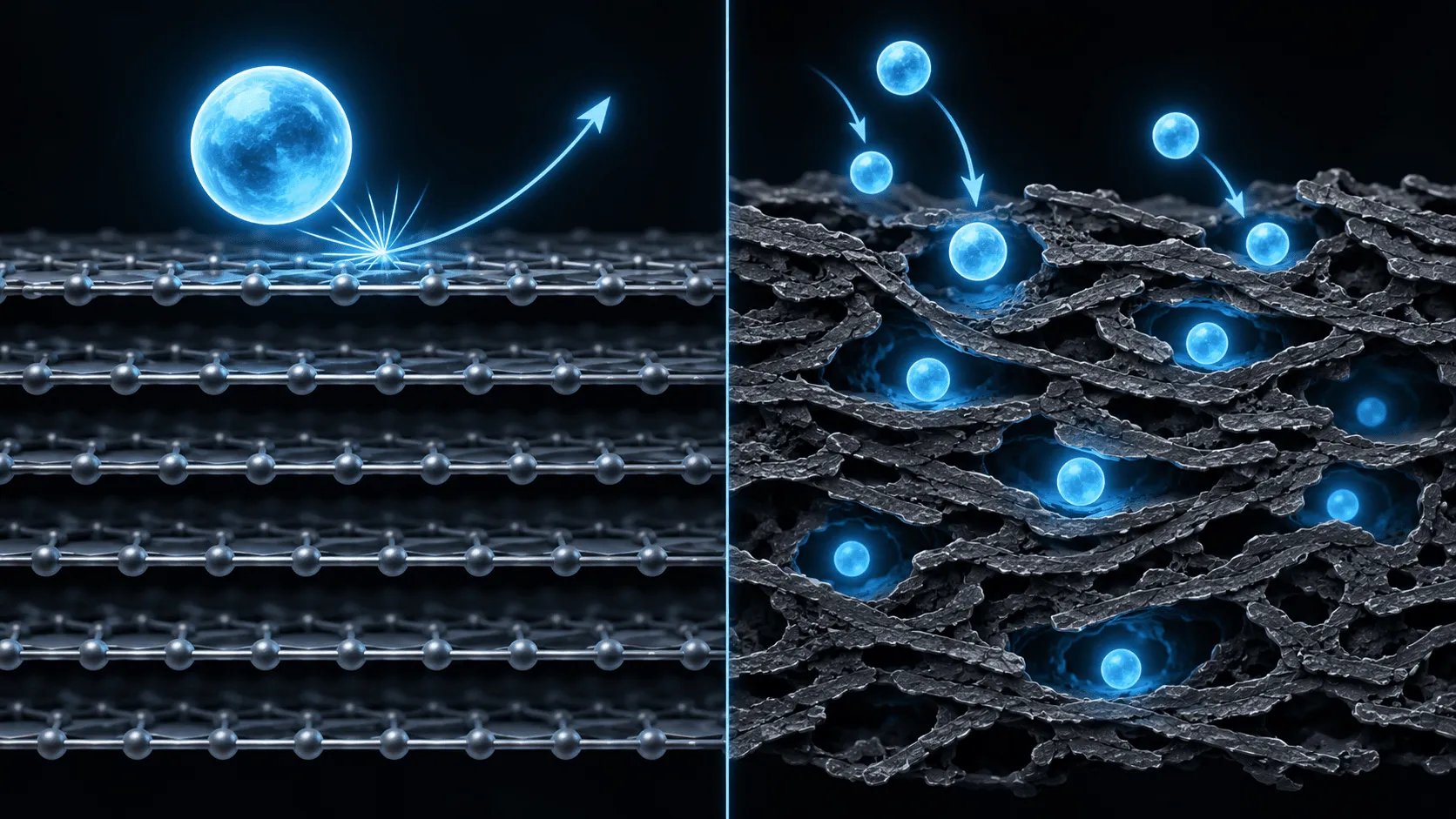
While hard carbon functions as an anode, a separate barrier emerged in mass production. The lifespan of sodium-ion batteries is determined by the stability of the SEI (solid electrolyte interphase) film formed on the hard carbon surface, and academic reports have achieved over 5,000 cycles through electrolyte additive engineering. The mass-production bottlenecks that CATL describes as having "resolved" in 2026 were moisture control in hard carbon electrodes and gas generation within cells. Material prices also shifted. Industry event reports attributed to material suppliers and CATL's domestic energy storage division CTO Lin Jiubiao indicate that hard carbon anode prices are expected to nearly halve, from 60,000-70,000 yuan/t in 2024 to 35,000-40,000 yuan/t by 2026.
CATL's own product has gone through three generations. Placing each generation's published figures in the same table makes the direction of evolution clear.
| Generation (announcement date) | Cell energy density | Cycle life | Low-temperature performance | Application |
|---|---|---|---|---|
| 1st gen (July 29, 2021) | Up to 160Wh/kg | Not disclosed | >90% capacity retention at -20°C | Vehicle (AB mixed pack with lithium) and general storage |
| Naxtra passenger vehicle (April 21, 2025) | 175Wh/kg | Over 10,000 cycles | Usable output retained at 90% at -40°C | Passenger vehicles (500km range), 24V starter battery for large trucks |
| Tener Sodium (June 22, 2026) | ~160Wh/kg (CATL figure reported by pv magazine; not listed in English-language release) | 15,000 cycles at 25°C (to SOH 70%), over 10,000 cycles at 45°C | >92% capacity retention at -20°C | Grid-scale storage (1 to 8 hours) |
Cell energy density has remained essentially flat—160, then 175, then back to around 160Wh/kg—while the five years of evolution have concentrated on cycle life (undisclosed, then over 10,000, then 15,000), low-temperature performance, and shifting applications (mixed vehicle use, standalone vehicle use, dedicated grid storage). There are caveats to this reading. Naxtra is designed for vehicles and Tener Sodium for grid storage, so the different design targets mean the flat density trend cannot be read as regression. Low-temperature performance is also measured differently: first-generation and Tener Sodium use "capacity retention," while Naxtra uses "output retention."
And all four metrics are CATL's own disclosed figures, with no third-party measurements confirmed. Still, CATL's own numbers show that raising density was not the theme of these five years.
Why 175Wh/kg Is Enough for Grid-Scale Storage
According to IEA figures, against sodium-ion cells' maximum of 175Wh/kg, LFP reaches 205Wh/kg and NMC (nickel manganese cobalt) reaches 265Wh/kg. In passenger vehicles, this gap directly determines how much energy can be packed into the same body dimensions and weight—in other words, driving range. In grid-scale storage, each Tener Sodium module weighs approximately 42 tons with a capacity of 3.75MWh, and eight modules combine to form a system rated at over 30MWh. A 1GWh-scale site would require arranging 34 sets of this 30MWh-plus system. Whether a 42-ton box placed on the ground is a few tons heavier carries a different meaning than it would for a battery mounted in a car.
According to BloombergNEF figures, LFP accounted for over 90% of new stationary installations in 2025. Density is not the axis that governs this selection.
The mechanism behind this reversed evaluation function lies in what the battery earns from. A vehicle battery's value is determined by how much energy can be packed per kilogram or per liter. A grid-scale storage battery is an asset that earns revenue in electricity markets each time it completes a charge-discharge cycle, and its value is determined by how many cycles, over how many years, and at what efficiency the initial investment can be recovered. This is why the figures CATL puts front and center for Tener Sodium are 15,000 cycles at 25°C, an estimated lifespan of 25 to 30 years, a roughly 2% improvement in system round-trip efficiency (RTE), auxiliary power consumption of 1% (versus an industry average the company describes as 2%), and support for discharge durations from 1 to 8 hours—density is not even among the disclosed items.
Temperature also becomes value under the same logic. CATL states that the battery retains over 92% capacity at -20°C, and C&EN magazine reports capacity loss at low temperatures as roughly 10% for sodium-ion versus 30-40% for LFP (conditions not specified in the article). For equipment placed outdoors, where power used for climate control eats directly into revenue, retained capacity at low temperatures and halved auxiliary consumption translate directly into differences in operating income.
Safety-related figures also stand as CATL's disclosed values. According to CATL's explanation as reported by Electrek, the cell surface temperature during thermal runaway is approximately 200°C, cell expansion force is 40% lower than conventional lithium-ion cells, and gas generation is also 35% lower. GM Vice President Kurt Kelty said in June 2026, when announcing the partnership with Peak Energy, that "the application should determine the battery, and for grid-scale stationary storage, sodium-ion is the right answer" (Peak Energy release, June 9, 2026). Electrek also wrote in a July article that what grid-scale storage needs is cycle life, safety, wide temperature tolerance, and low cost—not the density that makes lithium indispensable in cars. This proposition itself is no longer a rare viewpoint.
However, this proposition does not immediately mean "therefore sodium is cheap." BloombergNEF wrote in May 2026 that sodium-ion is generally more expensive than lithium-ion at present due to its smaller scale. In a comparison table published by C&EN magazine in November 2025, sodium-ion cost 60 to 100 dollars/kWh while LFP was under 50 dollars/kWh, and Matthew Bird of Benchmark Mineral Intelligence stated in a webinar that sodium-ion's cost advantage over LFP has disappeared and it is now more expensive than LFP. While it's certain that density is not the reason, as of 2025, cheapness was not the reason either. The selling points CATL emphasizes are separate from current pricing: a design that can be swapped into the same enclosure as LFP, and a property of not being tied to lithium prices.
The Cost of a Battery That Needs No Cobalt or Copper Current Collectors, and the Real Rival to 15,000 Cycles
The starting point for cost structure is resource abundance. According to the CRC Handbook, crustal abundance is 23,600ppm for sodium versus 20ppm for lithium—a ratio of roughly 1,180 times (CATL's official release describes this as "over 1,000 times that of lithium"). The cathode believed to be used in Tener Sodium contains neither cobalt nor nickel (though other nickel-containing cathode systems also exist for sodium-ion batteries). Tener Sodium's cathode chemistry is not officially specified, but CATL's official release contains a single line stating that production costs for NFPP (sodium iron pyrophosphate, Na4Fe3(PO4)2P2O7) will decline as the technology matures, leading to the presumption that it is an NFPP polyanionic system built on an iron-phosphate framework.
Current collectors also make a difference. Lithium-ion batteries must use copper foil for the negative electrode current collector, but because sodium does not alloy with aluminum, aluminum foil can be used for both electrodes. At July 2026 rates, copper was priced around 13,400-13,500 dollars/t and aluminum around 3,050-3,100 dollars/t, and a University of Birmingham review indicates that current collectors account for 10-15% of lithium-ion battery cell weight (previously 18%).
Even so, current cell costs are on par with or slightly higher than LFP. The peer-reviewed version of the process-based cost model CellEst 3.0 (2025, Fraunhofer) estimates layered oxide cathode (NaNFM111) sodium-ion cells at 54.4-62.0 dollars/kWh, LFP at 56.1-62.3 dollars/kWh, and NMC811 at 69.2-75.1 dollars/kWh. The same model counts hard carbon anodes and aluminum current collectors as favorable cost factors, while citing uncertainties such as variation in practical hard carbon cell capacity and voltage.
Renewables Now reported that CATL's public relations department stated in August 2026 that the company would achieve cost parity with LFP by the end of 2026 and undercut it thereafter. The 30-40% cost advantage over LFP figure reported by pv magazine is also CATL's own future projection, with calculation conditions not disclosed.
Lifespan figures require verification of the comparison target. CATL disclosed 15,000 cycles at 25°C (until SOH, or state of health, reaches 70%) and an estimated lifespan of 25 to 30 years for Tener Sodium. But on April 10, 2024, when CATL announced the LFP version of Tener (a 6.25MWh 20-foot container), it listed over 15,000 cycles, a 20-year lifespan, and no degradation for the first 5 years. The cycle count is identical.
When Electrek wrote that the battery "beats LFP on lifespan," the comparison target was the several thousand to roughly 10,000-cycle warranty range typical of general LFP storage systems—a figure with no cited source. When comparing against CATL's own latest LFP storage product, there is no difference in cycle count.
Where differences appear are in estimated lifespan years (LFP version: 20 years; sodium version: 25-30 years), the over-10,000-cycle figure at 45°C on the high-temperature side, and the over-92% figure at -20°C on the low-temperature side. However, the SOH threshold and temperature conditions for the LFP version Tener's 15,000 cycles are not disclosed, so this cannot be called an apples-to-apples comparison.
And the 15,000-cycle figure itself is CATL's own claim for both products. The typical cycle life figures in C&EN magazine's comparison table are 4,000-6,000 cycles for sodium-ion and 4,000-8,000 cycles for LFP. In published academic testing, an NFPP-based full cell using commercially available hard carbon (approximately 0.66Ah pouch) reported 2,000 cycles, but no published paper directly substantiating 15,000 cycles has been found, and the content of the "bipolar wide-temperature technology" that CATL cites as the basis for its low-temperature performance is also undisclosed. CATL calls Tener Sodium the world's first "field-validated" sodium-ion storage system, but no primary source—official release or news report—indicates the location, duration, or scale of this validation. Lifespan and temperature tolerance are items explained as reasons to choose this battery, but they are not yet items confirmed by a third party.
From 600,000 Yuan, to 58,860 Yuan, to 181,500 Yuan for Lithium Carbonate
China's battery-grade lithium carbonate price has reversed direction three times over these four years.
| Point in time | Price (yuan/t) | Source |
|---|---|---|
| November 2022 | Over 600,000 (peak) | SMM |
| 2024 (annual average) | ~90,000 | SMM |
| May 29, 2025 | 58,860 (futures closing price, year-to-date low) | SMM |
| October 2025 | 73,550 (monthly average) | SMM |
| January 26, 2026 | 181,500 (spot average, recent peak) | SMM |
| April 20, 2026 | 167,000 (spot average) | SMM |
| September 4, 2026 | 152,000 (up 102.69% year-on-year) | Trading Economics (single indicator) |
From the 2022 peak to the May 2025 futures closing price, prices fell to less than one-tenth; from there, the January 2026 spot average rebounded to roughly three times that level over eight months (this compares two different indicators—futures closing price and spot average).
LFP cell prices mechanically track this raw material price. According to SMM estimates, for every 10,000 yuan/t rise in lithium carbonate, cell cost rises by approximately 0.006 yuan/Wh, and 314Ah storage-grade LFP cells rose from 0.300 yuan/Wh (approximately 42 dollars/kWh) at the end of October 2025 to 0.365 yuan/Wh by April 20, 2026—an approximately 22% increase over six months (range: 0.335-0.395 yuan/Wh). ESS News attributes the rise to factors including the suspension of CATL's Jianxiawo mine in Jiangxi Province, tightening supply, and increased storage demand.
These wild price swings have continued to determine sodium-ion's economics. When CATL announced its first generation in July 2021, lithium carbonate was at the entrance to a rising phase heading toward over 600,000 yuan/t. The sharp decline from 2023 through the first half of 2025 erased that advantage.
BloombergNEF's December 2025 price survey found the average price of stationary storage packs at 70 dollars/kWh, down 45% year-on-year, with the lowest observed LFP cell price at 36 dollars/kWh. Faradion co-founder Jerry Barker said in November 2025 that oversupply of LFP over the past 2-3 years had pushed LFP below 50 dollars/kWh, creating a genuinely difficult situation for sodium. The convergence in 2026 of the projected halving of hard carbon prices and the rebound in LFP prices is shifting the dynamic. This reading of the timeline is the author's own interpretation, but the underlying prices and dates all match the table above.
CATL's logic for selling sodium-ion is also premised on this volatility. Tener Sodium uses the same enclosure and footprint as the LFP version, and according to CATL's explanation, it can be swapped in without enclosure changes, project redesign, or re-certification. For buyers, this means being able to switch suppliers within the same slot at the same site—sodium in years when lithium prices rise, LFP in years when they fall. What is being purchased is not cheapness so much as the property of not being tied to raw material prices.
Market scale is moving to support this logic. BloombergNEF projects global new storage installations (excluding pumped hydro) at 112GW/307GWh in 2025 (up 48% year-on-year) and 158GW/459GWh in 2026 (up 41%), with China accounting for roughly 54% of the world at 61.1GW/173.1GWh in 2025. Over 90% of this market is LFP.
Sodium-ion's current footprint is small. The IEA estimates current manufacturing capacity at "just over 1%" of lithium-ion cells, and even including planned capacity through 2030, only about 7% of planned lithium-ion capacity. Benchmark Mineral Intelligence puts it at under 1% of the global battery market, rising to at most 15.5% a decade from now. How much of the 459GWh market a 1% technology can capture depends on whether cost parity by the end of 2026 materializes as CATL claims.
China Expanding by 40GWh While a US Pioneer Disappears
On April 27, 2026, CATL signed a contract with HyperStrong (Beijing HyperStrong Technology), one of China's largest energy storage system integrators, to supply 60GWh of sodium-ion storage batteries over three years. CATL describes this as "the world's largest sodium-ion storage cooperation agreement," but there is no third-party confirmation of this claim, and the contract value has not been disclosed. The two companies had signed a 10-year contract in November 2025 covering 2026 through 2035, committing to procure over 200GWh of cells over the three years from 2026 to 2028. The chemical composition of the 200GWh has not been disclosed, and whether the 60GWh falls within that total or is separate cannot be determined from published materials.
To get a sense of scale on an annualized basis, dividing 60GWh by 3 years gives 20GWh per year, which corresponds to approximately 16.5% of CATL's 2025 storage battery sales of 121GWh (30.4% global market share per SNE Research, first place for five consecutive years). The figure Electrek cited—"about half of 2025 storage shipments"—compares a three-year cumulative total against a single year.
Production capacity figures vary in reliability. The plan to invest approximately 5 billion yuan (approximately 735 million dollars at the reported exchange rate) to expand a 40GWh-per-year sodium-ion battery production line at the Fuding base in Fujian Province is based on an environmental impact assessment document published by Ningde municipal environmental authorities dated May 7, 2026, with a construction period of 24 months. Meanwhile, the 160GWh facility in Jining, Shandong Province, is listed only as "planned capacity" in CATL's official release, with no confirmed investment amount, construction start date, or environmental assessment document. CATL states it has invested approximately 1.2 billion euros in sodium-ion R&D since 2016 (CnEVPost's figure puts this at approximately 10 billion yuan by the end of 2025).
China has mass-production players beyond CATL. BYD connected a 2.3MWh sodium-ion storage system demonstration unit, MC Cube-SIB, to the grid in 2025, and broke ground in January 2024 on a 30GWh battery plant in Xuzhou (originally described for small vehicles and two-wheelers; current operational status unconfirmed). HiNa Battery, affiliated with the Chinese Academy of Sciences' Institute of Physics, began operating a GWh-scale line in Fuyang in December 2022. Hithium and Envision Energy claim over 20,000 cycles with 162Ah and 180Ah cells respectively, with Envision beginning production in March 2026.
In the United States, the sequence has been reversed. Natron Energy, a pioneer using Prussian blue cathode chemistry, had its board acknowledge a failed fundraising effort on August 27, 2025, and ceased operations on September 3. It laid off 95 employees in Michigan and California and canceled a planned 1.4 billion dollar plant in North Carolina.
Nine months later, on June 9, 2026, GM entered sodium-ion. GM will develop next-generation cells at its Wallace Battery Cell Innovation Center in Michigan and retain exclusive manufacturing rights, while Peak Energy will handle system integration. GM Ventures' investment amount is undisclosed, and Vice President Kelty stated that adoption for EVs is "not even a medium-term prospect, let alone short-term," limiting the near-term application to grid storage. Prototypes are planned by the end of 2026, with commercialization targeted for 2028.
Peak Energy shipped a 3.5MWh system in July 2025, claiming "the first US grid-scale sodium-ion storage," and in July 2026 selected Sacramento, California for a system assembly plant with capacity up to 4GWh per year (investment up to 71 million dollars, shipping expected to begin Q1 2027). This differs in both process and scale from the 40GWh Fuding facility, which includes cell manufacturing.
ESS Tech, a maker of iron flow batteries, stated in a press release filed with the SEC on June 23, 2026, that it is accelerating development of a sodium-ion storage system in partnership with Alsym Energy, with an early-stage project pipeline of approximately 1 billion dollars. CEO Drew Buckley stated in the SEC filing (June 23, 2026) that "demand for sodium-ion is at a scale we've never seen in our company's history." The 1 billion dollars represents the scale of early projects the company is evaluating, not confirmed orders. Europe has players including France's Tiamat, Sweden's Altris, and UK's Faradion, but none has confirmed GWh-scale grid storage shipment track records.
The axis for reading the competitive landscape lies in the division of labor between "those who make cells" and "those who build systems." Chinese players have CATL holding everything vertically from cells to systems, using HyperStrong and Alfen as sales channels. The US has a division of labor with GM handling cells and Peak handling systems, while ESS Tech entered from the integrator side. Europe is centered on materials and cell startups, and the 5GWh CATL-made system Alfen is deploying, if realized, would become the first large-scale project. The sequence in which a US pioneer collapsed financially, followed nine months later by a major automaker entering the same chemistry, shows that what determines adoption is less the technology's viability than manufacturing capital and sales channels.
Japan Waiting Until the Mid-2030s, Europe Waiting Until H2 2027
Japan's position can be measured by the gap in development phase. On July 9, 2026, NEDO selected "technology development for next-generation sodium-ion batteries" under its "Innovative Storage Battery Technology Development and Advanced Analysis" program. The lead is Professor Shinichi Komaba of Tokyo University of Science, with participants including GS Yuasa, Musashi Energy Solutions, Kuraray, Toagosei, and MU Ionic Solutions (jointly implemented with Mitsubishi Chemical), plus 7 universities and research institutions—13 institutions total. The target application is stationary storage aimed at high safety and low cost, with a practical application goal of the mid-2030s. GS Yuasa will handle cell design verification and prototyping using lithium-ion battery pilot production facilities. Nikkei reported the support scale at approximately 800 million yen over two years.
The technology CATL began delivering in September 2026 and is shipping to Europe in 2027 is being researched by Japan's industry-academia consortium with a practical application goal of the mid-2030s. The phase gap is roughly a decade. There are points of contact in materials and small-scale products—Kuraray's hard carbon "KURANODE" is explicitly stated on its official product page as applicable to sodium-ion battery anodes (though supply to CATL or expansion plans cannot be confirmed). Elecom began accepting pre-orders on March 13, 2025 for a mobile battery using sodium-ion batteries (9,000mAh, 9,980 yen, operating temperature -35 to 50°C during discharge and 0 to 40°C during charging, 5,000 cycles), which the company describes as "world's first." For large-scale grid cells, no mass-production-stage products from Japanese companies can currently be confirmed.
Meanwhile, demand for grid-scale storage in Japan is growing. Japan's Agency for Natural Resources and Energy projects cumulative grid-scale storage battery installation for 2030 at 14.1 to 23.8GWh (converted using a 3-hour rate basis, starting from grid connection study applications as of end-May 2023, with a project realization rate of 10-20% and utilization rate of approximately 70%). Contract applications totaled approximately 24 million kW as of the end of September 2025 (approximately 3.9 times year-on-year), reaching approximately 28.688 million kW across 3,759 cases by the end of December 2025. Of this demand, the portion that domestically produced sodium-ion batteries could fulfill in time is zero if timelines proceed as targeted. Japan's grid-scale storage growth will, for the time being, be built on imported cells.
Returning to what fills Europe's one-year wait: CATL states international delivery starts from June 2027, while Alfen does not expect first deployment before the second half of 2027. These two statements are not contradictory. The former is the seller's shipment start month, and the latter is the buyer's deployment timing. Neither primary source states the reason, but the language CATL explicitly cited as the partnership's purpose—accumulating local operational experience with sodium batteries on European grids and optimizing product compliance with European grid codes—indicates what the two companies intend to do during this period.
Alfen and CATL's collaboration began with LFP products in 2023 and expanded in 2024, with the 5GWh MOU extending that relationship. JETRO's and CnEVPost's "starting from 2027" describes the seller's month, while Alfen's earnings materials describe the buyer's lower bound. Distinguishing between these two dates makes the gap explicable as planned.
The reason a battery with lower density is gaining adoption in CATL's grid-scale storage can be broken down as follows. The axes on which grid-scale storage selects batteries are cycle life, temperature tolerance, and cost stability—a proposition other outlets also share. What allowed CATL to turn this into a product is that even after the technical barrier fell with the hard carbon anode in 2000, wild swings in lithium prices continued to govern sodium's economics, and in 2026 the projected halving of hard carbon prices coincided with a rebound in LFP prices. The 15,000-cycle figure is identical to what CATL itself claimed for the LFP-version Tener two years earlier, and the differences lie outside cycle count—in estimated lifespan years, temperature tolerance, and cost that doesn't track raw material prices.
The next verifiable figures line up with dates attached. Will the first actual delivery in China truly begin in September 2026, and will cumulative shipments reach 1GWh by year-end? Will the cost parity with LFP that CATL marked for "end of 2026" be confirmed by third-party surveys such as BloombergNEF's year-end price survey? Will the Fuding 40GWh line proceed on its 24-month construction schedule, and will the Jining 160GWh facility receive a confirmed investment amount and construction start date? Where within the second half of 2027 will Alfen's first project actually connect to the grid?
The decision-making material for Japanese businesses is the same set of figures. If cost parity by end-2026 is confirmed through third-party price surveys, and if China's initial delivery project starting in September survives its first winter and produces operational data, then Chinese-made sodium-ion batteries will enter the pool of procurement candidates for Japan's domestic grid-scale storage batteries—projected at 14.1 to 23.8GWh by 2030—backed by actual numbers.