

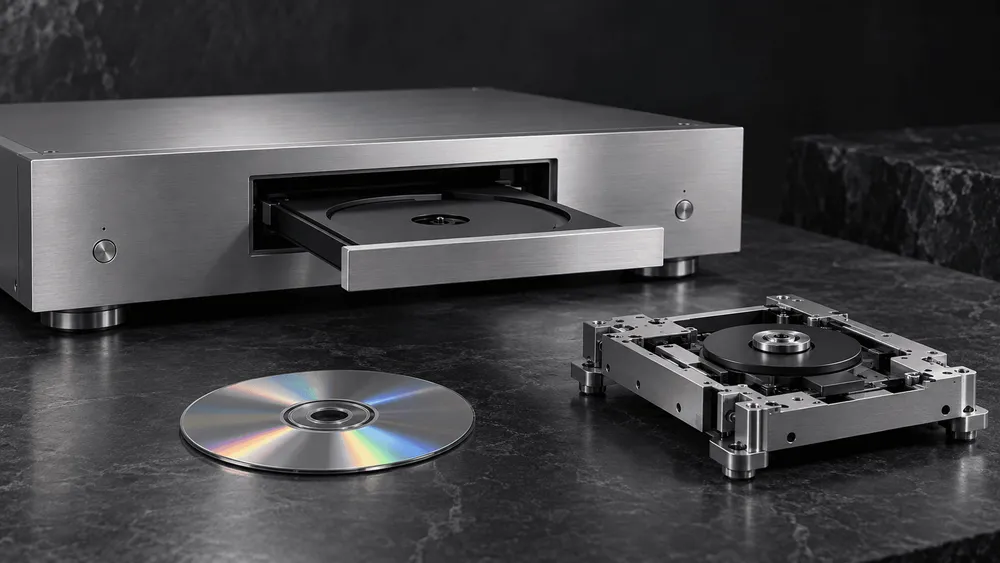
PS Audio's high-end SACD transport has ended new production, and Naim's Uniti Star has been reworked into the Star Lite, which can neither play nor rip CDs. Both companies point to the same underlying problem: they could no longer source an optical drive suited to the product. The issue, which surfaced in 2026, shows that even high-end audio products depend on components bought from outside suppliers. Still, drive mechanisms for CDs are still being offered for supply, so to understand why replacements are difficult, it helps to separate the mechanism that moves the disc, the control board that handles playback, and SACD support.
PS Audio ends production; Naim removes CD
PS Audio states on its official product page that it ended new production of the PMG Signature SACD Transport in 2026. A transport is a device that reads music data from a disc and passes it to an external DAC, which converts the digital signal into analog audio.
On January 30, the company's Paul McGowan explained on the official forum that a suitable drive was unavailable. He added that developing a disc-drive mechanism in-house would go far beyond the company's technical scope. Even a manufacturer strong in electronics and software cannot necessarily build the optical mechanism itself.
The sourcing difficulty had been visible for some time. On June 17, 2024, in a thread about D&M drives, McGowan wrote that the company needed to place a final order, and that the price of the mechanism had doubled. The plan, he said, was to secure stock through a large purchase to cover warranty service and new production. What doubled was the price of the mechanism the company buys, not the price of the whole CD player.
At Naim, as of February 26, 2026, the situation was still a "production pause." Richard Dane, who manages the official forum, said after hearing from Naim that the company was considering fitting an alternative drive or a broader redesign. Then, on August 26, he said that the Star Lite had been configured without the CD playback and ripping mechanism, giving the inability to source a CD drive suitable for the Star as the reason for the change.
In short, one company ended a dedicated disc player, while the other removed disc functions from an all-in-one unit. Naim's supplier has not been confirmed, so it cannot be said that the two companies lost the same part.
Why switching drives means a redesign
Products using optical drives contain a loader that moves the disc in and out, an optical pickup that reads information with laser light, and a control system to run them. The component maker SUOS-HiFi's development kit combines a loader with a servo board and an interface board, and the full version adds a control board and keys. Buying the mechanism does not give you something that simply plugs into a finished product.
SUOS's CD-84/CD-88 specification sheet shows that the board carries servo control, circuitry for processing the data that is read, and a microcontroller. The product sends commands and processes the returned information to fit its display. So when moving to a different set of parts, not only dimensions and mounting but also compatibility with the product's control software must be verified. The "redesign" Naim was considering can be understood as this kind of combination problem.
PS Audio has a precedent for changing mechanisms and relaunching a product. In its November 2020 announcement of the PerfectWave SACD, the Japanese distributor Kanjitsu explained that the earlier DirectStream Memory Player had ended production because of a drive-mechanism supply problem. In response to customer demand, the mechanism was renewed and disc-player sales resumed. Changing suppliers can extend all the way to moving to a new product.
Behind this is also a shift in mass-production demand larger than the specialist audio market. In May 2025, dCS's AndrewS explained that the mass market for music CDs and the PC market distributing software once supported mechanisms' production scale. Compared with that scale, the enthusiast specialist market is extremely small, he said. Being able to build an expensive finished product is a different condition from being able to sustain mass production of its internal parts.
Even with CD parts available, SACD machines can't simply be replaced
SUOS advertises mass-production availability for its slot-loading JPSL-33 loader. However, the company's FAQ states that even though the optical pickup could theoretically support SACD, the company's servo board does not.
Even a CD mechanism that SUOS lists as available for mass production cannot play the SACD layer with the company's servo board.
Checking parts supply against playback functions using the manufacturers' public information reveals the differences.
| Stage checked | What the public documents say | What it tells us |
|---|---|---|
| Loader supply | SUOS lists the JPSL-33 as available for mass production | CD mechanism supply has not vanished across the board |
| Control board function | SUOS FAQ states its own servo board does not support SACD | The optical parts' capability alone does not determine whether SACD playback is possible |
| Layer actually played | The CD-84/CD-88 spec sheet covers the "CD layer" of hybrid SACDs | Being able to play a disc does not mean the SACD layer is being read |
| Functions the finished product offers | PS Audio's PMG outputs the SACD DSD layer to the company's DAC via I²S | A swap to a CD playback system cannot maintain the same function |
The table compares the SUOS product page and FAQ checked on September 21, 2026, page 13, "4.1 Media," of the June 2020 spec sheet, and the PMG's official specifications. It is not the result of testing part compatibility on actual units, and a "mass production available" listing is not a guarantee of immediate delivery or long-term supply.
There is a clear difference between being able to read the CD layer of a hybrid SACD and being able to extract the audio from the SACD layer. For a product like the PMG, which sends the SACD's DSD signal to an external DAC, that path must be preserved as well. A disc that spins and produces sound does not make an equivalent replacement.
It has not been confirmed that SUOS parts were candidates to replace those used by Naim or PS Audio. But this comparison gives a concrete answer to the question, "If CD parts are on sale, why not just use them?" What is needed is a combination of parts that fulfills the playback functions the product promised.
After production ends, repair stock is what supports owners
On July 26, 2024, dCS explained that for the Rossini Transport and Vivaldi Transport II, which use D&M mechanisms, it had secured the stock needed for new production and ongoing service. Even if a parts supply policy changes, secured stock leaves room to keep producing and repairing finished products. However, that explanation dates from that time and does not indicate current stock quantities or how many years repairs will remain possible.
There is also a difference between parts remaining and development and maintenance continuing. According to SUOS's FAQ, the older CD-80 board continues to be supplied for existing units, but code maintenance has ended and it recommends the CD-88 for new development. Judging long-term use based only on the information that something is "available" can overlook such conditions.
For owners, the practical questions are which parts their model needs for a repair and whether the manufacturer or distributor can handle the replacement. If considering a replacement purchase, the candidates change depending on whether you want to play standard CDs or the SACD layer, and whether output to an external DAC is required. One cannot assume a product is unrepairable just because it is marked as discontinued, nor rest easy about the future just because past statements mentioned repair stock.
In his January explanation, McGowan also indicated an intention to try to release a new transport in 2027. But it would not be the PMG and might be in the Stellar line, he said, a stage that is not a commitment to launch. When a successor appears, it will be worth checking how its playback scope, including SACD, and its maintenance terms are presented. If it suits your discs and playback setup, you can keep listening to your music collection through this generational change in parts.