


On October 5, 2026, OpenAI announced that it will test a new ad format in ChatGPT that promotes products and services with images while a user's image is being generated. The test will begin in the US in late October with an initial group of advertisers. OpenAI says the ads will be clearly distinguished from the image being generated and will not affect the content of ChatGPT's answers.
OpenAI is also expanding its integrations with external measurement services so that it can gauge whether ads lead to actual purchases or sign-ups. The change turns the wait for an image to generate into a new point of contact with products, while also extending the system for evaluating how much those ads achieve.
Waiting for image generation becomes a new ad slot for showing products
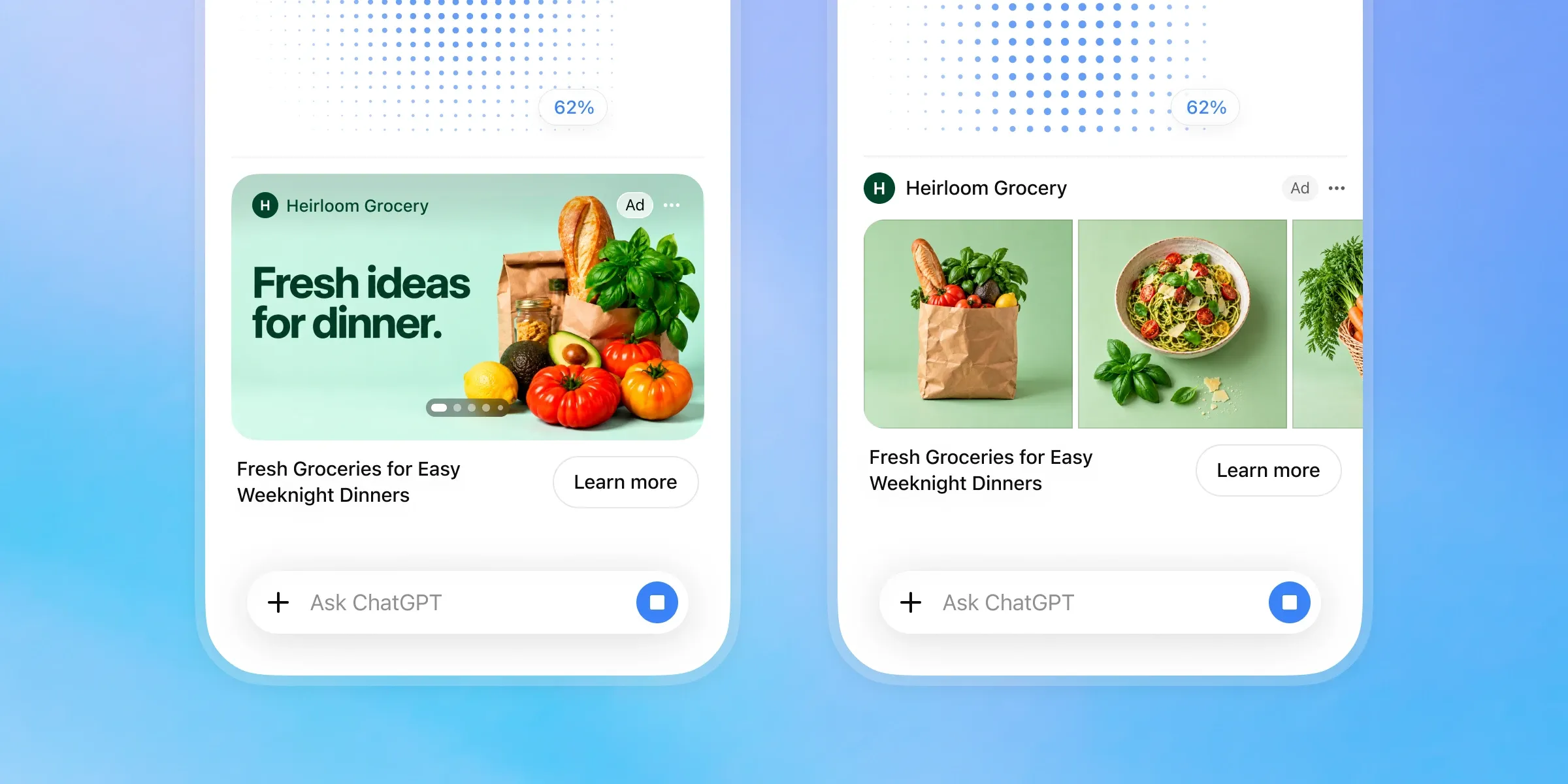
In the sample screens OpenAI released, ads from a grocery brand appear beneath the progress indicator for image generation. One is a carousel that switches between multiple photos; the other lays several product photos out side by side.
Both carry an "Ad" label and a button for finding out more. Rather than drawing products into the image the user requested, the format creates a separate ad slot on the screen where the user is waiting for the image to be generated.
Image ads can convey not only how a product looks but also the situations in which it is used and the experience it offers. For example, if someone is thinking about a dish and sees photos of ingredients, they may find it easier to imagine how to use them than with a text-only link.
OpenAI's aim with this format is to increase those encounters with products. However, not all image generation is done with shopping in mind. How naturally ads can be presented to users who are waiting for an image for creative or work purposes is one of the things this test will need to determine.
It would also be inaccurate to read this as the first time ChatGPT has introduced ads with images. The official help page for advertisers explains that existing ads can already use image assets.
What is new is that the period while an image is being generated becomes an ad placement, allowing products and services to be promoted more visually.
What has been published so far is the test schedule and sample screens. The actual frequency of display and the number of participating advertisers have not been disclosed. It is also unclear whether the wait for image generation will be deliberately lengthened in order to show ads.
Using a wait that already occurs for ads and lengthening the wait in order to show ads need to be evaluated separately.
Product suggestions in shopping search and paid ads are separate systems
ChatGPT already has a feature that responds to shopping questions with product photos, detailed information and links to sellers.
In its explanation of shopping search, OpenAI says these product results are selected independently by ChatGPT, are not paid ads, and are not ranked according to partnerships between OpenAI and merchants.
As a result, the mere appearance of product photos lined up side by side does not tell you whether they are paid ads or ordinary product suggestions from shopping search.
Ordinary product suggestions are chosen based on information such as the user's question, the context of the conversation and prices. Paid ads, on the other hand, are delivered by taking into account what the user is trying to do in the current conversation, along with relevance to the advertiser's information, bid amounts and other factors.
According to OpenAI, the ad delivery system operates separately from the model that generates answers, and advertisers cannot change the content of answers or the ranking of product suggestions.
Image generation itself is already moving closer to shopping features. In current shopping search, for clothing and accessories, users can choose virtual try-on and generate an image of themselves wearing the item using their own photo with ChatGPT Images.
However, that image does not perfectly reproduce the product's appearance, nor does it guarantee that the actual size will fit.
Here too, generated images, product suggestions selected based on a question, and paid ads need to be treated as separate systems.
Even if answer generation and ad delivery are technically separated, products shown on screen can still influence users' choices. Ads, after all, are placed in the expectation of exactly that influence.
What matters for users is being able to tell why a product is being shown. In evaluating the new format, it will be important not only to look at the quality of generated images but also whether the ad label is prominent enough and whether ads are confused with ordinary product suggestions.
Purchases after seeing an ad and purchases created by an ad are different things
The Pixel and the Conversions API, which measure outcomes such as purchases and sign-ups, are already offered as the measurement foundation for ChatGPT ads.
OpenAI said that, through integrations with Hightouch, Tealium and LiveRamp, it will make it easier for companies to send purchase and other data from their existing systems. Support for external ad measurement services will also be broadened.
If ad slots that capture attention with images are being increased, a mechanism for measuring what users do afterward is also needed.
However, outcomes after a click, outcomes after a view, and outcomes newly created by an ad are not the same thing.
Organizing the explanation in the ad measurement blog that OpenAI published on October 5 in terms of the relationship between ad exposure and purchases gives the following:
| What is measured | How a purchase is linked to the ad | What it tells you |
|---|---|---|
| Post-click outcomes | Actions occurring within a set period after an ad is clicked are attributed to the ad | Purchases and other actions after a click can be counted, but the person would not necessarily have failed to buy without the ad |
| Post-view outcomes | Outcomes occurring within one day of an ad being shown are attributed to it, even without a click | Ad exposures other than clicks can be captured, but it cannot be asserted that the ad impression caused the purchase |
| Incremental effect of ads | The difference from a scenario with no ads is estimated, for example through experiments that split regions | The outcomes newly added by ads can be estimated, but results depend on experimental conditions and estimation methods |
The first two deal with attribution: which ad a purchase that occurred should be linked to. The last, incremental effect, by contrast, estimates how many purchases would not have happened without the ad.
This table organizes the differences in measurement methods that OpenAI has published; it does not compare results between advertisers or brands. OpenAI itself says that measuring incremental effect is still at an early stage.
The figure of "52.7%" in the blog is also important for understanding this distinction.
According to OpenAI, in an initial analysis of campaigns worldwide optimized for outcomes such as purchases, 52.7% of the post-view outcomes within one day of an ad being shown that met the measurement conditions occurred within one hour of the ad being shown.
This does not mean that 52.7% of people who saw an ad made a purchase. Nor does it mean that ChatGPT ads generated 52.7% of all purchases.
The denominator is the post-view outcomes that were linked to an ad impression in measurement.
Image ads may influence later purchase decisions even if they are not clicked on the spot. Post-view measurement helps capture such exposure, but whether sales have truly increased because of ads must be verified by other methods.
For advertisers evaluating ads shown during image generation, it matters not only to look at impressions and click-through rates but also to know up to what period purchases are counted as outcomes and by what method the ad's contribution was measured.
Conversations are not handed to advertisers, while purchase data is sent to OpenAI
OpenAI says it does not provide advertisers with conversation content, chat history or memories, and that it provides ad results as aggregated information that does not identify individuals.
On the other hand, data for measuring purchases and other actions that come via ads is sent from advertisers to OpenAI.
In other words, a mechanism by which user conversations are passed to advertisers and a mechanism by which purchase data after viewing an ad is sent back to the ad platform are separate, and the direction in which data flows differs.
Under the Conversions API specification, a company sends event information such as purchases from its servers, and can optionally add hashed values such as email addresses to improve the accuracy of matching with ads. IP addresses and browser information are also defined as optional fields.
This explains how ad results can be measured without showing advertisers the conversations themselves. It does not, however, mean that no data is exchanged for ad measurement.
OpenAI states that, at present, it does not use data collected through the Conversions API to personalize ads for individual users.
There are also differences in user-side settings. According to the help page on ads, even if ad personalization is turned off, ads related to the content of the current conversation may still be shown.
A setting that stops past chats and memories from being used to select ads is not the same as an option to not see ads at all.
Under the current system, ads apply to Free and Go, and are not shown on Plus and Pro. Business, Enterprise and Edu are also exempt from ads.
Depending on region and conditions of use, users may be able to stay on Free with no ads, but in that case message limits are lowered and some features, such as image generation, may become unavailable.
For people who use image generation frequently, the choice to avoid ads has to be weighed against the features and usage allowances available to them. The announcement did not say that this existing system itself will change.
The new format starts in the US, on an ad platform that now spans more than 60 countries
ChatGPT ads began testing in the US on February 9, 2026, and by the August 11 update had been introduced in Japan as well. On September 23, OpenAI announced that with expansion to Southeast Asia and Taiwan, ads were available in more than 60 countries.
However, the fact that regular ChatGPT ads already appear in Japan is separate from whether the newly announced "ads during image generation" will start in Japan too. No start date for the new format in Japan has been given.
The advertising business itself has already grown beyond the stage of selling slots on a trial basis to a small number of advertisers.
In its August 31 announcement, OpenAI said the ad business reached an annualized revenue of $1 billion in under 200 days from launch, and that cost-per-click (CPC) and outcome-focused bidding make up the majority of campaigns.
Annualized revenue converts the current pace of sales into the scale it would reach if sustained for a year; it does not mean $1 billion in revenue or profit was actually recorded over a full year.
The figure of 1.2 billion weekly users given in the October 5 announcement likewise indicates the scale of ChatGPT's overall user base. It is neither the number of people who see ads nor the number of people the new format will reach.
Separating the figures on business scale from this limited test starting in the US, OpenAI's aim appears to be adding a new place to show ads, along with the means to evaluate them, to an ad platform that is already expanding.
OpenAI is also working with DoubleVerify and Integral Ad Science to develop tests that evaluate whether ads are displayed in environments that meet brands' standards.
Rather than accessing real personal conversations, the plan is to evaluate how ad safeguards work in a controlled test environment.
This is an effort to assess the safety of placement environments for advertisers; it is not an announcement that a third party has demonstrated that ads do not affect the content of ChatGPT's answers.
Once the new-format test begins in the US, two things will be worth watching: how much ads can actually be shown to increase purchases, and whether users can properly tell generated images, ordinary product suggestions and paid ads apart.
If OpenAI can measure contributions to purchases while keeping that distinction clear, an ad format that turns the wait for image generation into a new point of contact with products could become part of the ChatGPT shopping experience.