

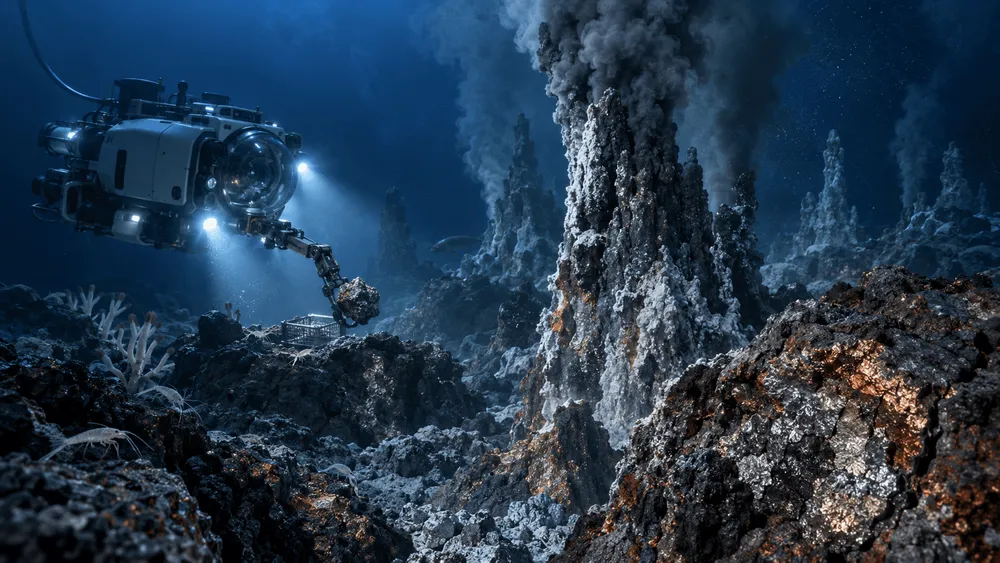
A joint expedition led by China's Tsinghua University and other institutions has found a hydrothermal deposit rich in gold and silver on the floor of the western Pacific. Initial analysis of partial samples shows gold reaching up to 15.4 grams per tonne of ore and silver up to 1,271 grams. China Central Television (CCTV) reported the findings on September 11, 2026, and the South China Morning Post (SCMP) followed on the 13th. Bringing back physical samples from a seafloor where high-temperature hydrothermal fluids vent, and measuring their metal concentrations, is a significant step. But peak concentrations alone cannot establish the total quantity of the deposit or whether it would be economically viable.
High gold and silver concentrations confirmed in partial samples
The expedition left Shenzhen on August 10 aboard the research vessel Xiangyanghong 10 and carried out seven dives over an 18-day voyage. Participants included Tsinghua University, the Qingdao Institute of Marine Geology of the China Geological Survey, and Shanghai Jiao Tong University. The newly identified deposit reportedly consists of three large cone-shaped ore bodies.
The main minerals are chalcopyrite, pyrite, and sphalerite, and the gold and silver were found in association with ore containing them. This is not a story of lumps of pure gold lying on the seabed; it is a sulfide deposit containing multiple metals. According to SCMP's report, richness in gold and silver is what distinguishes this discovery.
Converting the shipboard analysis figures reported by CCTV into weight per unit of ore gives the following:
| Metal | Peak concentration in partial samples | Equivalent per tonne of ore |
|---|---|---|
| Gold | 15.4 ppm | 15.4 grams |
| Silver | 1,271 ppm | 1,271 grams (1.271 kilograms) |
One part per million by mass equals 1 milligram per kilogram of ore, or 1 gram per tonne. The values in the table are conversions of the maximum values reported for each metal. Neither CCTV nor SCMP has said whether the maximum gold and silver values were recorded in the same sample.
A maximum value also differs from the average grade of the whole deposit. Grade refers to the concentration of metal in ore, and even when a sample with a high content is found, separate surveys are needed to learn how much ore of similar concentration extends around it. CCTV also says the average concentrations exceed those of land-based deposits, but the average figures themselves and the conditions of the deposits used for comparison have not been disclosed, so there is not enough information to compare it numerically with a land-based gold mine.
Metals gathered by hydrothermal fluids, sampled on the seafloor
In more than a dozen surveys before this one, dozens of high-temperature hydrothermal vents had been found in this area at depths of roughly 700 to 1,500 meters. The temperature of the venting fluid reportedly exceeds 315°C at its highest. That is not the temperature of the sea as a whole, but a measurement of hot water emerging from vents on the seafloor.
Hydrothermal fluids play a role in concentrating metals. According to an explanation of seafloor hydrothermal deposits from the Japan Organization for Metals and Energy Security (JOGMEC), seawater that seeps beneath the seafloor is heated by magma and other sources and picks up metal elements from the crust. When the hot water that vents onto the seafloor is cooled by the surrounding seawater, the metals precipitate and build up into deposits. The gold and silver in this case were likewise confirmed within sulfides associated with this kind of hydrothermal activity.
In this expedition, researchers examined in detail hydrothermal areas already known from preliminary surveys and analyzed samples obtained on site aboard the ship. Analysis to confirm ore composition was thus added to surveys that locate vents and measure fluid temperatures. The maximum gold and silver concentrations come from the analysis results of these partial samples.
On location, CCTV describes the site as a back-arc basin in the western Pacific within China's exclusive economic zone (EEZ). A back-arc basin is a basin lying behind an island arc. However, according to SCMP, the exact coordinates have not been released, and no information has been provided from which a specific sea area name or mining-claim boundary could be determined.
From high grades to recoverable resources
In 2017, Japan successfully carried out a pilot mining and ore-lifting test targeting seafloor hydrothermal deposits at a depth of 1,600 meters off Okinawa. According to JOGMEC, the test involved continuously lifting ore excavated and collected on the seabed to the surface together with seawater, using a submersible pump and a lifting pipe.
Whereas China's expedition involved taking samples and examining their composition, that test dealt with the process of continuously transporting excavated ore to the sea surface. Producing metal from the seabed requires not only reaching the deposit but also making a full sequence of operations work: excavating, collecting, and lifting the ore. Japan's successful test does not prove that this Chinese deposit can be developed profitably.
To evaluate a deposit's scale as a resource, the average grade across the whole deposit and the quantity of ore are essential. Only after estimating how much of the contained metal can be recovered can the metal yield be weighed against costs. If one simply applied the peak grade to the entire deposit and multiplied by the gold price to arrive at a total value, the estimate could be badly wrong from the very first stage.
What has been released are the voyage results as relayed through media reports and preliminary shipboard analysis. The reports give no average grade or total ore tonnage for the deposit, and no peer-reviewed paper detailing sample numbers and measurement errors has been identified. The assessment of high development value from Song Shiji, deputy dean of Tsinghua University's Ocean Engineering Institute, as relayed by SCMP, should be read in light of this research stage.
Song also points out that the biological communities living in active hydrothermal areas have scientific value too. Metal-bearing rock and organisms adapted to extreme environments become research subjects in the same place. If data become available to confirm the extent and average grade of the deposit and to examine mining and lifting costs and the impact on biological communities, the discovery of highly concentrated gold and silver could advance into material for judging whether development should proceed.