

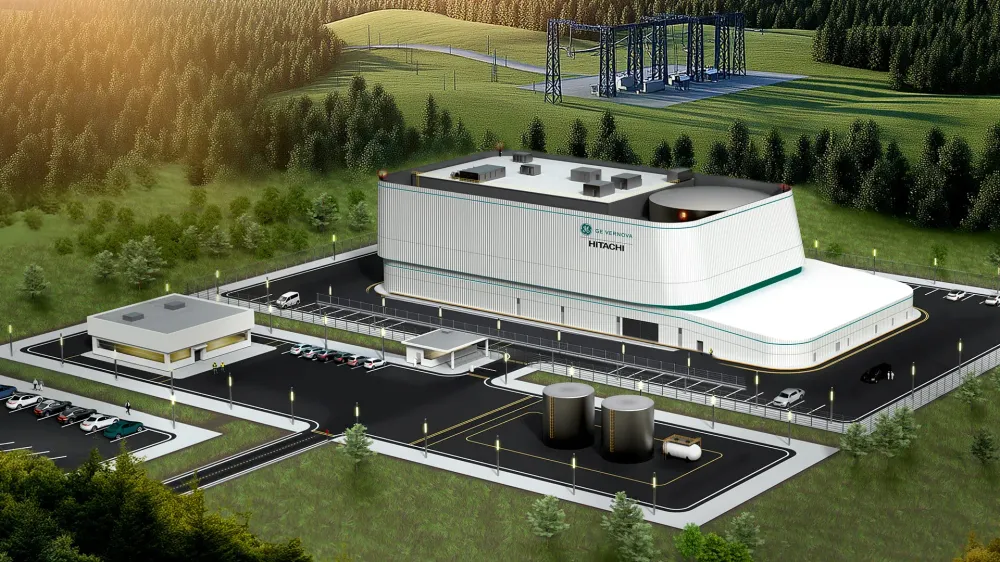
On September 29, 2026, the US Nuclear Regulatory Commission (NRC) announced that it had issued a construction permit for Clinch River Unit 1, a reactor the Tennessee Valley Authority (TVA) plans to build in Tennessee.
The plant will use the BWRX-300, a small modular reactor (SMR) with an electrical output of about 300 MW. It is the first construction permit the NRC has issued for this reactor type.
The BWRX-300 simplifies its equipment by relying on natural water circulation, and it has now cleared the regulatory review needed to move toward actual construction in the United States. However, no construction start date had been set as of the announcement, and TVA will need a separate NRC license before it can load fuel or begin operation.
To turn the design advantages of a smaller, simpler reactor into a working power business, it is not enough to establish safety. The construction schedule and cost sharing also have to be made concrete.
First US construction permit for the BWRX-300
The permit covers Unit 1, planned at Clinch River near Oak Ridge, Tennessee.
The BWRX-300, developed by GE Vernova Hitachi Nuclear Energy (GVH), is a scaled-down boiling water reactor with a simplified equipment layout and simplified safety systems.
The 300 MW figure is the planned electrical output. It is not a generation record that has been confirmed at the site.
According to the NRC announcement, the review formally began in July 2025 and reached a permit decision in 14 months.
A safety evaluation completed in June 2026 concluded that TVA's construction permit application met regulatory requirements, and a hearing was held in Oak Ridge in August.
The approval means the application has passed through this review and reached the stage where construction of the reactor is authorized.
The NRC also states plainly that, regarding fuel loading and operation, "TVA must obtain a separate operating license from the NRC before loading fuel and beginning operation."
In other words, permission to build a reactor and permission to operate the finished plant are separate procedures.
Nor should "first in the US" be read to mean that the BWRX-300 is the first to be built anywhere in the world.
According to GVH's announcement of the same day, a construction permit for the first BWRX-300 was issued in April 2025 at Darlington, Canada, where work is already under way.
The operator, Ontario Power Generation, applied for an operating license in March 2026, and that application is also under review.
Even in Canada, which is ahead, construction progress and approval to begin operation need to be considered separately.
Why natural circulation lets the design use fewer pumps
The BWRX-300 uses differences in water density caused by temperature to circulate water through the reactor core.
According to GVH's design explainer, water and steam rise through a chimney-like structure in the center of the reactor vessel, while cooler, denser water descends on the outside and returns to the core.
The design is intended to let water circulate naturally through this density difference and the height differences inside the reactor vessel.
This makes it possible to omit large mechanical pumps for circulating water through the core.
The manufacturer's aim is to reduce the electricity and maintenance needed to run pumps, and to have fewer moving parts that could fail.
That does not mean the plant as a whole needs no power. Nor does this permit supply operating experience showing how much reliability or operating cost will actually improve.
The design also incorporates an approach that reduces reliance on electrical power and continuous operator action for accident cooling.
GVH explains that even if all AC power is lost, passive safety features can maintain a safe condition for seven days without external power or operator action.
The design uses heat exchangers placed in a pool inside the seismically robust reactor building to remove heat generated after shutdown.
Hitachi GE Vernova's Japanese product page likewise says the reactor can be cooled for seven days without AC power or human intervention.
The "seven days" here refers to the design period over which heat generated after reactor shutdown can be removed and a safe state maintained.
It does not mean the plant can keep supplying electricity for seven days when external power is cut off.
Safely cooling a reactor during an accident and continuing to deliver stable power to the grid are different capabilities and must be evaluated separately.
This news is based on the NRC's licensing announcement and design materials published by the manufacturer. It is not the announcement of new experimental results from a peer-reviewed paper or preprint.
The natural circulation and seven-day cooling claims are likewise not measurements from operating the Clinch River unit, nor results of third-party demonstration tests.
For now, they should be understood as safety functions that hold under the conditions assumed in the design.
What remains between the construction permit and power generation
In its September 29 announcement, TVA has not yet announced when construction will begin.
It also said it is continuing negotiations with industry partners on how to share the costs of design and construction.
In other words, even after obtaining the NRC construction permit, decisions remain that go beyond regulatory procedure and concern how to actually carry the project forward.
The situation as of September 29, 2026 can be summarized as follows.
| Item to check | Status shown by the Sept. 29 announcements | Source |
|---|---|---|
| Construction permit | Approved for Clinch River Unit 1 | NRC announcement |
| Operating license | Separately required before fuel loading and start of operation | NRC announcement |
| Construction start date | Not announced | TVA announcement |
| Sharing of design and construction costs | Under negotiation with industry partners | TVA announcement |
This table sorts what the NRC and TVA announced on the same day into regulatory procedures and business conditions.
It is not an estimate of the completion date or of the total future project cost.
Obtaining a construction permit does not automatically settle other conditions such as the start of construction, the operating license, or cost sharing.
TVA explains that manufacturing the main components of small modular reactors in factories and assembling them on site may help shorten construction schedules and cut costs.
GVH likewise aims to limit construction complexity by simplifying equipment and drawing on technology and experience accumulated with existing boiling water reactors.
However, no construction start date has yet been announced for Clinch River.
For now, these should therefore be treated as benefits that TVA and the manufacturer expect, distinct from any record of actually reducing construction time or cost at this plant.
Faster regulatory review, a reactor design with less equipment, and factory manufacturing of components each address a different challenge.
The NRC finishing its review in 14 months does not mean the construction itself will also be completed quickly.
Similarly, a design that can reduce core-cooling pumps does not by itself show that the economics of the whole plant are favorable.
The cost-sharing negotiations TVA is now pursuing will be an important condition for making the BWRX-300 viable as a commercial power project.
Once the construction start and cost sharing become concrete, it will be easier to judge the terms on which TVA proceeds.
And once construction is finished, the separately required operating license is obtained, power generation begins, and construction costs and operating performance become known, it will be possible to verify concretely how much the BWRX-300's simple design improves schedule, cost and safety.