

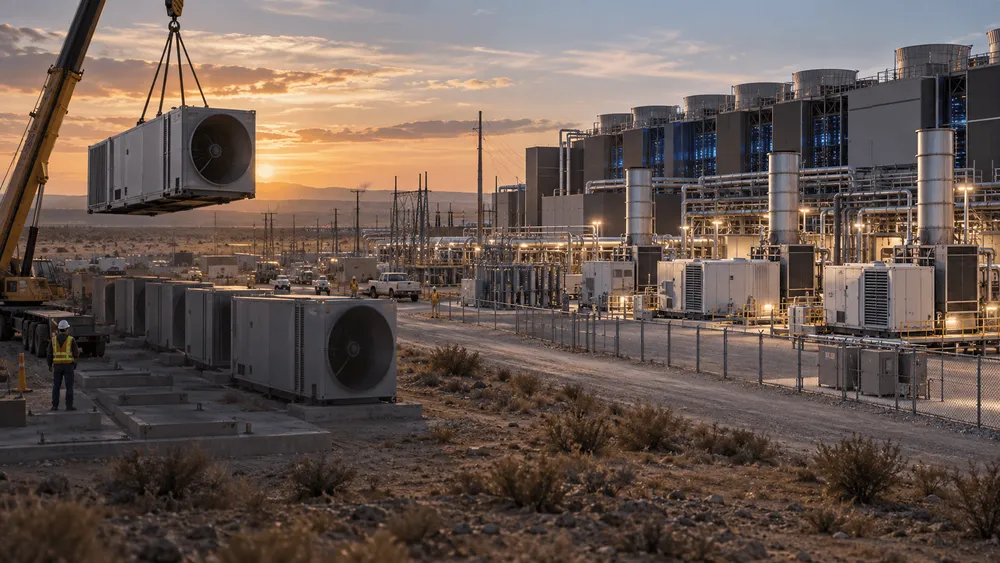
AI data center developer Crusoe has called off its plan to deploy 29 units of Boom Supersonic's natural gas turbine, "Superpower." TechCrunch reported the news on September 25, 2026, based on a post by Boom CEO Blake Scholl on X and an interview with Crusoe's PR team. The planned generation capacity totaled 1.21GW, and according to TechCrunch, the contract was valued at $1.25 billion.
However, this does not mean Crusoe has halted construction of its Abilene data center or abandoned natural gas-based self-generation. The company has ordered roughly 1GW of generation equipment from GE Vernova and has also signed a contract with Bergen Engines. What has occurred is not a reversal of its power-securing strategy itself, but a reconsideration of which equipment and suppliers to adopt.
Rather, the greater impact falls on Boom. Boom had planned to use this large-scale deal as a springboard to begin mass production of Superpower, accumulate real-world operational data, and use the resulting revenue to help fund development of its supersonic airliner, "Overture."
How much of the $1.25 billion plan has actually been scrapped?
In December 2025, Boom announced Crusoe as Superpower's first customer. Each unit has an ISO-rated output of 42MW, and 29 units together would total 1.21GW. Boom explained that the equipment fits within a footprint roughly the size of a shipping container, requires no water, and can maintain its rated output even when outside temperatures exceed 110°F. Initial deliveries were scheduled to begin in 2027.
What has now ended is the partnership premised on the initial delivery to Crusoe. In his post on X, Scholl explained that since Superpower was no longer part of the main power configuration to be built out at Crusoe's Abilene site and elsewhere, there was no longer reason to continue the partnership. Crusoe also told TechCrunch that it currently has no business relationship with Boom, and that it selects the appropriate combination of gas turbines, wind, solar, batteries, and grid power on a site-by-site basis.
That said, the contract figure requires careful interpretation. TechCrunch reported that Crusoe had planned to pay $1.25 billion for the 29 units. Meanwhile, Boom's official announcement described its overall Superpower backlog as "more than $1.25 billion," without explicitly stating that this entire figure referred to the Crusoe contract.
The terms of the contract termination, any penalty fees, and amounts already paid have not been disclosed. As a result, it cannot be concluded that the full $1.25 billion has simply vanished from Boom's confirmed revenue.
Crusoe hasn't abandoned gas turbines
Crusoe varies its power mix depending on the role and conditions of each data center. At its existing Abilene site, built for Oracle and OpenAI, the company ultimately plans to expand to 8 buildings and 1.2GW. Crusoe told TechCrunch that at this site, natural gas turbines are used as emergency and backup power, with the grid serving as the primary source under normal operation.
By contrast, the adjacent 900MW site being developed for Microsoft follows a different design. It combines two data center buildings with a dedicated on-site power plant, with the first building slated to come online in mid-2027. In a March 2026 announcement, Crusoe CEO Chase Lochmiller stated that the company would integrate 900MW of new on-site generation capacity.
While canceling the 1.21GW Boom deployment plan, Crusoe has secured roughly 1GW from 29 aircraft-engine-derived gas turbines ordered from GE Vernova. It has also contracted 438MW of generator sets with Bergen Engines, along with a preliminary agreement for an additional 310MW.
In other words, Crusoe is not withdrawing from natural gas-based self-generation itself, but is reconsidering the type of equipment, suppliers, and contract terms it uses.
| Supplier / Equipment | Announced Capacity and Configuration | Status as of Announcement | Timing / Use |
|---|---|---|---|
| Boom Superpower | 29 units, 42MW each, 1.21GW total | Initial deployment plan for Crusoe ended | Deliveries originally scheduled to begin in 2027 |
| GE Vernova LM2500XPRESS | 29 units, approx. 35MW each, approx. 1GW total | 10 units ordered December 2024, 19 units ordered June 2025 | For Crusoe's data centers. Starts in about 5 minutes, equipped with selective catalytic reduction |
| Bergen Engines generator sets | Contracted: 27 units at 12.5MWe and 20 units at 5MWe, totaling approx. 438MW; additional 310MW under preliminary agreement | 438MW contracted, 310MW under preliminary agreement | Phased delivery to multiple U.S. sites through 2027, planned for use as 24/7 primary power |
This table organizes publicly disclosed equipment types, capacities, contract status, and deployment timing, and does not directly compare pricing or generation efficiency. Boom's 1.21GW plan has already been terminated, and Bergen Engines' 310MW is not yet a formal contract at this stage. Additionally, since the equipment configurations and installation sites differ, the capacities of the three cannot simply be added together as figures of equal certainty.
Still, Crusoe's direction is clear. The company combines proven aircraft-derived gas turbines, gas engines suited for continuous operation, grid power, and batteries, matching them to each site's timeline and use case. Even though Superpower—whose first unit has yet to be completed—has fallen off the list of near-term power candidates, Crusoe's underlying strategy of securing its own power supply remains unchanged.
What Boom lost was more than just a large order
For Boom, Crusoe's 29-unit order carried significance beyond simply being a large generation equipment contract. Superpower shares core components—including high-pressure compressors and high-pressure turbines—with "Symphony," the aircraft engine being developed for Overture. Boom has explained that the power-generation version of Superpower replaces the aircraft's fan with an additional compressor stage and power turbine, and uses fuel nozzles designed for natural gas.
Boom had roughly three goals in mind.
First, to use the 1.21GW order as a foundation for establishing mass production of Superpower. As of December 2025, the company stated it had ordered equipment to achieve an annual production capacity of 2GW.
Second, to accumulate reliability data on the engine core shared with Symphony through extended turbine operation at the data center. And third, to use profits from the Superpower business to fund Overture's certification and aircraft development.
Fundraising was also tied to this business vision. Alongside the Superpower announcement, Boom raised $300 million, which it said would fully cover Symphony's development costs. It also outlined a longer-term vision in which ongoing revenue from the power generation business would help sustain aircraft development.
Having lost its first major customer, Boom will now need to reconsider its original plan of simultaneously pursuing sales opportunities, ramping up mass production, gathering data through extended operation, and securing revenue from the power generation business.
However, extended ground operation of a gas turbine does not automatically substitute for the certification testing required for an aircraft engine. What Boom has presented is a business concept aimed at both improving the reliability of shared components and building out manufacturing capacity. How much data obtained from ground operation regulators will actually accept for aircraft engine certification cannot be determined from the materials confirmed here.
Additionally, it is not currently possible to confirm from publicly available materials whether the engine core testing originally planned for completion in 2026, or Superpower's mass-production facilities, are actually operating as scheduled.
The next focus: roughly 250MW planned for 2027
While acknowledging the end of the partnership with Crusoe, Scholl stated that Boom plans to deliver approximately 250MW of Superpower to a different site in 2027, with a target of reaching 1GW by 2028. Using simple arithmetic based on the 42MW unit size, 250MW would correspond to roughly 6 units.
However, this "250MW" figure was presented as an approximate target, and details such as the customer name, the number of formally contracted units, installation location, and delivery terms have not been disclosed. At this stage, it is necessary to distinguish between confirmed orders and the delivery targets Boom has set out.
Whether Boom can get the Superpower business off the ground as planned, even after the end of its contract with Crusoe, will depend on future announcements of specific customer contracts, the results of Symphony's engine core testing, the start of operations for the first Superpower unit, and actual annual production volumes.
If the roughly 250MW planned for 2027 comes online as expected, Boom will be able to advance Superpower's mass production and real-world operation even with a different customer base. If it does not proceed as planned, however, the vision of using power-generation revenue to support Overture's development may require a reassessment of both funding plans and the development schedule.