

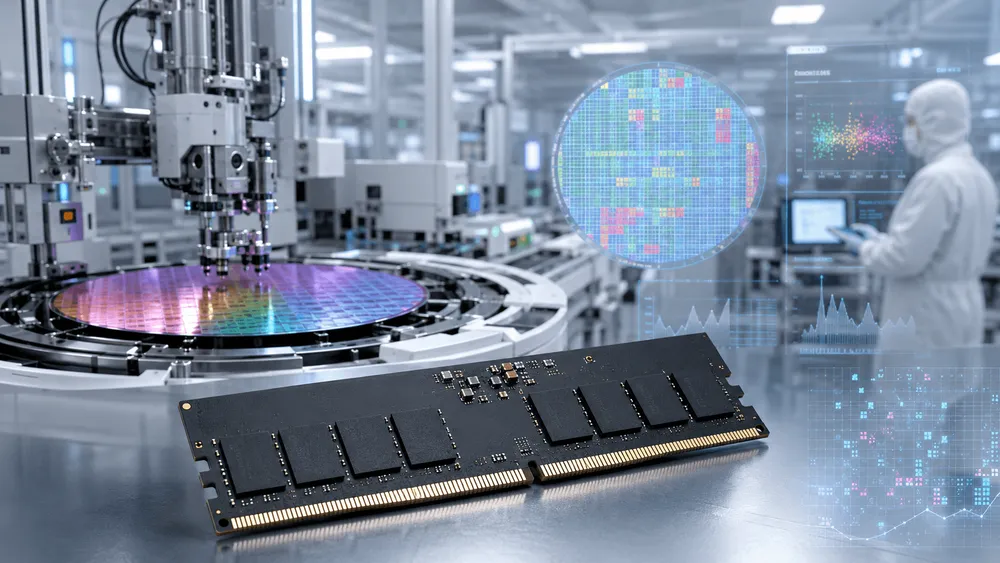
MyDrivers (快科技) reported on August 10 that the yield for DDR5 from Chinese DRAM maker CXMT (长鑫科技), described as 17nm-class, has surpassed 90%. This is not a disclosure from CXMT itself, but it is a report that may signal a shift in manufacturing conditions relevant to how far DDR5 mass-production products actually translate into supply.
However, the figure of 90% cannot simply be taken at face value as a measure of supply capacity. The article does not clarify which lots or time period were measured, nor whether the figure refers to wafer-process yield or post-packaging good-die rate. When compared against the products, factory utilization, and customer certification processes confirmed in official materials, manufacturing milestones and market adoption need to be tracked separately.
Yield reported to exceed 90%, but the definition remains unclear
On August 10, 2026, MyDrivers (快科技) reported that CXMT's 17nm DDR5 yield had surpassed 90%. The same article also reported that major PC makers had completed certification of CXMT-made DRAM by around mid-2026, and had begun shipping small volumes in some notebook PCs. Both the "17nm" designation and the "over 90%" figure cited here are expressions based on this outlet's reporting.
It was also MyDrivers (快科技) that reported an earlier yield figure. According to a December 2024 article, DDR5 yield had improved from an initial 40% to around 80%, with a target of reaching approximately 90% by the end of 2025. If the latest report is accurate, it suggests that CXMT may have at least reached that target level.
But even placing the two articles side by side does not clarify what exactly lies behind the "over 90%" figure. It remains unclear whether this applies to all DDR5 products or to a specific lot, and it is not a number that can be compared against competitors under any industry-standard, apples-to-apples conditions. While this latest report points to manufacturing improvement, there is no basis for treating it as an audited result or as an average across all products.
The meaning of "yield" changes depending on which process stage is measured and what counts as a "good" unit. A figure counting only wafer-process defects is not the same as one counting dies that have passed testing, sorting, and packaging. The MyDrivers article does not specify the denominator or the measurement stage. As such, the "over 90%" figure should be treated as a starting point for reading the state of the production line, not a number that can be directly converted into shipment volume.
What official materials confirm: mass-production products and utilization rates
CXMT's product page lists 16Gb and 24Gb DDR5 products with speeds up to 8000Mbps, citing servers, high-performance PCs, and tablets as applications. CXMT's IPO prospectus materials likewise list 16Gb, 24Gb, and 32Gb DDR5 as mass-production products with speeds up to 8000Mbps. While official materials position DDR5 as a commercially available product lineup, they do not mention a "17nm" designation or any yield figures.
According to the same materials, CXMT halted production of its own DDR4 and shifted to DDR5 from the end of 2024 onward. In 2025, revenue composition was 31.87% from the DDR series, 66.43% from the LPDDR series, and 1.70% from other products. However, the revenue share or shipment volume for DDR5 alone is not disclosed, so it is not possible to derive DDR5 supply scale from this revenue breakdown.
The IPO materials describe DDR5 mass production as based on the company's fourth-generation proprietary process technology platform. However, these materials do not use the term "17nm." It cannot be assumed that the "17nm-class DDR5" reported by MyDrivers is the same as the technology platform referenced in the official materials.
Factory-level figures also need to be read separately from yield. The capacity utilization rate for the entire 12-inch wafer line rose from 87.06% in 2023 to 92.46% in 2024 and 95.73% in 2025. Meanwhile, the production-to-sales ratio for major DRAM products on a capacity basis was 99.45%, 97.94%, and 90.67% in the same respective years. The former indicates how much equipment was operated, and the latter indicates how much of production volume was actually sold—neither figure corroborates the reported yield of over 90%.
Moreover, the 95.73% figure represents utilization across the entire 12-inch wafer line, not any specific DDR5 product. Likewise, the 90.67% figure is not a shipment ratio isolated to DDR5, but rather the production-to-sales ratio for major DRAM products on a capacity basis. While these official utilization and sales indicators offer clues about the company's operational status, they cannot be placed on the same axis as the yield figure reported by MyDrivers. Even though all these figures hover in the 90% range, capacity utilization, production-to-sales ratio, and the reported yield each refer to entirely different measures.
The same materials also state that, based on Omdia's Q4 2025 revenue rankings, CXMT held a 7.67% global DRAM market share, ranking fourth worldwide and first in China. This, too, is a revenue-based indicator covering all of DRAM—not a figure specific to DDR5 shipped bits or good-die rates. Mixing different denominators together risks making manufacturing progress and actual market sales appear to mean the same thing.
Certification and regional conditions shape PC adoption
CXMT's materials describe a process in which products move toward mass-production decisions only after passing through process verification, JEDEC inspection, customer verification, and certification. Between DDR5 being included in mass-production products and all PC makers adopting it across every region and every SKU lies this process, along with individual procurement decisions. Differences in capacity, speed, and module configuration change the reliability verification required and the procurement conditions that vary by region. Adoption scope is not determined uniformly.
MyDrivers reports that Acer and ASUS have limited their adoption of CXMT-made DRAM to products destined for mainland China and emerging markets, HP has limited adoption to mainland China, and Dell does not use it at all. The outlet also noted that certification had been completed and small-volume shipments had begun, but it did not disclose volumes, target SKUs, or the duration of adoption. Since this has not been confirmed through official announcements from each company, this adoption status should be understood as reporting from this particular outlet.
Here lies the gap that remains between yield and supply. A higher good-die rate can increase the number of shippable good units from the same wafer input, potentially improving per-bit cost and supply stability. But the actual number of bits that reach the market is determined by the volume of good dies that have passed testing, sorting, and packaging, combined with customer certification and allocation across different applications.
Even for DDR5 that conforms to standard specifications, differences in memory capacity, speed, and module design change the verification required on the PC side. Reports that a customer has completed certification do not, by themselves, indicate how broadly that adoption extends across different configurations. To gauge the true breadth of supply, one needs to look simultaneously at manufacturing-side yield and the specific configurations being selected on the product side.
Micron's published figures don't offer an apples-to-apples comparison
Micron describes its 1γ DRAM as increasing bit density per wafer by more than 30% compared to the 1β generation, and offering DDR5 speeds of up to 9200MT/s. The company also references process improvements involving EUV. By contrast, the maximum speed CXMT officially lists for its DDR5 is 8000Mbps—meaning the speed figures, process technology, and measurement conditions between the two companies are not aligned.
Therefore, the "over 90%" figure reported by MyDrivers cannot be treated as evidence that CXMT has caught up to Micron, nor as a basis for comparing performance superiority. Micron's 1γ description covers a technology generation encompassing bit density, speed, and EUV, whereas the figure reported for CXMT is a yield number whose definition remains undisclosed. The two companies' figures answer entirely different questions.
The over-90% yield reported by MyDrivers will only translate into actual supply capacity once the same definition can be confirmed to hold consistently across multiple lots over time, and once it can be verified that this is supported by rising shipped-bit volumes—following testing and sorting—and expanding adoption across region-specific SKUs.