


On July 17, 2026, DigiTimes reported that orders for China's major DRAM maker CXMT (ChangXin Memory Technologies) are booked through the end of 2027, with supply allocations being prioritized for major PC manufacturers. Dell, HP, and Apple were cited as likely allocation recipients, while smaller manufacturers may struggle to secure sufficient volumes. Neither the companies nor CXMT have disclosed individual contracts or quantities. Still, CXMT's listing documents reveal that its factory utilization rate rose to 95.73% in 2025. While there is hope that adopting Chinese-made DRAM could help avoid procurement difficulties, CXMT's existing equipment also has little spare capacity.
DigiTimes Reports "Orders Booked Through End of 2027"
According to DigiTimes, major PC manufacturers have completed verification of CXMT products, but passing verification does not guarantee that the required volumes will be allocated. This is because large customers can offer long-term contracts and substantial order volumes. The priority allocation to Dell, HP, Apple, and others mentioned in the report remains a projection, and the specific models and shipment volumes have not yet been disclosed.
Explanations from the PC manufacturers themselves also reveal that memory procurement has shifted from short-term price negotiations to securing multi-year supply. At its February earnings briefing, HP estimated that memory and storage costs had increased approximately 100% from the previous quarter, and would account for about 35% of PC component costs in fiscal year 2026—a sharp rise from 15-18% in the prior quarter. The company explained that it is securing necessary volumes through long-term supply contracts and preparing configurations with reduced memory capacity.
Dell also revealed at its May earnings briefing that supply negotiations with major customers now span 3, 4, and 5-year terms. In an environment where component prices are revised "almost daily," some customers are securing multi-year volumes in advance, anticipating future shortages. While this is not confirmation of specific contracts related to CXMT, both companies' explanations agree that the market has shifted to one where order volume and contract duration determine supply allocation. Smaller manufacturers find themselves at a disadvantage in terms of purchasable quantity even before price negotiation power comes into play.
95.73% Utilization Rate: Little Spare Capacity Even at CXMT
According to the prospectus CXMT submitted to the Shanghai Stock Exchange, the company operates three 12-inch DRAM fabs in Hefei and Beijing. The factory utilization rate rose from 87.06% in 2023 to 92.46% in 2024, and to 95.73% in 2025. This is a level at which absorbing large new demand simply by tightening downtime on existing equipment would be difficult.
CXMT's scale has also become non-negligible in the global market. Citing Omdia data, the prospectus states that CXMT's DRAM revenue share reached 7.67% in Q4 2025, ranking fourth globally. Meanwhile, the top three—Samsung Electronics, SK hynix, and Micron—held a combined share of over 90% for the full year 2025. CXMT has grown to a scale where it can expand its customer base, but it is not large enough to single-handedly absorb global PC demand.
CXMT mass-produces DDR5 at speeds up to 8,000Mbps, offering 16Gb, 24Gb, and 32Gb memory dies. Its LPDDR5/5X reaches up to 10,667Mbps. According to the development process outlined in the prospectus, after completing internal technical verification and JEDEC compliance testing, products move to customer verification, followed by certification and yield refinement before mass production decisions are made. Verification completion by PC manufacturers is merely the entry point for adoption; actual supply volumes depend on production plans and yield rates.
PC-Bound DDR5 and Two Major Sources of Demand
CXMT's mainstay in 2025 was mobile-oriented products. Of its core business revenue of RMB 61.28 billion (61,275,372,100 yuan), LPDDR products accounted for 66.43%, while DDR products used in PCs and servers made up 31.87%. The company halted production of its own DDR4 at the end of 2024 and has been transitioning its product line to DDR5. What PC manufacturers want is a share of this DDR5 supply, which is still in the midst of this transition.
Joining this demand are Chinese cloud service providers. Reuters reported on June 29 that CXMT signed a server DRAM supply agreement with Tencent worth over RMB 20 billion. The contract spans multiple years, though whether it includes HBM remains unclear. CXMT's prospectus also lists Alibaba Cloud, Tencent, and Lenovo among its key partners. There is no assumption that increased production will be redirected to PC-bound supply.
The trend of major customers signing long-term contracts has also spread to the global market. Micron announced on June 24 that it had signed 16 strategic customer agreements spanning data centers, consumer devices, and automotive applications. The typical contract term runs five years, from 2026 to 2030, with these 16 agreements accounting for approximately 20% of DRAM volume during that period. Because these contracts involve purchase obligations that lock in demand in advance, the volume available for non-contracted customers to purchase on an as-needed basis shrinks. The prioritized allocation reportedly occurring at CXMT is also a result of the broader memory industry's shift toward long-term contracts.
RMB 29.5 Billion Investment, But Completion Not Until 2028
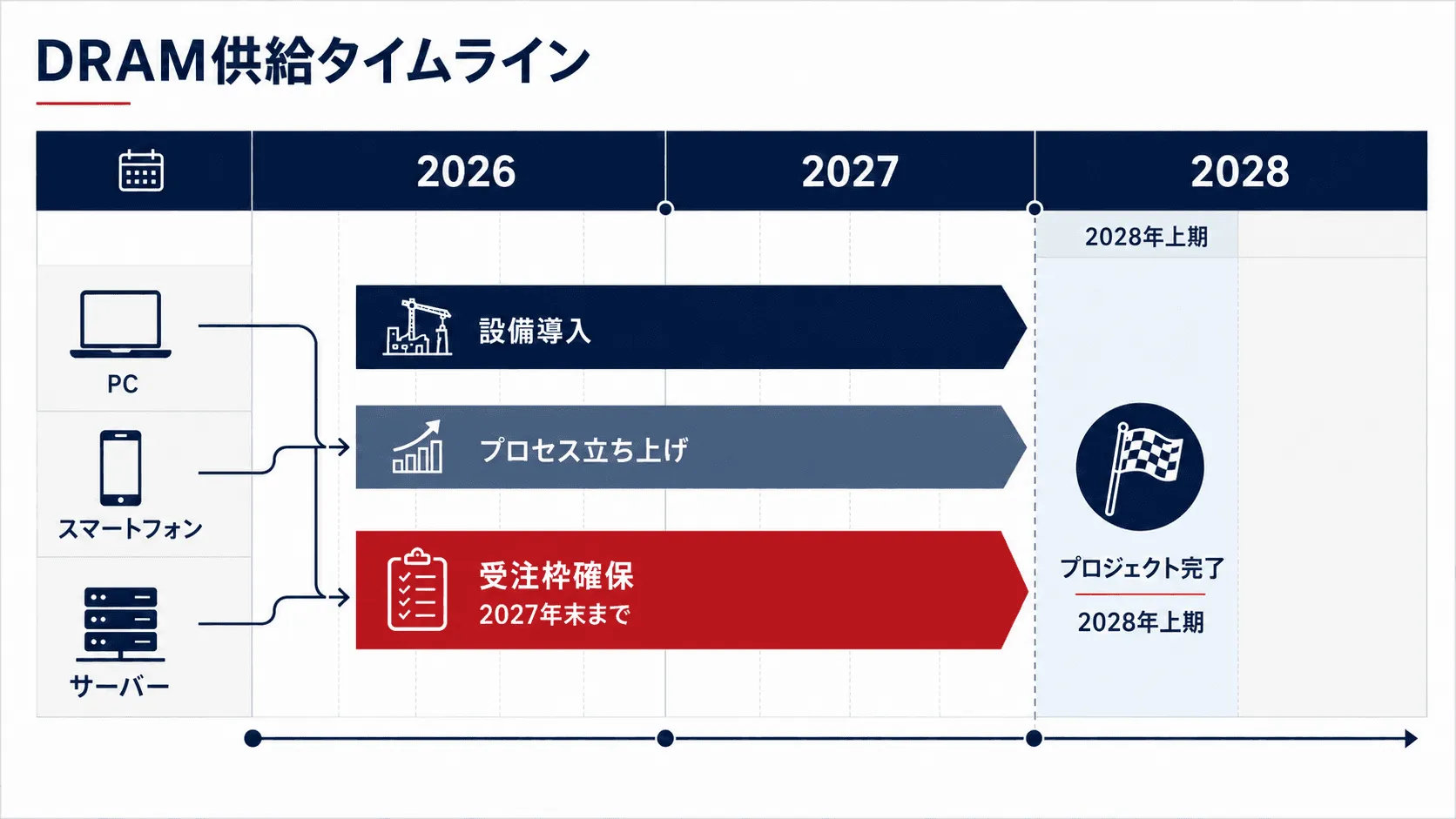
CXMT plans to allocate RMB 29.5 billion of the funds raised through its IPO across three business areas: RMB 7.5 billion for upgrading existing wafer mass production lines, RMB 13 billion for DRAM technology upgrades, and RMB 9 billion for future technology R&D. This is not a timeline where supply increases immediately once funding arrives.
For the two production line-related projects, equipment will be sequentially installed from 2026 through the end of 2027, with adjustment and operation proceeding thereafter. Completion and inspection are scheduled for the first half of 2028. Even for upgrades using existing factories, installing new equipment, building out processes, and product certification take years. Reuters reported that the combined capacity of the three existing fabs is approximately 300,000 wafers per month, with future plans targeting approximately 600,000 wafers per month, but also reported that DDR5 yields were low in Q1 2026. Even as wafer input volumes increase, the number of good bits that can be shipped does not increase at the same ratio.
Micron also expects that the tight supply-demand balance for DRAM and NAND will continue beyond 2027, with the timing of supply catching up to demand still uncertain. The company expects global supply improvement to begin only from 2028—coinciding with the timing of CXMT's factory upgrade completion. The report that orders are booked through the end of 2027 is consistent with this timeline if one considers that major customers secured volumes ahead of the full-scale production ramp-up.
Between the 1260H Designation and the Entity List
U.S. regulatory frameworks also factor into adoption decisions. CXMT was included in the U.S. Department of Defense's Section 1260H list of Chinese military companies, published on June 10.
Meanwhile, as of July 15, CXMT does not appear on the U.S. Department of Commerce's Entity List. The 1260H designation is made by the Department of Defense, a different framework from the Entity List, which the Department of Commerce uses to manage export licenses for U.S. technology. The 1260H designation itself does not uniformly prohibit purchases by private companies. However, future additions to the Entity List or changes to procurement regulations in various countries could make it harder to use the same memory as a globally standardized specification.
Whether CXMT can help alleviate the PC-bound DRAM shortage will depend on equipment operations ramping up through 2027 and improvements in DDR5 yields. Once Dell, HP, and others officially announce products featuring CXMT memory and disclose the target regions and capacity configurations, it will be possible to judge that the situation has progressed from the "verification completed" stage to actual supply.