

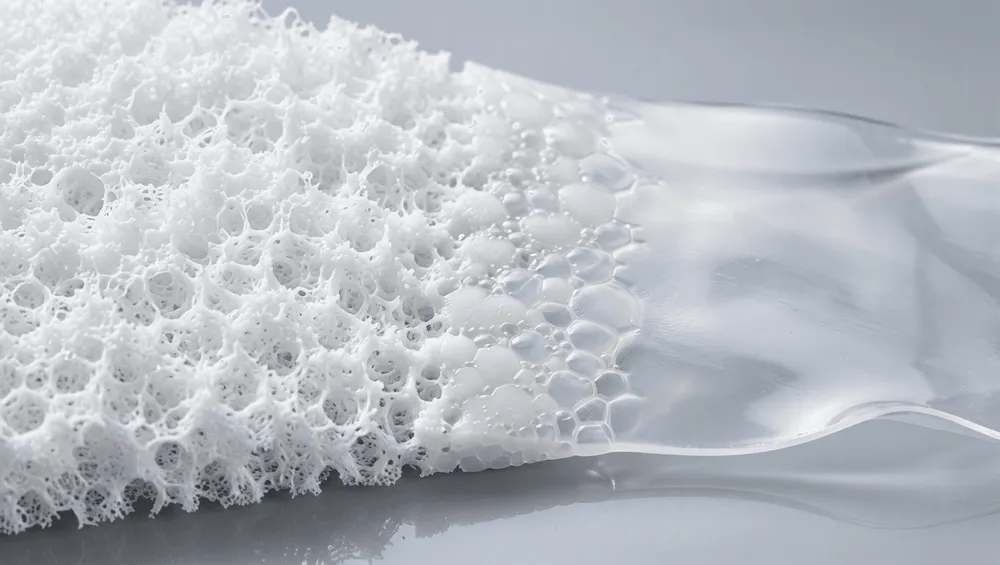
The white spray of waves depicted in Hokusai's "The Great Wave off Kanagawa," and the snowflakes that drift down from a winter sky, are not colored white by pigment. Rather, the boundary between a transparent substance—water or ice—and air scatters light in every direction, and this scattering appears to the human eye as pure white. Japanese washi paper looks white for the same reason: its tangled plant fibers scatter light. Applying this natural mechanism to industrial materials could eliminate the need for environmentally burdensome chemicals.
A new technology unveiled by Professor Easan Sivaniah of Kyoto University's ICeMS and colleagues, published in the journal Nature in September 2026, uses only light and solvent treatment to create microscopic bubbles inside a material, drawing out both color and water repellency at the same time.
Whiteness and Water Repellency That Have Long Relied on Harmful Chemicals
In modern industrial products, bright whiteness and the ability to repel water and oil in everyday goods and building materials are indispensable. But behind these properties lies a heavy dependence on specific chemical substances.
Titanium Dioxide, Now Removed as a Food Additive
Titanium dioxide has long been the go-to substance for producing white color. With an extremely high refractive index of about 2.7, even a small amount mixed in produces strong opacity that hides the substrate and yields a vivid white. Thanks to these excellent optical properties, it has been widely added to paints, plastics, paper, and cosmetics. In recent years, however, the safety of its nano-sized particles when taken into the body has become a point of debate. The European Union, citing suspected carcinogenicity and the inability to fully rule out the risk of accumulation in the body, banned its use as a food additive entirely in 2022. These safety concerns have spurred the search for alternative technologies in other applications as well.
Expanding Regulation of PFAS, the "Forever Chemicals"
At the same time, scrutiny has intensified around the group of organofluorine compounds widely used as water-repellent coatings. Known as PFAS, these substances feature carbon-fluorine bonds that are chemically extremely strong, repelling both water and oil while withstanding heat. They have proven invaluable in frying pan surface treatments, outdoor apparel, and waterproofing sprays. But precisely because of that strong bonding, they are extremely resistant to breakdown by microorganisms or light in the natural environment, and they persist in ecosystems for long periods via groundwater and soil. Linked to water contamination and health harms, they have been dubbed "forever chemicals," and regulations restricting their manufacture and use are rapidly expanding around the world.
Industry has been pressed to find ways to replace these two additives while still preserving whiteness and water repellency. Synthesizing new, safe chemicals from scratch and clearing toxicity testing requires enormous time and cost. So the research team shifted its approach—away from what to mix into a material, and toward how to physically change the material's shape.
Slicing Molecules with Light, Then Swelling Them with a Mild Solvent
The technology the research team developed, called Deep Foam Photolithography (DFP), rewrites a polymer's internal structure using light and solvent.
A Three-Dimensional Application of Photolithography
The principle is close to an application of the photolithography technology used in semiconductor manufacturing, but the goal here is not to draw flat circuits—it's to create a three-dimensional network of bubbles. The process proceeds in two stages. First, a polymer film containing a photosensitizer is exposed to ultraviolet light of a specific wavelength. The light's energy reaches deep into the film, cutting the long molecular chains that make up the polymer into shorter fragments. At the same time, in areas where the light strikes strongly, a cross-linking reaction that binds molecules together also progresses. This exposure to light creates a state inside the material where two opposing reactions—cleavage and cross-linking—coexist.
Swelling with Solvent and Fixing the Structure
Next, the light-exposed film is immersed in a mild solvent. Normally, putting a polymer into a strong solvent would dissolve it entirely, causing it to lose its shape. But in a film that has undergone DFP treatment, the newly formed cross-linked network created by the light acts as a skeleton, maintaining the shape of the film as a whole.
Meanwhile, the molecular fragments cut short by the light absorb the solvent, dissolving locally and attempting to expand. Within the rigid, cross-linked network, these dissolved fragments exert pressure from the inside, pushing the space outward and creating countless microscopic pores. By controlling the processes of penetration and swelling in a viscoelastic manner, the bubbles are prevented from collapsing, fixing the porous foam structure in place.
Scattering and Water Repellency Mechanisms Learned From the Lotus Leaf
The resulting collection of microscopic bubbles produces two functions simultaneously. One is the scattering of light by internal cavities. Because the boundary between the bubbles and the polymer reflects light in all directions, a strong whiteness appears without containing any pigment such as titanium dioxide at all.
The other is a change in surface shape. The foaming process creates tiny bumps and ridges on the film's surface, and these repel water through the same mechanism found on the surface of a lotus leaf. Because the area where a water droplet makes contact becomes extremely small, the water forms into a sphere and rolls off, producing strong water repellency.
By varying where and how strongly the light is applied, the location of the foaming can be freely controlled. The research team succeeded in printing this microstructure at an extremely high resolution of 20,000 DPI. This is precise enough that the periodicity of the microstructure can even harness light interference to trigger color effects through diffraction—a resolution far beyond that of an ordinary household printer.
The Advantage of Using Existing Commercial Polymers As-Is
| Item | Conventional Technology | Deep Foam Photolithography (DFP) |
|---|---|---|
| Mechanism for producing white color | Light scattering by pigments such as titanium dioxide (TiO2) | Light scattering by an internally formed foamed porous structure |
| Imparting water repellency | Surface coatings such as PFAS (organofluorine compounds) | Microscopic bumps and ridges formed on the surface (lotus effect) |
| Environmental and safety risk | Regulations tightening worldwide due to toxicity concerns and long-term persistence | No additives used; achievable with existing commercial polymers |
| Microfabrication resolution | Depends on pigment particle size and physical limits of application methods | Can be formed at any location, up to 20,000 DPI |
Cost Advantages From Avoiding Synthesis From Scratch
Another strength of DFP technology lies in the low barrier to practical implementation. Many biomimetic technologies that imitate structural color and water repellency found in nature require self-assembly processes that precisely arrange microscopic silica particles, or specialized etching in a vacuum environment—and the high manufacturing costs involved have been a persistent challenge. Moreover, synthesizing an unknown chemical substance to impart a new function requires years of toxicity testing to evaluate long-term safety and environmental impact.
DFP technology bypasses these challenges. Working with researchers at Donghua University, the research team confirmed that this method functions using several common polymers already widely circulating on the market. By using existing, safe materials as the base and simply combining existing industrial processes—light and solvent—new functionality can be drawn out.
Application to Fabrics and Three-Dimensional Objects, and Weight Reduction
The foaming process can also be applied not only to flat films but to fibrous materials such as fabrics and three-dimensional objects with curved surfaces. The steps of light exposure and solvent penetration make it easy to apply the treatment uniformly from the surface to the interior, even for objects with complex shapes.
Furthermore, because no physical layering of pigment powder or heavy fluorine-based coating agents is needed, the material itself becomes lighter in weight. The porous structure containing microscopic air bubbles also has the effect of lowering the overall density of the material. It offers a realistic option for removing harmful chemicals from disposable packaging and clothing while maintaining the same appearance and function as before.
Conditions Still to Be Verified for Wear Resistance and Long-Term Use
The design philosophy of shifting the primary driver of function from chemistry to structure greatly enhances the sustainability of the materials industry. However, precisely because it relies on physical structure, there are constraints it must also confront.
Ensuring Uniformity in Continuous Production Processes
For industrial implementation, the question is whether the 20,000 DPI precision and uniformity of foaming can be maintained in mass-production processes such as roll-to-roll methods, in which film or fiber is wound onto rolls and processed continuously. How to optimize the balance between the speed of the production line and the speed at which the solvent penetrates and the polymer swells will determine manufacturing costs.
Long-Term Durability Against Physical Stress
The next factor to weigh is how well the microscopic foam structure can withstand outdoor environments and physical stress. The fine bumps and ridges on the surface will wear down and flatten if subjected to strong friction or pressure. If the structure collapses, water repellency is lost as well. In addition, if fine dirt or oil penetrates the interior of the porous structure, light scattering could be impeded, potentially preventing the whiteness from being maintained over the long term.
As durability and mass-production processes are further verified, the conditions will be in place for the materials behind the white products around us—in everyday goods and building materials—to be fundamentally replaced.