

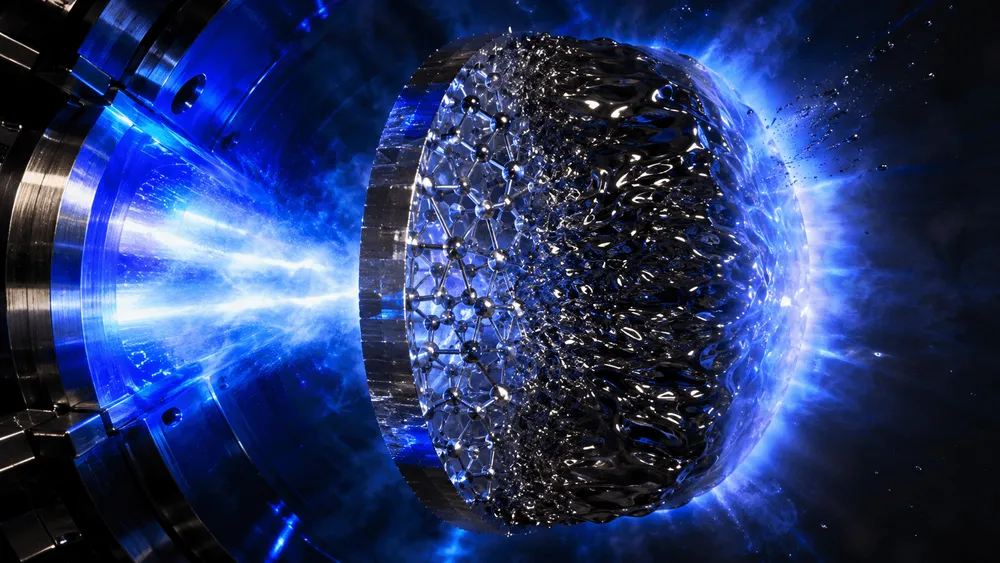
Marius Millot and seven colleagues at Lawrence Livermore National Laboratory (LLNL) shock-compressed diamond to pressures at the trillion-pascal scale, tracking its atomic arrangement as it melted. Near about 7,300 K, the crystal's diffraction signal weakened, and the peaks observed until melting was complete remained consistent with ordinary cubic diamond. No clear signal of BC8—the high-pressure carbon phase long predicted by theory—appeared.
The findings were published as a peer-reviewed paper in Nature Physics on August 13, 2026 (DOI: 10.1038/s41567-026-03413-1). The new temperature measurements agree with quantum-mechanics-based calculations, resolving a temperature discrepancy that had lingered from shock experiments conducted about two decades ago. However, this measurement cannot definitively rule out any occurrence of BC8 whatsoever. Separating what was actually observed from the detection limits helps explain why, under extreme pressure, a material's "thermodynamically stable phase" and its "actually observed phase" can diverge.
Cubic Diamond Persisted in Diffraction Even at 1 Trillion Pascals
The experiments were carried out across three campaigns at the University of Rochester's OMEGA EP laser facility. The research team used microcrystalline diamond discs, about 100 micrometers thick and 2 millimeters in diameter, grown by chemical vapor deposition. They combined 12 shots using steady shocks with 7 experiments using decaying shocks, tracking shock velocity, temperature, and reflectivity with optical velocimeters and radiometric pyrometers, while recording atomic arrangement via X-ray diffraction.
The steady-shock laser operated at a wavelength of 351 nanometers. Typically, a single pulse lasting about 10 nanoseconds with total energy of roughly 2,000 to 5,500 joules compressed the sample. Across the 9 shots where both temperature and pressure could be jointly quantified, values ranged from 656±32 gigapascals and 7,404±370 K up to 1,269±20 gigapascals and 11,999±600 K. Among the 7 decaying-shock experiments, 4 equation-of-state data points fell between 1,281±11 and 1,743±9 gigapascals. Not all diagnostics were available for every shot; in two shots without windows and one shot with strong photoionization, no steady-shock temperature table was obtained.
The melting boundary sits near about 7,300 K, showing a slight tendency for the melting point to decrease as pressure increases. This is consistent with an equation of state in which liquid carbon becomes denser than solid diamond at high pressure, suggesting a regime where solid diamond could float on liquid carbon. This conclusion is based on combined experimental evidence from temperature, reflectivity, and diffraction intensity—not a direct image of the liquid's atomic arrangement.
What 12 Shots Captured: The Solid-to-Liquid Transition
The X-ray diffraction integration time was about 1 nanosecond. As pressure increased, the signal attributed to the sample's cubic diamond 111 diffraction line weakened to roughly one-tenth of its original strength as shock velocity rose from 21 to 24 kilometers per second. Under still stronger shocks, the diffraction line disappeared entirely, and optical measurements were also consistent with fluidization. The research team interprets this as the crystalline fraction decreasing while the liquid fraction increased, with the crystalline signal ultimately being lost.
Previous temperature measurements and theoretical calculations had not agreed with each other near this same trillion-pascal range. The new optical diagnostics accounted for spatial variation and temporal evolution within the sample, and X-rays cross-checked the decline in crystalline fraction. As a result, the melting temperature of about 7,300 K now agrees closely with quantum-mechanics-based calculations. While the earlier experiments' judgment that the material had "melted" was itself supported by X-ray diffraction, the temperature calibration has now been updated.
Meanwhile, only a single diffraction peak could be clearly observed from the compressed sample. Since a single peak cannot uniquely determine crystal structure, the research team assigned the peak to multiple candidate structures and compared the resulting densities against previous measurements. When identified as the 111 line of cubic diamond, the density matched earlier measurements; but when assigned as either the 002 or 112 line of BC8, the resulting density came out roughly 30% higher or roughly 30% lower than previous values. The judgment that BC8 is difficult to explain rests on this comparison.
Was It Time, Rather Than Pressure, That Kept BC8 Away?
Density functional theory has long predicted that carbon's BC8 phase becomes thermodynamically more stable than cubic diamond above roughly 1 trillion pascals. Simulation studies published in Physical Review Letters in 2023 and in the Journal of Physical Chemistry Letters in 2024 suggested that nucleating BC8 by rearranging diamond's strong carbon bonds might require double-shock loading or specific, limited pressure–temperature pathways. These are computational results, not experiments that observed BC8 formation.
Most regions of the sample experienced peak pressure for more than 2 nanoseconds before the X-ray snapshot was taken. Existing molecular dynamics and metadynamics calculations predict that, once BC8 nucleates within its stability region, it would replace cubic diamond in under 1 nanosecond. Given that no BC8 line was observed despite this, the authors raised the possibility that under single-shock conditions, diamond may have melted before nucleation could even begin. What the experiment directly captured was the evolution of the diffraction signal; the kinetic processes that might inhibit bond rearrangement are an explanation informed by simulation, not a direct observation.
Detection limits also remain a factor. Even at the highest pressures, the signal-to-noise ratio was only about 10, and the team estimated that if crystal grains were sufficiently large, a diffraction line could be detected if about 1% of the sample converted to BC8. However, the broad, weak peaks produced by crystals smaller than roughly 1 nanometer in diameter could be buried in the background. The conclusion, therefore, is "no evidence of a coherent BC8 phase"—not "BC8 does not exist."
A Threefold Fusion Yield Gain Remains Confined to Models
Diamond is used as an ablator enclosing the deuterium-tritium fuel in inertial confinement fusion at the National Ignition Facility (NIF). If the initial shock can melt the ablator uniformly, surface perturbations that would otherwise disrupt fuel compression can be suppressed. Conventional designs have relied on a strong first shock of about 1.2 trillion pascals to ensure complete melting.
Using the new measurements, the research team estimates that complete melting in diamond can be achieved with a shock velocity of just 24.5 kilometers per second. Converted to the velocity transmitted into liquid deuterium, this works out to a reduction from the current design's 33–34 kilometers per second down to 28 kilometers per second. Using existing shock-timing measurements and scaling relations, supplementary material estimates that this change would lower fuel entropy at peak compression by 13%, reducing the minimum shock adiabat from 1.56 to 1.36.
The "threefold fusion yield gain" is a further-downstream estimate. Scaling relations from existing research indicate that a 10% reduction in in-flight adiabat corresponds to a threefold increase in fusion reaction energy yield. The OMEGA experiments reported here did not burn fusion fuel or measure yield directly. This projection presupposes that degradation factors—such as instabilities not captured in one-dimensional calculations—can be controlled.
The Remaining Distance from Pure Carbon to Planetary Interiors
Inside Uranus and Neptune, carbon is thought to crystallize under high temperature and pressure, potentially producing what is known as "diamond rain." The new melting curve provides a reference point for planetary interior models, but the experimental sample was pure microcrystalline carbon, differing from the actual composition of planetary interiors, which include hydrogen, oxygen, and other elements. The property of solid floating on liquid also does not mean that floating diamonds inside planets have been directly observed.
While the Nature Physics paper has passed peer review, it remains a single study, newly published. LLNL has indicated plans to next use NIF to probe the limits of diamond's structure at even higher pressures and through a series of multiple shocks. If the presence or absence of BC8, along with complete melting at 24.5 kilometers per second, is reproduced there, both the update to planetary models and the low-adiabat fusion design could be advanced further using the same body of experimental data.