


On October 15, 2026, E Ink announced Kaleido 4, the latest generation of its color e-paper. The company says gamut volume is double that of the previous generation, white reflectance improves by 15%, and contrast improves by 50%. The first device to use it is the M10C II, an e-notebook from China's Hanvon Technology. As color PDFs and technical drawings become more common reading material, the update goes beyond vividness to address text legibility and how quickly pages move. However, the published improvement figures mix numbers for the display technology itself with numbers for a complete device, so it helps to consider how each affects the reading experience separately.
What Doubling Gamut Volume Changes
Kaleido 4's optical improvements are expressed through three different metrics: gamut volume, white reflectance, and contrast. E Ink says gamut volume is twice that of the previous generation, at "over 40K." This metric describes the range of colors that can be reproduced, and it should be distinguished from a claim that the screen displays 40,000 colors.
The foundation of the technology is a combination of monochrome e-paper and a color filter. According to E Ink's technical description, Kaleido consists of a TFT backplane that drives the pixels and an ink layer, with a color filter layer and a protective sheet stacked on top. Because color is created by layering a filter over a monochrome display, the fineness of the ink layer and the fineness of the color display cannot be read as the same figure.
Indeed, Kaleido 3, announced on April 7, 2022, offered 300ppi in black and white versus 150ppi in color, with 4,096 displayable colors. PPI indicates pixel density per inch. A wider gamut, more color gradations, and sharper outlines are each separate changes.
| Aspect evaluated | Kaleido 4 announcement | What can be inferred |
|---|---|---|
| Color reproduction range | Gamut volume 2x the previous generation, over 40K | Cannot be converted into an increase in the number of displayable colors |
| Appearance of white | White reflectance improved by 15% | Baseline reflectance and measurement conditions not given in the announcement |
| Light-dark difference | Contrast improved by 50% | Absolute contrast ratio not given |
| Motion display | Video playback of up to 18fps via a new algorithm | Trade-offs with image quality, ghosting, and power consumption need verification |
The table organizes E Ink's October 15 announcement by evaluation target. All figures are manufacturer-published values, not independent measurements. Because the announcement does not specify the color space or units for gamut volume, or the test conditions for the optical characteristics, it is hard to judge from these numbers how the screen compares with other display types or printed paper.
Still, placing white reflection and light-dark contrast alongside gamut is meaningful when thinking about use cases. In drawings and data tables, color coding is of little help if fine text is hard to read. The use cases E Ink lists also span e-books, color PDFs, presentation materials, and educational diagrams. This update is a design that tries to improve color expression and document legibility together.
The 27% Speedup Comes from Whole-Device Design
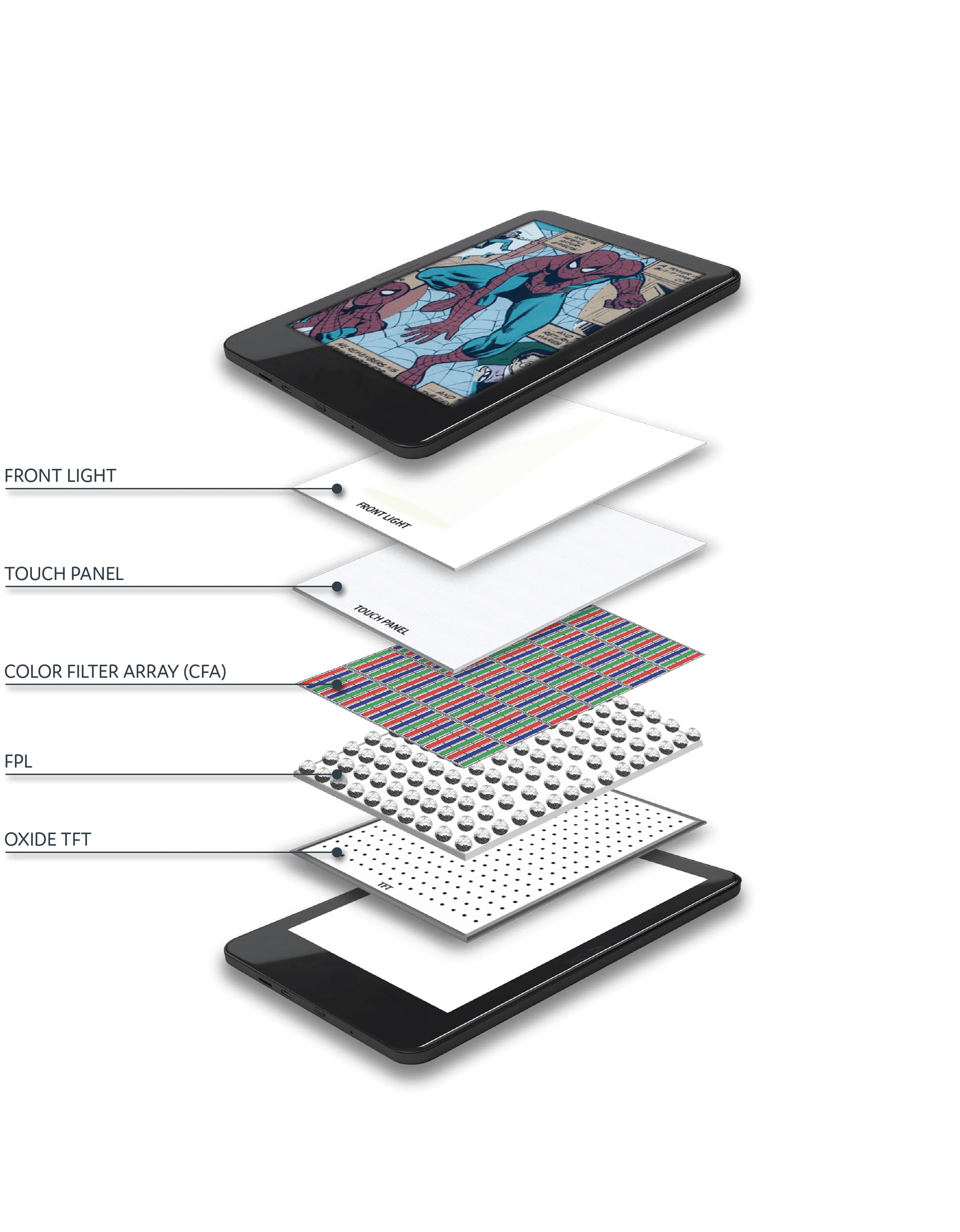
E Ink says page turning and scrolling are 27% faster on the M10C II. The configuration combines a new oxide TFT backplane that supports higher drive voltages and faster screen refreshes, Hanvon's proprietary "Enhanced Pressure Floating" technology, and the "T2000" timing controller. The front light has also been redesigned, reportedly aiming for more natural color reproduction.
The 27% speedup in E Ink's October 15, 2026 announcement is a figure for the M10C II, which combines Kaleido 4, Hanvon's proprietary technology, and the T2000, and should be read separately from any improvement in the panel alone.
This distinction becomes clearer when looking at the T2000's history. E Ink and Himax jointly announced the T2000 on July 31, 2024, and even then described support for Kaleido 3, Gallery 3, and Spectra 6. It is not a control IC that debuted alongside Kaleido 4; rather, existing display-control technology has been incorporated into the new panel and device design.
According to the joint announcement, the T2000 controls the timing and duration of the voltages that drive the screen and also handles temperature compensation. In other words, moving the screen quickly involves not only the voltages the panel can handle but also control over when, and for how long, those voltages are applied. Connecting the adoption of oxide TFTs with the controller's role shows why the feel of e-paper operation depends on how each device is built.
The comparison baseline and measurement conditions for the 27% figure are not stated in this announcement. Whether other manufacturers adopting Kaleido 4 will see the same gain therefore needs to be checked case by case. The contributions of the T2000 and the oxide TFTs have not been separated either, so it would be wrong to treat this as a uniform 27% cut in waiting time.
The 300ppi Color Report, and What to Check on Real Devices
On color display sharpness, Good e-Reader reports, saying it confirmed with E Ink, that Kaleido 4 reaches 300ppi. That is a notable change from the previous generation's 150ppi, but E Ink's October 15 announcement lists neither resolution nor total displayable colors. The 300ppi figure should be treated as the outlet's own reporting and checked against official device spec sheets.
Video is not a capability that Kaleido 4 introduces for the first time, either. The 2022 Kaleido 3 announcement already specified support for video and animation. What is new is a concrete performance figure: playback of up to 18fps via a new algorithm. That "up to 18fps" figure does not reveal how well color and ghosting are controlled at the same time, or how battery life holds up during video playback.
With the M10C II, Hanvon aims to turn these display updates into a work tool. According to E Ink's announcement, the device supports business apps that use OCR, voice, and AI, as well as cloud library sync. Display scaling and font rendering for third-party apps have also been optimized, improving usability from opening a document to reading it.
For writing, it uses a battery-free wireless digital pen that detects 8,192 levels of pressure. Finely textured tempered glass reportedly reduces glare and parallax and provides writing resistance close to paper. The direction is not merely adding more screen colors but letting the device handle the whole workflow of reading, writing, and recording.
E Ink Chairman and CEO Johnson Lee said in the announcement, "Color ePaper needs to offer more than simply producing color." The M10C II's price, release date, and availability in Japan are not included in the announcement, however. When other manufacturers will adopt Kaleido 4, and with what specifications, also awaits individual product announcements.
In hands-on evaluations, it would be worth reading color-coded legends and fine text in the same color PDF, and checking how the display behaves when moving between pages while writing. If lighting conditions and front-light settings are matched, improvements in optical characteristics and in operating speed can be compared separately. Only if both are confirmed in everyday document work will Kaleido 4 truly broaden the choices among e-notebooks for reading color materials.