

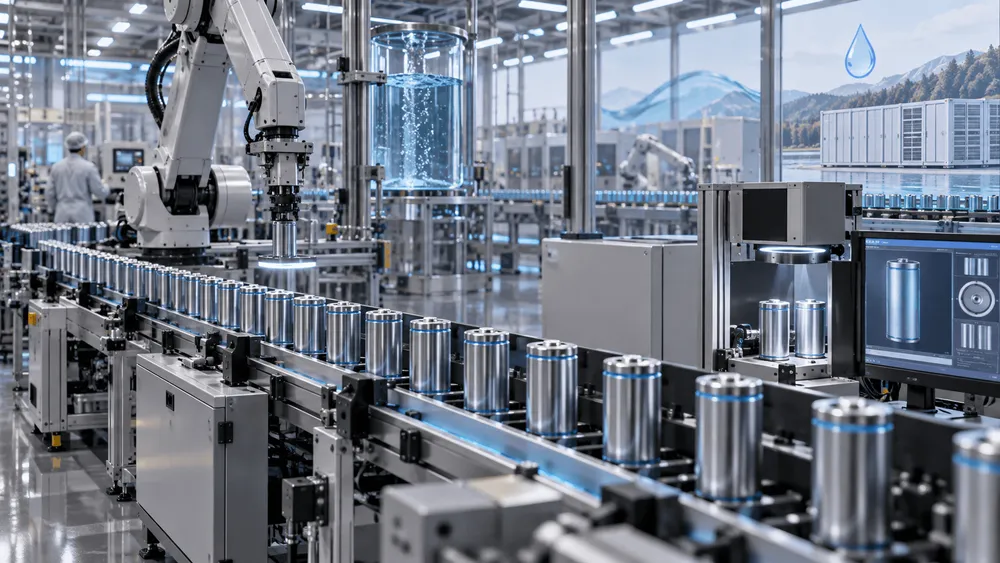
On September 24, 2026, US-based EnerVenue announced that it had started up a dedicated mass-production line for its aqueous battery, the Aqueous Metal Cell (AMC), in Wujin District, Changzhou, Jiangsu Province, China. The first phase has a designed annual capacity of 250MWh. The company calls it the world's first mass-production line dedicated to AMC.
The battery applies the nickel-hydrogen gas battery mechanism long used in spacecraft to stationary storage on the ground. It carries a design target of 30,000 charge-discharge cycles and a 30-year design life, and it is now moving toward full-scale commercial supply.
For companies that actually deploy it, the key question is how far this long life can reduce battery replacements and maintenance costs.
250MWh Line Starts Up, With an 11MWh Commercial Order
The new Changzhou line is due to reach full-scale operation by November. Once fully automated, it is designed to produce about 300 fourth-generation AMC cells per day.
EnerVenue plans to expand annual capacity to 1GWh in 2027 and to multiple GWh in 2028.
However, 250MWh is the factory's designed annual production capacity. It does not mean 250MWh of product has already been produced or shipped. In the company's factory announcement, the start of production and future expansion plans need to be considered separately.
Customers are also starting to take shape.
The day before, on September 23, the company announced its first commercial order at multi-MWh scale. It will install 26 "Energy Prism" units, totaling 11MWh, at an oilfield in northern China.
The systems will store electricity generated by on-site solar power and supply it during the hours when oilfield operations need power. The first three units are scheduled to ship in December 2026, and the remaining 23 in March 2027. The customer's name has not been disclosed.
Before this, a 150kWh system combining renewable energy with electric bus charging in Jintan, Changzhou, has reportedly been operating since November 2025.
The order announcement shows that AMC is beginning to move from small demonstration systems to MWh-scale deployment at operating industrial sites. The oilfield systems, however, have not yet shipped.
Mass production also raises the question of whether identical-quality cells can be produced continuously in volume.
The new line automates steps such as electrode stacking and glass-fiber wrapping, and uses automated guided vehicles to move parts between processes. Every cell passes through 11 inspection stations and undergoes 41 checks, including weld condition, airtightness, and performance.
For batteries meant to be used for decades, manufacturing quality that reproduces the designed performance consistently in production units matters as much as the design life itself.
An Aqueous Battery That Stores Energy Using Hydrogen Gas
The AMC consists of an alkaline aqueous electrolyte, a positive electrode using nickel hydroxide, and a negative electrode using a nickel alloy.
When charged, hydrogen gas forms inside the cell and is stored in the sealed container. During discharge, the reverse reaction takes place to extract electricity.
According to EnerVenue's technology explanation, this mechanism is known as a Ni-H2 (nickel-hydrogen gas) battery. Unlike a fuel cell, it does not require a continuous external supply of hydrogen.
"Aqueous" here means that the electrolyte uses water. The battery does not generate electricity from water itself; it stores electrical energy that has been charged in advance as a chemical reaction and releases it when needed.
EnerVenue says the AMC takes the nickel-hydrogen gas battery mechanism used in the Hubble Space Telescope, the International Space Station, and elsewhere, and reduces its cost for stationary storage on the ground.
Even a technology with a track record in space needs lower costs before it can be installed in large quantities at power plants and factories.
One piece of the research background is a study by Wei Chen and colleagues published in PNAS in 2018. According to the abstract published by Stanford University, the work showed a method that uses a nickel-molybdenum-cobalt alloy in place of expensive platinum catalysts to promote both hydrogen evolution and oxidation.
However, that research aimed at lowering the cost of large-scale ground-based batteries, and the performance and materials costs of the prototype batteries at the time cannot be treated as the product specifications of the current fourth-generation AMC.
The start of mass production can be seen as the stage at which such cost-reduction ideas are carried into an actual product, including quality inspection and commercial supply.
Cell Performance Differs From Whole-System Performance
The published AMC cell specifications list a nominal capacity of 3.0kWh, peak round-trip efficiency above 90%, and an operating temperature range of minus 20 to 60°C.
The "Energy Rack," which combines many cells and adds control equipment and other components, has different specifications.
Comparing the cell specifications and the rack specification sheet, checked on September 27, 2026, gives the following:
| Item | AMC cell | Energy Rack |
|---|---|---|
| Published capacity | Nominal 3.0kWh | Rated 150kWh |
| Temperature range | Minus 20 to 60°C | Minus 10 to 45°C, with a note of up to 60°C |
| Round-trip efficiency | Peak above 90% | Above 87% at 25°C |
| Cooling / thermal management | Described as needing no active thermal management | Forced-air cooling |
| Auxiliary power consumption | No figure on overview page | Up to 1,200W |
Even if the cell is described as needing no active cooling, that does not mean a complete storage system needs no cooling equipment or auxiliary components.
The Energy Rack uses forced-air cooling, and auxiliary power is included in its specifications. The 1,200W figure is a maximum and the rack does not necessarily draw that much all the time, but it must be considered when calculating overall system efficiency and operating costs.
Round-trip efficiency calls for the same caution.
Round-trip efficiency shows how much of the electricity put in during charging can be recovered during discharge.
However, the cell's figure of over 90% is a peak value, while the rack's figure of over 87% is conditional on 25°C. Because the measurement targets and conditions differ, the two cannot simply be subtracted to conclude that racking adds three percentage points of losses.
To evaluate efficiency in an actual installation, you need values measured on the whole system under the same operating conditions.
Temperature conditions are similar.
The rack specifications include a note of up to 60°C, but they do not make clear how well output and efficiency are maintained during continuous operation at that temperature.
Even if aqueous batteries themselves tend to limit high-temperature and fire risks, buyers need to check the specifications of the finished storage system.
Where Does a 30,000-Cycle Life Deliver Value?
Energy Rack is expected to retain at least 80% of its capacity after 30,000 charge-discharge cycles.
However, the figures of 30,000 cycles and 30 years are design lifetimes stated by EnerVenue. They do not mean that AMCs currently on sale have actually operated for 30 years, nor that they will not degrade at all over that time.
The benefit of long life is that it may reduce how often batteries must be replaced midway through a system's operation, or how often extra batteries must be added to make up for capacity loss.
For example, if electricity generated by solar power is stored every day and used at night, that is about 365 cycles per year.
In simple terms:
- One cycle per day comes to about 10,950 cycles over 30 years
- Two cycles per day comes to about 21,900 cycles over 30 years
- Using up 30,000 cycles over 30 years means an average of about 2.7 cycles per day
That means 30,000 cycles is easier to put to good use in applications that charge and discharge many times a day.
Conversely, in systems such as emergency backup power that rarely charge and discharge, the 30,000-cycle capability may go unused.
To compare battery economics, you need to look not only at the initial purchase price but also at replacement costs, losses from charging and discharging, and auxiliary power for cooling and other functions, and at how much electricity can be delivered over the system's lifetime.
The announcements of the factory startup and the order do not disclose the sale price of the whole system or operating costs on a comparable basis.
Safety of Aqueous Batteries Is Also a Commercial Adoption Point
In the oilfield order, safety is cited as one reason the AMC was chosen.
The aqueous electrolyte is hard to burn, and EnerVenue says the AMC has a low risk of fire from thermal runaway.
However, the UL 9540A test results introduced in the September 23 announcement show that fire did not spread at the cell level.
According to UL Solutions' explanation, UL 9540A examines characteristics such as thermal runaway and the flammability of released gases at the cell level. It then evaluates safety at progressively larger scales: modules, units, and installations.
A good result for a single cell therefore does not mean all safety measures become unnecessary in an installed storage system.
EnerVenue itself says fire suppression equipment can be omitted only "where local regulations allow." The company's explanation of safety also separates the measures required for the battery itself from the fire protection required of the facility as a whole.
Whether the safety of aqueous batteries can translate into lower facility costs depends on the actual installation method and local regulations.
The shipments beginning in December 2026, and the subsequent operation at the oilfield, will be the first opportunity to see how far the AMC can demonstrate its economics as a long-life storage system.
If quality holds at production scale, and actual utilization rates and maintenance costs track close to design assumptions, industrial storage systems that have been built around repeated battery replacement would gain a new option.