

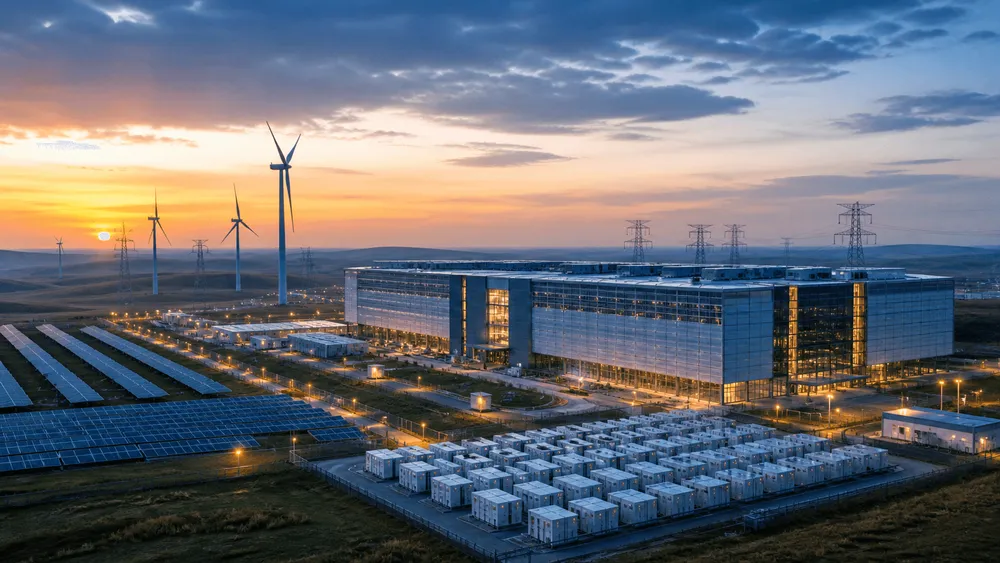
Envision Energy announced on August 6, 2026, that it had opened the "Envision Galaxy Campus" in Ulanqab, Inner Mongolia, China. The eye-catching numbers in the plan are an installed capacity exceeding 2GW and up to one million AI accelerators. But that million-unit figure is not the current number of chips installed. What changed this time is that Envision activated the first site of Mission Gobi—under construction as of June—and began assembling everything from power generation to computing equipment as a single piece of infrastructure.
The Million Chips Are Not the "Current Deployment"
The core of the campus is an AI supercomputing facility with 120,000 square meters of total floor space. Envision describes this as equivalent to 20 standard soccer fields, calling it the world's largest AI data center as a single building. However, the one million AI accelerators and 1 million PFLOPS cited in the company's announcement are both design targets for "full completion." The number of units currently installed and the current computing capacity have not been disclosed.
Performance comparisons also require caution. While Envision claims up to 10 times the computing output per square meter compared to conventional data centers, it has not disclosed the comparison baseline or measurement conditions. As for the 1 million PFLOPS figure, there is no mention of computational precision or target workloads, making it impossible to compare on equal terms with other AI clusters. The manufacturer and model of the accelerators also remain unannounced.
Before focusing on the scale of the numbers, it's necessary to distinguish between the design ceiling and the current actual figures. What has been confirmed this time is the opening of the site—not the completion of the million-chip deployment.
Designing 2GW and Power Simultaneously
A defining feature of Galaxy Campus is that renewable energy generation facilities, dedicated transmission infrastructure, and large-scale battery storage were designed together with the computing load from the start. Envision's proprietary "AI Power System" controls power generation and storage, delivering electricity directly to the computing equipment. The power infrastructure is built in from the outset to match computing demand.
Why design from the power side first? The reason lies in how demand is growing. According to the International Energy Agency (IEA), global data center electricity demand grew 17% in 2025, far outpacing the 3% growth in overall global electricity demand. By 2030, overall data center power consumption is expected to double, while AI-specific facility consumption is projected to triple. Moreover, because AI computing loads fluctuate sharply over short periods, the IEA points out that onsite battery storage is becoming increasingly important.
Direct connection to renewables alone cannot guarantee stable operation. Absorbing the output fluctuations of wind and solar power depends on battery output and capacity, transmission line headroom, and the range over which computing loads can be shifted. Envision's announcement does not disclose any of these three figures. It also remains unclear at what stage and to what extent the 2GW-plus design value will translate into actual load.
A 2GW-Plus Site Representing 40% of the 5GW Target
On June 18, 2026, Envision announced "Mission Gobi," an initiative to build green AI data centers in desert and arid regions, with a goal of reaching 5GW worldwide by 2030. At the time of that announcement, the Galaxy Campus in Ulanqab was described as under construction. The following August, the company opened this same site as Mission Gobi's first flagship project.
Galaxy Campus's final design value of over 2GW represents at least 40% of Mission Gobi's 5GW target. This is not a ratio of already-completed capacity. Even so, it is a scale at which whether this single site can be expanded as planned will significantly affect achievement of the 2030 target.
This concentration embodies Mission Gobi's underlying concept of clustering computing equipment in locations rich in renewable resources. On the other hand, no client companies, network specifications, or phased commissioning dates have been disclosed. While the campus has opened, the current number of clients and utilization rate remain unknown.
Numbers to Verify Before GPU Counts
The real-world effectiveness of "green AI" is not determined merely by whether renewable energy facilities are co-located. According to the IEA's 2025 analysis, while renewables are expected to cover nearly half of the increase in data center power demand through 2030, fossil fuels are projected to account for more than 40%. A distinction must also be made between contractual renewable energy procurement and the actual hour-by-hour power mix the facility uses in practice.
Regarding Galaxy Campus, Envision has not disclosed renewable generation capacity, battery storage capacity, or hourly renewable supply ratios. The degree of reliance on grid power or backup power sources, as well as power usage effectiveness (PUE), also remain unknown. While the structure of integrated power-and-computing design has been revealed, environmental performance based on actual operational data has yet to emerge.
The next milestone is not the million-chip target itself, but the implementation figures disclosed at each stage of expansion. Once the number of active accelerators and IT load, along with battery storage in MWh and hourly renewable supply ratios, are all in place, it will become possible to verify just how far a 2GW-class AI site can overcome power constraints.