

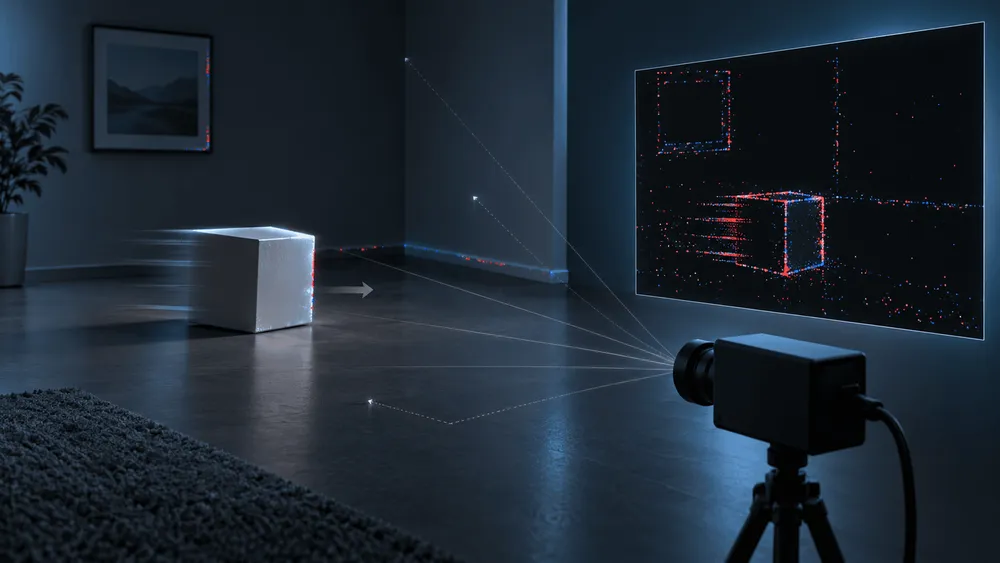
A research team led by Chiba University announced on September 30 a new simulation method that generates the output of an "event camera" directly from a 3D space in motion. Unlike a conventional camera, an event camera detects changes in brightness at each pixel. The new method traces light paths to calculate the brightness of each pixel, while efficiently identifying the moments at which that brightness changes. It does not need to generate large numbers of images at fixed intervals, as earlier approaches did, so it keeps computation down while still capturing changes that occur between frames. Its distinguishing feature is that the way light is calculated and the way times are searched are both tailored to the event camera's characteristic of outputting information at different moments for each pixel.
The results were published online on September 17 in the journal "IEEE Transactions on Visualization and Computer Graphics." According to the joint announcement, using statistical techniques to skip unnecessary computation, combined with GPU-oriented optimization, reduced computation time to roughly one-third of what it was when using the bisection method alone. This study does not improve the recognition performance of AI using real event cameras. It is a technique for generating synthetic data, used for AI training and performance evaluation, more efficiently and accurately.
Why Event Cameras Are Hard to Reproduce
A conventional digital camera captures the entire frame at fixed time intervals. An event camera, by contrast, operates independently at each pixel and outputs information only when a change in brightness reaches a certain threshold. The output data includes the position of the pixel where brightness changed, the time of the change, and whether it became brighter or darker. This is fundamentally different from ordinary video, which is a sequence of images captured at regular intervals.
In the basic operating model of an event camera, an event fires when the change in logarithmic brightness reaches a certain threshold. What is detected is not brightness itself but the change from the previous reference brightness.
Event cameras have drawn attention for tasks such as tracking fast-moving objects because they obtain information immediately from pixels whose brightness has changed, without waiting for the next capture of the whole frame. They offer microsecond-level time resolution, low power consumption, and the ability to handle environments with large differences between light and dark.
Reproducing this mechanism in computer graphics, however, is not easy.
Trying to reproduce event camera output by generating images at fixed intervals, as with ordinary video, requires enormous computation. According to the joint announcement, achieving microsecond-level time resolution through continuous image generation would require computing hundreds of thousands of images for just one second of a scene. Reproducing light reflections and similar effects precisely increases the load even further.
Another approach is to generate fewer images and interpolate between them. But changes not recorded in the original images cannot always be estimated accurately.
For example, if an object passes at high speed or brightness changes abruptly between capture intervals, events may be missed, or events that did not actually occur may be generated by mistake.
In the first place, computing the whole frame at fixed intervals is not well suited to reproducing events that occur at different times for each pixel.
Combining Light Calculation with a Search for Event Times
Instead of the conventional approach of generating images at fixed intervals, this study directly computes the brightness of only the necessary pixels at only the necessary times.
The foundation is "path tracing." Path tracing follows the process by which light reflects and refracts off objects and calculates the light that reaches the camera. The brightness of each pixel is estimated by examining multiple light paths.
Path tracing, however, is computationally heavy. The research team therefore combined it with the "bisection method" to efficiently identify the times at which events occur.
The bisection method searches for a target value by narrowing the search range by half at each step. In this study, it is used to find the time at which the change in brightness reaches the threshold.
Rather than generating images for every moment in advance, the method concentrates computation on the times when events are likely to occur, reducing wasted processing.
The team also introduced a mechanism that uses statistical hypothesis testing to end unnecessary computation early.
In path tracing, brightness estimates vary depending on which light paths are examined. The new method takes this variation into account, and when it can determine statistically that no event occurs in a particular time interval, it stops searching that interval.
Computation is not skipped simply because of visual conditions, such as the screen being dark or objects not moving. Instead, the method uses the statistical properties of the estimates to decide whether further computation is needed.
According to the paper's abstract, the method also employs hardware-accelerated fast light-path computation, temporal interpolation using a motion blur feature, and GPU-oriented optimization that gathers only the data requiring processing.
When brightness calculation is left to general-purpose rendering software, it is hard to build optimizations specific to event cameras into the rendering process. By integrating light calculation and the search for event times, as this study does, computation can be concentrated more easily where it is needed.
That said, because computation is terminated using statistical methods, the absence of errors under all conditions is not guaranteed. Beyond the reduction in computation, how much accuracy can be maintained is also an important evaluation criterion.
The Difference from Prior Work: Directly Searching for Event Times
The team, including Yuichiro Manabe, also proposed an event camera simulation method combining path tracing and hypothesis testing in earlier work published in 2024.
However, that method advanced computation at fixed time intervals and reduced the number of light paths examined for pixels where events were unlikely to occur.
The new study develops that method further. It makes it possible to calculate pixel brightness at any arbitrary time and introduces a mechanism to narrow down the event times themselves.
Other research also uses physical light calculation for event camera simulation.
For example, "EventTracer," developed by the University of Hong Kong and others, samples a relatively small number of light paths to generate high-frame-rate RGB images and converts them into event data using a lightweight neural network.
"v2e," which generates event data from ordinary video, offers temporal interpolation of video as well as a sensor model that reproduces responses close to those of real event cameras.
It is therefore not accurate to characterize all earlier methods as simply calculating brightness differences between images.
Organizing each method by input data, timing of brightness calculation, and how events are generated gives the following comparison.
| Method | Input data and brightness calculation | Approach to event generation |
|---|---|---|
| The team's 2024 method | Evaluates 3D space at fixed time intervals | Ends light-path computation early through hypothesis testing |
| v2e | Interpolates ordinary video over time | Models responses close to real sensors, such as thresholds and noise |
| EventTracer | Generates high-frame-rate RGB images via path tracing | Converts images to event data using a dedicated neural network |
| This method | Directly calculates brightness at any time for any pixel in 3D space | Searches for times with the bisection method and reduces computation through hypothesis testing and GPU optimization |
As this shows, whether path tracing is used does not fully explain the differences among the methods. The timing of brightness calculation and how events are generated from it are the key points of comparison.
Note that this table organizes design differences based on earlier papers, the developers' explanations, and the joint announcement. It is not a performance comparison under unified conditions such as GPU, resolution, threshold, and time resolution, so it does not indicate superiority in processing speed or generation quality.
What distinguishes this study is that it not only calculates the behavior of light physically but also moves away from generating images at fixed intervals and directly determines when events occur.
About One-Third the Computation Time: What Changed in Accuracy?
The joint announcement presents comparison results for both the reduction in computation time and the accuracy of event generation.
First, for computation time, the team compared a configuration using only the bisection method with one combining statistical early termination and GPU-oriented optimization.
The result was that the latter took about one-third of the computation time of the former.
It is important to note that this does not mean the method is three times faster than existing event camera simulators in general. It is strictly a comparison, within this method, between using the bisection method alone and combining it with various optimizations.
The quality of the generated event data was assessed in a separate comparison.
Figure 1 in the joint announcement visualizes the positions and times of events for a CG-created scene in which a box placed at the back of a room moves smoothly left and right.
According to the team, existing methods that reproduce events from images generated at fixed intervals produced false detections and missed events, and discontinuities appeared in the visualized results.
In contrast, the new method showed no such discontinuities and produced results close to the "Reference" used as the baseline for comparison.
However, this shows the quality of event generation in a CG scene; it does not prove that any data captured by a real event camera can be reproduced with the same accuracy.
For event cameras, it matters not only which pixel produced a signal but also when. Beyond whether the generated results look similar, the accuracy of event positions and timing must therefore be evaluated.
The joint announcement does not give the specific number of seconds the computation took, the GPU model used, or the total number of scenes used in the evaluation.
Confirming the reproducibility of processing speed and accurately comparing performance with other methods would require verification under matched conditions, including GPU, resolution, event detection threshold, and permissible timing error.
Also, achieving microsecond-level time resolution is a separate matter from running the simulation in real time. High time resolution alone does not mean real-time processing has become possible.
Applications to AI Training Data and Remaining Challenges
The research team expects the technology to help generate training data for AI that uses event cameras.
Because event cameras output information in a different format from ordinary cameras, collecting data for AI training requires dedicated equipment. When equipment is hard to obtain, or when large amounts of footage under varied conditions are needed, data collection itself becomes a burden on research.
With CG, training data can be generated before any actual filming, while varying object placement, movement, lighting conditions, and so on.
If this method can reproduce event timing more accurately, researchers will be able to study in detail, under controlled conditions, how event data changes with the motion of objects and cameras.
However, calculating the behavior of light accurately is not necessarily the same as faithfully reproducing the signals a real event camera outputs.
In real sensors, detection thresholds vary from pixel to pixel, and circuit response speed and various kinds of noise change the event data that is output.
For example, the public implementation of v2e includes features that reproduce per-pixel threshold variation and response bandwidth, as well as mechanisms that model events caused by leakage current and shot noise. It can also set a refractory period after an event during which the sensor cannot detect the next one.
The joint announcement and the paper's abstract alone do not make it possible to judge how far the new method can reproduce such device-specific phenomena.
Whether AI trained on synthetic data can also deliver sufficient recognition performance in environments using real event cameras will need to be verified in the future.
If the goal is applications such as autonomous driving and robotics, it must be confirmed that results obtained in simulation hold up in real environments. This announcement does not show improvements in object recognition accuracy on real devices or in autonomous driving safety.
Participants in the study include Yuichiro Manabe and Associate Professor Hiroyuki Kubo of Chiba University, Professor Shigeo Morishima of Waseda University, and Associate Professor Tatsuya Yatagawa of Hitotsubashi University.
If this technology for accurately reproducing event timing can be combined with real-device noise and sensor response characteristics, it would become possible to generate training data under a wide range of conditions without relying solely on actual filming. It could also become an important research foundation for understanding what makes AI recognition difficult in real-world environments.