

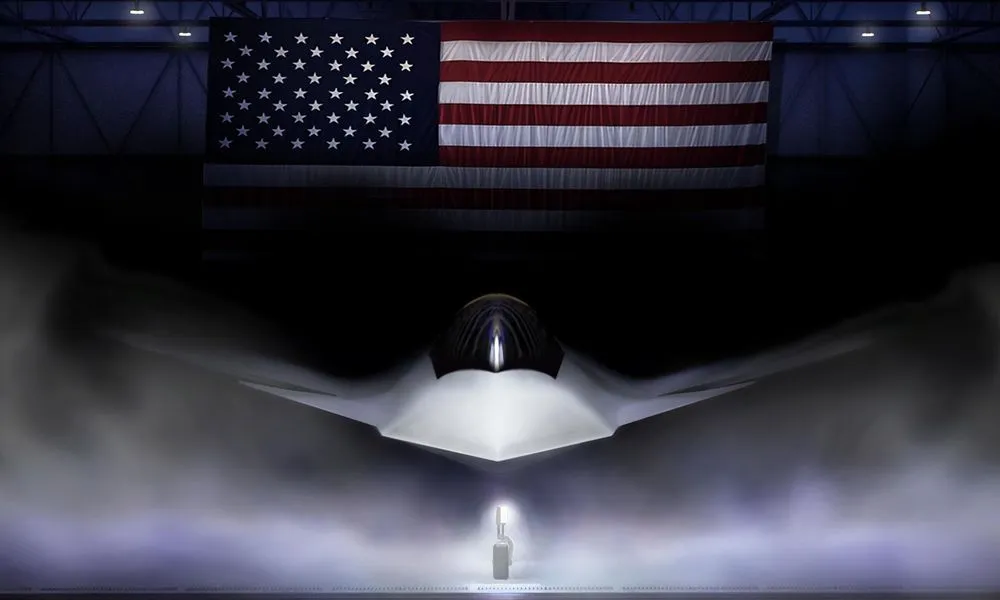
The US Air Force has reaffirmed that Boeing's next-generation fighter, the F-47, has entered Engineering and Manufacturing Development (EMD) and will fly during the current administration. According to Defense News, the first F-47 is still on track for a 2028 first flight, with a small number of aircraft to be built for evaluation. But it would not be accurate to treat 2028 as "the year America's sixth-generation fighter technology first takes to the sky." Two DARPA-backed X-planes made their first flights in 2019 and 2022, respectively, and each has logged hundreds of flight hours.
What has advanced now is the process of moving from technology demonstration to flying a test aircraft integrated as the F-47. The accumulated experience of the earlier aircraft underlies what the Air Force calls "unprecedented maturity," yet the aircraft's engine configuration and measured performance remain undisclosed. Moreover, the next-generation engine program, NGAP, continues development in preparation for potential aircraft integration work around 2030. The 2028 first flight is an important milestone, but it is not a date that fixes the specifications or fielding timeline of the finished aircraft.
Only a small number of EMD test aircraft will fly in 2028
US Air Force General Dale White, who oversees the F-47 program, explained in an official statement dated July 29, 2026, that the program has entered EMD with "unprecedented maturity." White's official phrasing is that "the F-47 will fly during the current administration." Defense News reported the following day, July 30, that the first aircraft remains on schedule for its 2028 first flight.
EMD does not mean the start of mass production. The contract the Air Force awarded Boeing in March 2025 covers the work of maturing, integrating, and testing all elements of the aircraft. It calls for producing a small number of test aircraft for evaluation and includes priced options for low-rate initial production. The number of test aircraft has not been disclosed.
Accordingly, the July 2026 update is not an announcement that "F-47 production has been decided for the first time." The EMD contract and the plan for a small number of test aircraft were already disclosed in March 2025, and in September of that year then–Air Force Chief of Staff David Allvin revealed that construction of the first aircraft had begun, with first flight targeted for 2028. What this update signifies is that the stage of actually integrating and evaluating the aircraft has progressed, and that the Air Force has not, as of now, backed away from this demanding schedule.
There is also a gap between first flight and operational fielding. EMD aircraft exist to test everything from flight controls, structures, and propulsion to mission systems; flying does not mean the aircraft is ready for use by operational units. Even if options for low-rate initial production are included in the contract, this does not indicate that the Air Force has exercised them or that the production configuration has been finalized.
The 2019 and 2022 X-planes compressed the schedule
In 2025, DARPA for the first time provided concrete details on the history of the technology demonstration effort leading to the F-47. Under DARPA research and development contracts, Boeing and Lockheed Martin each designed one X-plane to reduce risk for NGAD. The two aircraft made their first flights in 2019 and 2022, and each reportedly logged hundreds of flight hours.
This flight record offers a way to understand the roughly three-year span—from Boeing's selection in 2025 to 2028—as a compressed schedule. The Air Force did not begin studying aerodynamic shapes and operational concepts from scratch after the contract was awarded. It flew design candidates on earlier aircraft, gathered data, and then moved on to EMD for the F-47. Allvin's reference at the time of contract award to "the X-planes of the past five years" and White's use of "unprecedented maturity" this time both point to the same development path.
At the same time, the hundreds of hours logged by the X-planes cannot simply be added to the F-47's own flight record. DARPA's explanation shows that the two aircraft reduced technical and design risk, but it has not been disclosed that they shared the same outer shape, engine, or mission systems as the F-47 that Boeing will build following selection. 2019 and 2022 mark the first flights of demonstrator aircraft; 2028 marks the first flight of an aircraft integrated as the F-47.
With this distinction in place, the meaning of the Air Force's claim of the "world's first crewed sixth-generation fighter" also becomes clearer. This is the Air Force's designation for the F-47 as a program moving toward operational use—it is not a claim that no next-generation fighter flight testing existed before 2028. Whether the achievements of the earlier X-planes can be carried forward depends on whether the F-47 test aircraft can bring the same technologies together into a single functioning airframe.
The F-47's 2028 and NGAP's "around 2030"
Among the publicly known information, the largest unresolved element is propulsion. According to the Congressional Research Service, the Next Generation Adaptive Propulsion (NGAP) program is a competition between GE Aerospace's XA102 and Pratt & Whitney's XA103. Adaptive engines are designed to shift the balance between efficiency and thrust depending on flight conditions, aiming to let a single aircraft achieve both long range and high thrust.
However, the publicly disclosed timelines for the aircraft and the engine do not align. On July 27, 2026, Breaking Defense reported that John Sneden of the US Air Force's propulsion office said the service is preparing for "potential integration work" on NGAP around 2030. While noting the possibility that the next-generation engine could be installed on the F-47, he stressed that no final decision—including which platform would receive it—has been made.
If the F-47 is to fly in 2028 while preparations for NGAP aircraft integration point to around 2030, the question of what engine the first-flight aircraft will use remains open. The Air Force and Boeing have not disclosed the configuration. This gap in timing does not allow one to conclude definitively either that the aircraft will fly with an existing or interim engine, or that the 2028 schedule has collapsed. What can be confirmed is that, based on public information, the F-47 airframe's first-flight target and the preparations for next-generation engine integration are proceeding on separate timelines.
First flight serves as an entry point for verifying aerodynamics, structure, and control systems, among other things, with whatever configuration the aircraft has at that time. EMD involves maturing, integrating, and testing each element—from propulsion to software, sensors, and weapons—but the order in which the F-47 program will tackle these has not been disclosed. The mere fact that the aircraft takes off in 2028 does not mean that the production aircraft's range or thermal management capability, for example, will already have been verified.
$5 billion in development funding and a plan for more than 185 aircraft
The US Air Force's fiscal year 2027 budget request allocates $5 billion for research, development, test, and evaluation of the F-47. According to Defense News, the fiscal year 2026 allocation was $3.45 billion. This pattern of increasing spending ahead of first flight is consistent with the fact that building test aircraft and integrating systems are about to move into full swing. That said, because budget requests must go through congressional review, there is no guarantee that the $5 billion will translate directly into confirmed spending.
According to figures the Air Force has released, the F-47 procurement plan calls for more than 185 aircraft, with a combat radius exceeding 1,000 nautical miles and a speed above Mach 2. The Congressional Research Service lists the F-22's combat radius as 590 nautical miles, so the F-47's target reflects a design philosophy of reducing dependence on aerial refueling while reaching farther airspace. However, none of these figures represent performance measured on a production aircraft. The number of aircraft, too, is not a confirmed order but a current plan.
The F-47 acquisition plan is not complete on its own as a single aircraft. NGAD is a "family of systems" that includes, in addition to the F-47, the Collaborative Combat Aircraft (CCA)—semi-autonomous unmanned aircraft. If a crewed aircraft with a long combat radius can operate together with unmanned aircraft that distribute sensors and weapons, the result would be a force structure that goes beyond a simple one-for-one replacement of the F-22. Conversely, if communications with CCA, mission software, and basing and maintenance arrangements are not all in place, the F-47's performance alone will not be enough to realize the concept.
What should be confirmed in 2028 is not simply the fact that the aircraft flew, but with what engine and system configuration it flew, and how far the test envelope could be expanded. Based on those results, will the options for low-rate initial production be exercised, and will the plan for more than 185 aircraft move into actual budgets and orders? The true pace of the F-47's development will only become measurable after first flight.