

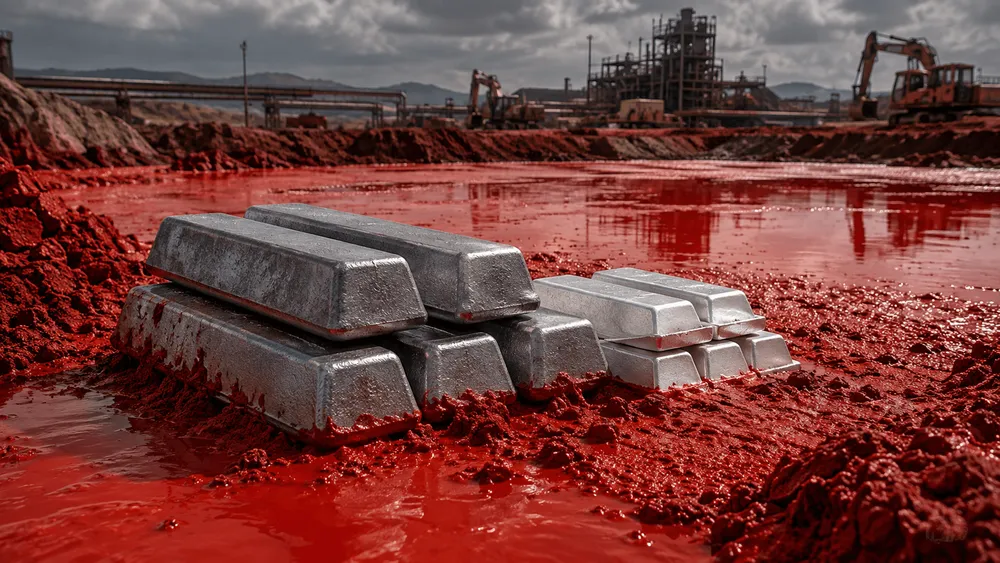
A massive environmental liability that the aluminum industry has carried for decades is now drawing attention as a potential goldmine of strategic resources.
When bauxite—the raw material for aluminum—is refined, it produces a huge amount of red sludge known as "red mud" as a byproduct. FAST Metals, a US startup developing patented technology to extract critical minerals from this waste, has raised $4.3 million in pre-seed funding. The round was led by New Climate Ventures, with participation from Azolla Ventures, Humba Ventures, Astor Swiss, and mining giant Rio Tinto (via Founders Factory).
Alongside the funding, the company also announced a partnership with mineral processing company Metalox Mineral. Under the deal, FAST Metals plans to process one ton of red mud per week at Metalox's facility in Florida, aiming to demonstrate the commercial-scale viability of its technology.
An Industry Sitting on 4 Billion Tons of Liability
Red mud is an unavoidable and troublesome byproduct of aluminum production worldwide. According to FAST Metals' estimates, the total volume of red mud accumulated globally to date exceeds 4 billion tons.
This waste is typically stored in enormous outdoor ponds or piles. Red mud is a toxic sludge with a strongly alkaline pH of 10 to 13, and it also contains heavy metals such as arsenic and chromium. In 2010, a dam holding a red mud reservoir at an aluminum plant in Hungary collapsed, sending a huge volume of toxic sludge into nearby villages and rivers—an incident that made the world acutely aware of the environmental risks this waste poses.
At the same time, buried within the large quantities of iron oxide that give red mud its red color are critical minerals such as titanium, scandium, and rare earth elements. According to the company's estimates, the metals contained in red mud worldwide are worth between $3 trillion and $4 trillion. While it has long been known that red mud is mineral-rich, the prohibitively high cost of separating those minerals from the tightly bound iron oxide has been the major barrier blocking practical use.
Alchemy: Covering Processing Costs With Iron, Turning a Profit With Rare Earths
According to FAST Metals CEO Sumedh Gostu, the company's patented technology is what breaks through this economic barrier. Gostu, a former technical director at mining giant Glencore, co-founded the company in 2025 together with Anthony Staley, a former CEO of a major smelting company.
The key to the breakthrough lay in leveraging another waste stream. "We realized that by utilizing a different waste liquid stream from aluminum refining plants, we could make the entire process very economical," Gostu told TechCrunch. The company uses this waste liquid along with other chemicals to progressively separate minerals from red mud through a six-stage chemical process.
This hydrometallurgical process first removes iron from the low-grade raw material, which dramatically improves the processing efficiency of the remaining material. "Selling the iron covers the operational costs of the business, and we make our profit from the other extracted materials," Gostu explains.
The margins on the remaining extracted materials are extremely high. For example, titanium dioxide trades at $2.50 to $3 per kilogram, while scandium oxide trades at around $750 per kilogram. As a result, miners can not only secure a new revenue stream from existing assets but also fundamentally reduce the total volume of toxic red mud and its management costs.
The US-China Rivalry and a Shortcut Called the "Artificial Ore Deposit"
If this technology proves viable, its significance will extend beyond waste management into the realm of geopolitics.
Currently, the United States and other Western nations depend on China for more than 80% of the refining of rare earths and critical minerals essential to the defense industry and high-tech manufacturing. The US Department of Defense has launched a $12 billion initiative called "Project Vault" to accelerate the stockpiling of critical minerals and the buildout of a domestic supply chain. In addition, starting in January 2027, regulations are set to take effect that will, in principle, prohibit defense contractors from sourcing rare earths from China and other such countries.
However, building up domestic production capacity in the US has proven difficult. Developing new mines takes many years, and even established companies are struggling to optimize their refining processes.
This is where FAST Metals' approach comes in. Rather than opening new mines, it taps into the 4 billion tons of "artificial ore deposits" that already exist above ground. Because this waste has already been extracted and gathered in centralized locations, the costs and environmental impact of mining and transport drop dramatically. If the demonstration program with Metalox proves out a low-cost recovery cycle, it could open a path to rapidly securing critical minerals by repurposing existing liability assets.