

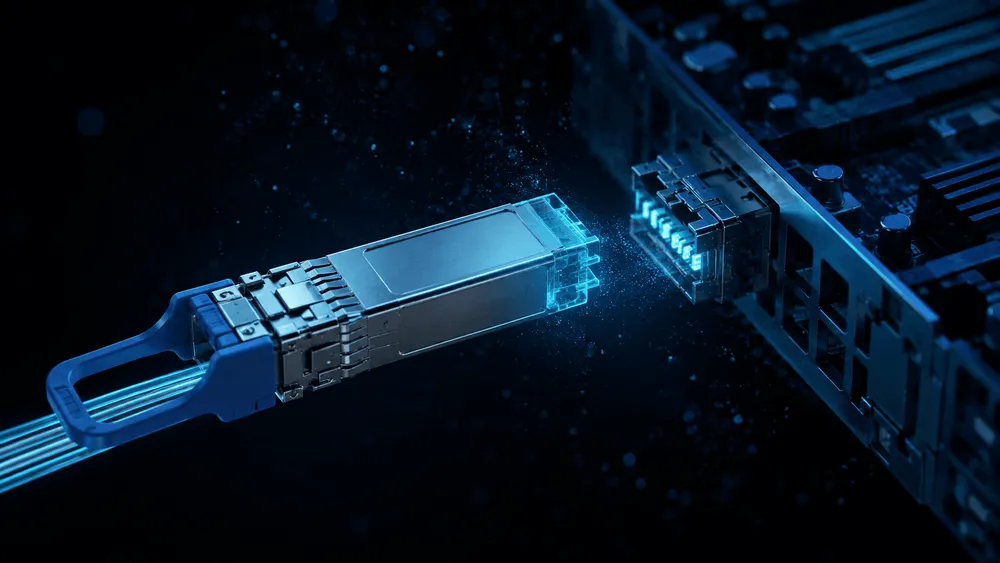
The pace at which AI data centers can expand depends on both the supply of GPUs and the procurement networks for the optical transceivers that connect servers to one another. In this market, China's Innolight (Zhongji Innolight) holds a 27% global market share (according to Counterpoint Research). Just five days after raising $6.81 billion (approximately ¥1.0692 trillion) in the Hong Kong market, speculation emerged that the company had become a target of a U.S. export ban. According to a Reuters report dated August 4, 2026, the U.S. Federal Communications Commission (FCC) is drafting a rule to ban new imports of Chinese-made optical transceivers. The stock market immediately pushed up shares of Coherent and Lumentum, but given that the regulation appears designed to apply only to new models, and given the precedent of the Huawei exclusion program—which began in earnest in 2021 and, five years later, remains only 42% complete in budget execution—reshaping the market map will not be easy.
Export Ban Speculation Emerges Five Days After Hong Kong IPO
Optical transceivers are components that connect GPU servers to one another at speeds of hundreds of gigabits per second, and as demand from AI data centers grows, the industry is transitioning from the 800G generation to the 1.6T generation. Innolight is the main player in this growth market.
Innolight (Zhongji Innolight) conducted an initial public offering on the Hong Kong Stock Exchange on July 30, 2026, raising $6.81 billion (approximately ¥1.0692 trillion, at ¥157 to the dollar). For full-year 2025, the company posted revenue of RMB 38.24 billion (up 60% year-on-year) and net profit of RMB 10.8 billion (up 109% year-on-year), with the share of overseas revenue rising to 90.58% from 86.8% the previous year. Backed by strong performance driven by demand for data-center optical transceivers, investor interest was intense.
Five days later, on August 4, Reuters reported that the FCC is drafting a rule that would ban imports of new Chinese-made models of optical transceivers for data centers. Whether the rule would take the form of an update to the Covered List or a new standalone regulation remains unconfirmed, as the primary document has not been made public. The stated purpose of the ban is cybersecurity measures to prevent data theft, malware installation, and denial-of-service attacks. The scope appears limited to imports of new models only, and is not designed to require the removal of equipment already deployed in data centers.
The stock market reacted immediately to the report. Shares of Coherent surged as much as 12–18% depending on the source, while Lumentum shares jumped 5–14%, and Amazon shares fell more than 1.7% on the view that AWS would face higher costs from having to switch away from Chinese-made components. The range in the magnitude of the gains reflects differences in timing and sources, but the direction was consistent. The market began pricing in a scenario in which Innolight, the largest supplier, gets shut out—even before the details of the rule had been finalized.
The Chinese Embassy in the U.S. protested, stating it would "take all necessary countermeasures against actions that seriously harm China's interests." The timing of the export ban speculation, coming right after Innolight had just raised $6.81 billion in the Hong Kong market, could hardly have been worse for the company. But at this stage, nothing has been decided about how far the rule will actually go.
Why Innolight, With Its 27% Global Share, Became a Target
One background factor behind Innolight apparently being targeted is its addition, on June 8, 2026, to the U.S. Department of Defense's "Chinese Military Companies List" (Section 1260H). This list, updated annually by the Department of Defense under the National Defense Authorization Act, designates companies suspected of ties to the People's Liberation Army; the designation itself carries no immediate legal effect. However, the Department of Defense's procurement ban applies to direct contracts with listed companies starting June 30, 2026, and will expand in stages by June 30, 2027, to cover procurement that includes products from listed companies. The August 4 report on the FCC's draft ban came roughly two months after this list update.
Behind Innolight becoming a target lies the sheer size of its market share. While Counterpoint Research's survey puts Innolight's global share of data-center optical transceivers at 27%, Innolight's own Hong Kong IPO prospectus and official website cite a different figure—21.2% of the "optical interconnect market," citing China Insights Consultancy research, along with the claim of having ranked No. 1 globally for five consecutive years. The discrepancy between the two figures likely stems from differences in the population being measured—"data-center optical transceivers" versus the broader "optical interconnect market"—though neither party has disclosed detailed calculation methods. Regardless of which figure is used, Innolight remains the single largest player in the world.
Looking at Chinese vendors as a whole, Innolight is just one company among many. Industry estimates suggest that the combined global share of all Chinese vendors, including other Chinese manufacturers such as Eoptolink, exceeds half the market. The scale of this combined share shows that dependence on China in the optical transceiver market is rooted in the very structure of the industry.
Innolight's full-year 2025 figures—RMB 38.24 billion in revenue and RMB 10.8 billion in net profit—demonstrate that it is one of the companies that most embodies the explosive growth in AI data center demand. Nvidia's decision in March 2026 to invest a combined $4 billion in Coherent and Lumentum and sign multi-year procurement agreements with them, in a rush to diversify its supply chain, was the flip side of this concern over concentration in a single supplier. In other words, nearly half a year before the export ban speculation surfaced, the industry's biggest player had already made its next move.
The Reality of a Regulatory Design That Makes "Immediate Export Bans" Unlikely
Even if the rule is published as planned, it is unlikely to bring about a change as abrupt as the phrase "immediate export ban" suggests. If the design targets only imports of new models and does not require a "rip-and-replace" of existing equipment, existing Chinese-made transceivers will likely remain in use until they fail or are due for replacement anyway. This design element alone means the practical impact of the rule is closer to a gradual replacement pressure than an immediate effect.
The record of the "Rip and Replace" program to remove Huawei and ZTE equipment supports this view of "gradualness." Congress allocated $1.9 billion in funding in 2021, but the total amount actually claimed by telecom carriers reached $4.9 billion—about 2.6 times the original allocation ($4.9 billion ÷ $1.9 billion). To cover the shortfall, it became necessary to draw on a $3.08 billion borrowing facility from the Treasury (under the Spectrum and Secure Technology and Innovation Act), and as of mid-2026, only 42% of the 126 targeted projects had been completed. Even a removal program with a clearly defined scope has failed to reach even half completion five years after it began.
A useful reference point is the FCC's existing "Covered List" mechanism. Following the enactment of the Secure Equipment Act in November 2021, the FCC established an equipment authorization ban rule in November 2022. Companies placed on this list are barred from obtaining new equipment authorizations, effectively halting the sale and import of new models within the United States.
Chinese manufacturers such as Huawei, ZTE, and Hikvision are already subject to this. If the current regulation takes the form of an addition to the Covered List, the legal framework already exists, potentially allowing it to take effect faster than crafting an entirely new rule from scratch. Conversely, if it is established as an independent new rule, the process—including public comment periods—would take longer, delaying enforcement.
If established as a new rule, FCC rulemaking is typically finalized after a public comment process. Opposition from telecom carriers and data center operators with heavy reliance on Chinese-made components is to be expected, and this process alone commonly takes anywhere from several months to about a year. While this rule, which does not require removal of existing products, has a narrower scope than Rip and Replace, practical issues such as defining the line for "new models" and certifying covered items could actually prove more complex. Given the lesson from the Huawei exclusion—which was not simply a matter of budget execution—it is reasonable to expect that a Covered List route could take a matter of months, while a new standalone rule could take multiple years, similar to the Huawei precedent. Which route the FCC takes will determine how long it takes for the export ban speculation to actually change procurement behavior in the market.
The China-Dependency Risk That Coherent and Lumentum Also Carry
The reason the stock market welcomed news favorable to Coherent and Lumentum is simple. In March 2026, Nvidia invested $2 billion in each company—a combined $4 billion—and signed multi-year procurement agreements with both. Coherent's data-center and telecom segment revenue has continued to grow 20–40% year-on-year on a quarterly basis, and Lumentum's quarterly revenue is already growing at a 90% year-on-year clip, putting both companies in a position to benefit most if Innolight were to be shut out of the market. Raymond James analyst Simon Leopold reportedly named Coherent and Applied Optoelectronics as the biggest beneficiaries.
At the heart of an optical transceiver is a semiconductor laser that converts electrical signals into optical signals. The compound semiconductor used for its substrate, indium phosphide (InP), has light-emission properties that silicon cannot replicate, making it difficult to substitute. China is said to control roughly 70% of global production of indium, the raw material used in InP. In InP substrate manufacturing, U.S.-based AXT and Sumitomo Electric together are said to account for roughly 80% of global production capacity. Many of AXT's production sites are located within China, leaving a geographic concentration risk in place.
When China introduced an export licensing system for indium phosphide-related items in February 2025, the price of InP substrates surged 250%. In simple terms, that translates to procurement costs ballooning to 3.5 times the original level. Coherent and Lumentum, seen as the "winners" here, are not outside this supply chain either.
To address this constraint, Coherent has set a plan to double its in-house InP wafer production capacity by the fourth quarter of 2026, and says it has already reached about 80% of that target. While the company discloses production sites in the U.S., Sweden, and Switzerland, it also relies in part on external supplier AXT (many of whose production sites are in China), and AXT is said to be carrying a substantial order backlog. Lumentum is also expanding its own InP-related production capacity, but reports indicate its order backlog is stacking up all the way to 2028. While it has been repeatedly reported that Coherent and Lumentum stand to gain if Innolight is shut out, both companies' own capacity-expansion plans are themselves not immune to this upstream supply constraint.
Even if the export ban does take effect, if the pace of increased production by alternative suppliers is constrained by the availability of InP substrates, replacing supply across the market as a whole will take even longer. What separates the "winners" from the "losers" is not the completeness of their products. Rather, it is a constraint shared by both camps—who can secure how much of an invisible upstream raw material—that determines the outcome.
Ripple Effects Extending to Sumitomo Electric and Furukawa Electric
This standoff also has ripple effects on Japanese companies. Sumitomo Electric may not be prominent in the finished optical transceiver market, but it holds a world-leading share in key internal components such as EML lasers and CW-LDs (continuous-wave laser diodes). The more Coherent and Lumentum rush to increase production, the more orders flow to Sumitomo Electric, which supplies these upstream components. The company has plans to expand its production capacity for AI-related optical devices.
In the optical fiber sector, Furukawa Electric is pursuing capacity-expansion investment on the order of ¥100 billion (approximately $640 million, at ¥157 to the dollar). Rising demand for AI data centers is pushing up the market for the finished product—optical transceivers. That benefit extends to business opportunities for component and material makers as well. If a ban on Chinese products were to take effect, orders to Japanese companies could increase as part of an alternative supply chain, but expanding EML laser and CW-LD production capacity requires capital investment and time to ramp up mass production, meaning the gap cannot be filled instantly.
This standoff is also not irrelevant to operators building and running AI data centers within Japan. If procurement costs for optical transceivers rise, this could spill over into the infrastructure investment costs of domestic cloud providers and data center operators. If the capacity-expansion investments by Sumitomo Electric and Furukawa Electric bear fruit, procurement options will broaden, but the effects will likely not become visibly apparent until 2027 or later.
Three Turning Points to Watch to Judge Whether the Export Ban Speculation Is Real
Putting all these pieces together, the conclusion is that the FCC's export ban speculation will not reshape the market map anytime soon. The regulatory design limited to new models, the precedent of the Huawei exclusion reaching only 42% completion after five years, and the shared weakness that even Coherent's and Lumentum's expansion plans remain tied to China-dependent upstream InP supply chains—all of these factors work to put the brakes on the pace of change. For Innolight, the $6.81 billion raised in its Hong Kong IPO also serves as the financial staying power to survive the grace period until the regulatory details are settled. The "immediate power shift" that the market priced in appears, at this stage, to have been a reaction that got ahead of itself.
There are three specific points in time worth watching. The first is when the FCC formally publishes its proposed rule, which could happen as early as later in 2026. The second is whether Coherent achieves its goal of doubling InP wafer production capacity by the fourth quarter of 2026. The third is the length of time it takes for the proposed rule to be finalized after the public comment period—if it follows a pattern similar to the Huawei exclusion, this process alone could take more than a year.
If the public comment period drags on for more than a year, similar to the Huawei exclusion, the rule's effective date will slip into 2027 or later, and the production capacity that Coherent and Lumentum have built up will find its way to customers beyond just those seeking to replace Innolight. Conversely, if the comment period wraps up within a few months and Coherent manages to overcome the InP substrate supply constraints in line with its Q4 target, then the stock surge on August 4 will prove to have been a correct prediction. That said, unless all three conditions align, it cannot yet be concluded that a genuine shift in the supply chain away from Innolight has occurred.