

On September 16, 2026, Mozilla announced a partnership with Mistral, adding Mistral Small 4 to the beta of Firefox's AI browsing feature, "Smart Window." Users in the US and Canada can now select it as a new model option, while France becomes the first market to receive Smart Window with official French-language support.
However, this doesn't mean Firefox's AI engine is being consolidated around Mistral. Mistral Small 4 takes on the "Personalized" role among three built-in models. What this partnership reveals isn't just about model openness—it's a design that separates user choice, the inference provider, identifying information sent during communication, conversation retention, and memory stored on the device, each controlled independently.
Mistral Is One of Three Options, Not a Fixed Choice
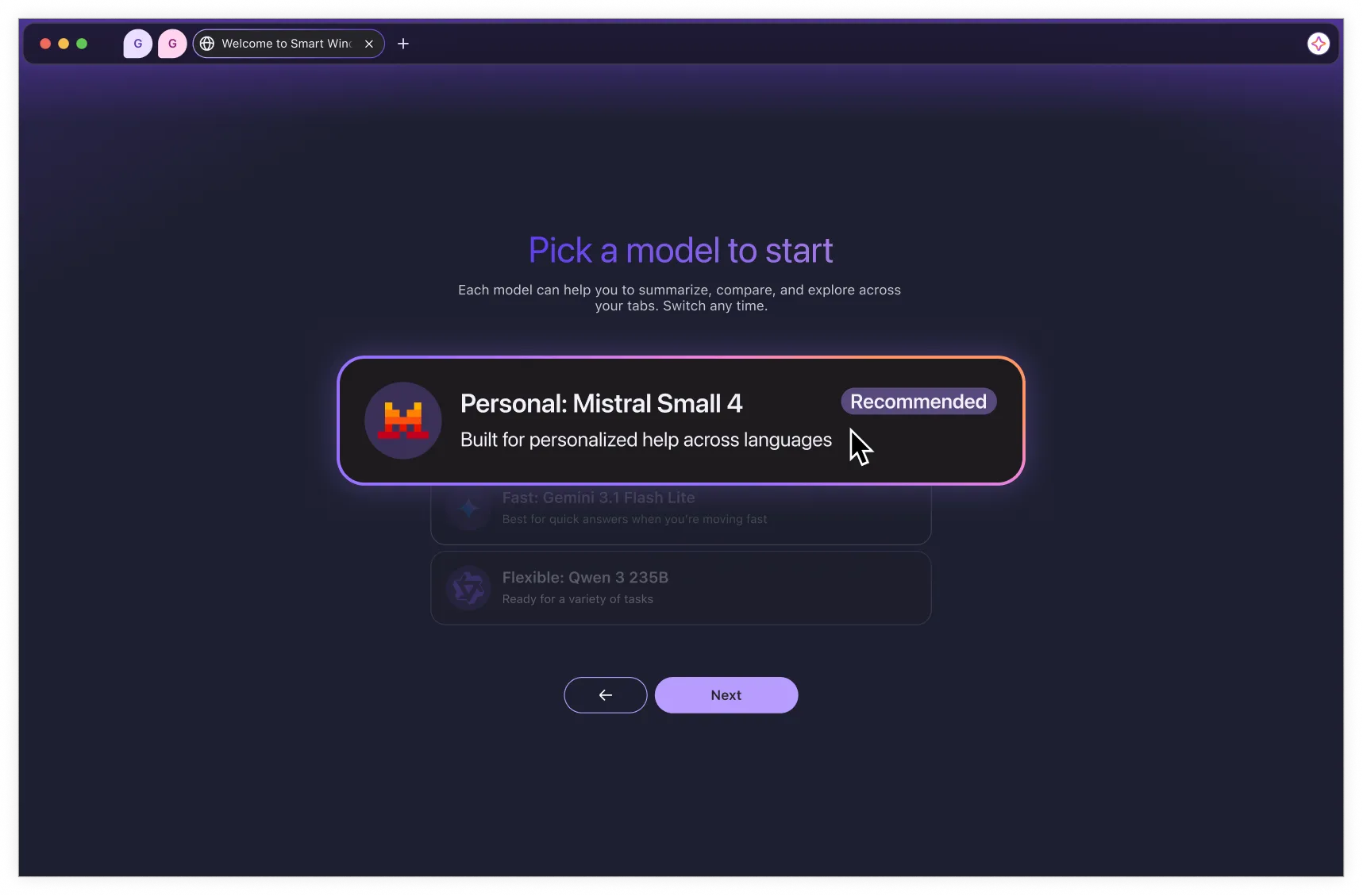
Smart Window is an optional window type that can be opened separately from regular and private browsing windows. With user permission, the built-in assistant can reference open tabs and browsing history to summarize pages, compare multiple tabs, help rediscover previously viewed pages, and assist with research or planning. This differs from the AI sidebar in regular windows, which displays third-party chat services alongside content but has different access to browser context.
Mozilla's current support documentation divides Smart Window's built-in models into three categories:
| Role | Model | Developer | Host | User-Adjustable Range |
|---|---|---|---|---|
| Fast | Gemini 3.1 Flash Lite | Google Cloud | Default model, current conversation | |
| Flexible | Qwen3-235B | Alibaba | Google Cloud | Default model, current conversation |
| Personalized | Mistral Small 4 | Mistral AI | Mistral AI | Default model, current conversation |
| Custom Model | Any OpenAI API-compatible model | User-selected | User-specified | Configure custom endpoint |
Mistral Small 4 is not the sole model powering Firefox Smart Window. It handles the "Personalized" role among three built-in models, alongside "Fast" (Gemini 3.1 Flash Lite) and "Flexible" (Qwen3-235B). Users can change both the default model and the model used for individual conversations, and advanced users can connect their own custom endpoint.
This structure implements, as a product setting, Mozilla's stated position: expanding partnerships while avoiding lock-in to any single company's model. Users who don't want to use Smart Window at all can disable it individually, and there are also controls to block Firefox's AI features entirely.
Why Mistral Small 4?
Mozilla has explicitly cited performance evaluation within Smart Window and multilingual capability as the selection criteria. France becomes the first market outside North America to receive the rollout, and Mistral states its policy of incorporating regional languages, dialects, and cultural context into model tuning. Rather than building an English-first feature and translating it later, the company frames this as factoring multilingual use into model selection from the start.
Mistral Small 4 is a unified model combining general instruction-following, reasoning, image input, and coding assistance. It's released under the Apache 2.0 license, with 119 billion total parameters. It uses a mixture-of-experts (MoE) architecture, drawing 4 of 128 expert blocks per token, resulting in 6 billion active parameters. Its context window spans 256,000 tokens and accepts both text and image input.
Compared to its predecessor, Small 3, Mistral states that a latency-optimized configuration cuts processing completion time by 40%, while a throughput-optimized configuration triples requests handled per second. However, this comparison was conducted by Mistral itself against its own previous generation—it is not a like-for-like comparison of latency within Smart Window against Gemini or Qwen. Mozilla says it conducted its own internal evaluation covering summarization, page-based questions, product comparisons, safety, and operational costs, but has not disclosed scores or the number of tests performed.
What Firefox users can confirm, therefore, is only that the model "met selection criteria for Smart Window use cases including multilingual support." There's no guarantee that model specifications like 119 billion parameters or a 256,000-token context window directly translate into Smart Window's usage limits or the context available in a single conversation.
Even With an Open Model, Inference Runs in the Cloud—Protection Operates in Layers
The fact that Mistral Small 4's weights are available under Apache 2.0 is separate from whether the model runs locally on your device within Firefox. Mozilla's support documentation states that the Smart Window version of Mistral Small 4 is hosted by Mistral AI. This announcement does not mean the 119-billion-parameter model runs directly on a user's PC.
Smart Window's protections are designed by separating communication from retention. According to Mozilla, requests to the model pass through a Mozilla proxy. As a result, model providers never receive the user's IP address or information that uniquely identifies their Firefox instance or device. Model providers temporarily process requests to generate responses but do not retain the conversation. Mistral also states it agreed, as a condition of the partnership, not to retain data.
Meanwhile, Mozilla states it does not collect or store conversations for training or human review unless users consent. This is not the same as saying "no data ever leaves the device." Response generation involves cloud processing; the core of the protection lies in stripping identifying information from what's sent to providers and ensuring conversations aren't retained after processing.
Furthermore, switching models doesn't change how data is handled on a per-model basis. Mozilla imposes common privacy standards and safety evaluations across all three models. The structure expands choice while keeping the minimum data protection standards unified on Firefox's side.
Even so, large language models' capacity for incorrect answers doesn't disappear. Mozilla itself lists hallucinations, harmful responses, and prompt injection via instructions embedded in web pages as known risks. It takes measures to limit what information can be input and to distinguish untrusted content from instructions, but this doesn't guarantee the accuracy of responses.
Memory Is Stored on Device, But Creation Passes Through a Server
Understanding Smart Window's "Personalized" feature requires separating the model from memory. Memory consists of short summaries generated from browsing history and Smart Window conversations, which users can optionally enable. Activity in private browsing windows is not included as material.
When memory is first created, it can draw on up to 60 days or 3,000 browsing entries—whichever limit is reached first. This material is sent to Mozilla's servers for temporary processing, and the completed memory is then returned to the device. Mozilla states it does not retain the source material after processing, while the memory itself is stored on the device. There is currently no cross-device sync.
Users can review which memories were used in a response, delete individual memories, or retry a specific conversation without using memory at all. However, stopping the creation of new memories does not delete memories that already exist. Fully disabling personalization requires not only turning off the learning settings but also deleting saved memories separately.
Reading only the description "stored on device" might suggest the entire personalization process happens locally. In reality, though, there are three distinct stages: server-side processing during creation, on-device storage after completion, and model-host processing at response time. Users should evaluate separately what data is sent, where it remains, and whether it can later be deleted.
What to Watch After France
Smart Window remains in beta. France becomes an officially supported market starting with Firefox 155, and Mistral expects the UK and Germany to follow within 2026. However, specific rollout dates have not been disclosed. Timing and Japanese-language support for Japan also remain unannounced.
The lineup of available models may change over time, and daily usage limits exist, though specific per-user figures haven't been published. It's also unclear which inference configuration of Mistral Small 4 is used within Smart Window, or how much of its maximum context window is actually made available.
The measure of Firefox's AI strategy isn't simply the fact that it added Mistral to its roster of partners. What matters is whether users can still switch models freely, whether they can turn AI features off entirely, and whether they can verify where each piece of data is processed and what remains afterward. As Mozilla expands into the UK, Germany, and beyond, the real test will be whether it can maintain these four principles without compromise.