

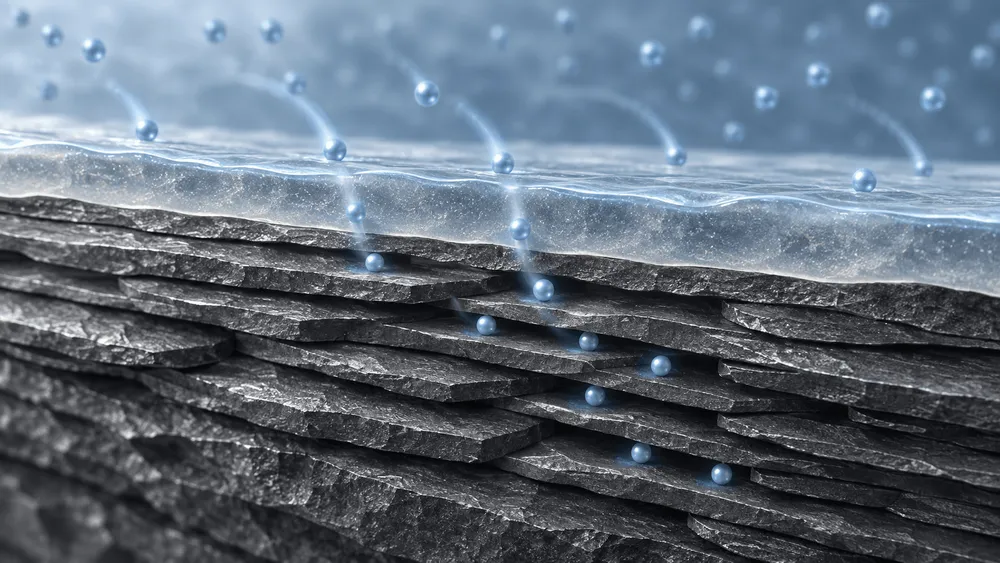
On September 7, 2026, the Japan Advanced Institute of Science and Technology (JAIST) announced the development of "FPTI," an electrolyte additive designed to protect the graphite anode in lithium-ion batteries. In test cells, capacity retention after 1,000 charge-discharge cycles reached 95.6%, compared to 62.7% without the additive. Rather than replacing the anode material itself, the achievement lies in refining the thin film that forms on its surface to boost durability. However, in configurations closer to actual batteries, the additive was not left in the electrolyte; instead, the anode was pretreated with it beforehand.
What Does the 95.6% Figure After 1,000 Cycles Actually Measure?
The research team used CR2025-type coin cells combining graphite and metallic lithium for the long-term testing. Such "half-cells" are configurations designed to examine the behavior of a specific electrode. This must be distinguished from lifespan testing of actual batteries used in smartphones or EVs.
According to the university's announcement, tests were conducted using electrolyte without FPTI and electrolyte with 2 mg/mL or 4 mg/mL of FPTI added. The charge-discharge rate, expressed as C-rate, was 0.1C for the first 3 cycles and 0.5C thereafter. The capacity retention rate was calculated against the maximum capacity obtained at around the 200th cycle.
| Half-Cell Electrolyte | Capacity Retention After 1,000 Cycles |
|---|---|
| Without FPTI | 62.7% |
| FPTI 2 mg/mL | 89.4% |
| FPTI 4 mg/mL | 95.6% |
All figures represent ratios relative to the maximum capacity achieved around the 200th cycle. Source: JAIST's research announcement.
Under the same test procedure, varying the amount of additive produced different rates of decline from the maximum capacity. In this sense, the results represent an intervention experiment examining the improvement effect of adding FPTI. However, interpreting this as "95.6% of the initial capacity remains after 1,000 cycles" would shift the basis of comparison. The university's announcement does not provide absolute values for either the maximum capacity or the capacity at the end of testing, so the actual amount of mAh retained cannot be confirmed.
Additionally, the three conditions compared do not necessarily mean only three test cells were used. The announcement does not specify the number of cells per condition, the number of repeated trials, or the variability in capacity retention rates. This information remains necessary for evaluating the magnitude and reproducibility of the effect.
What the Calculations Suggest About Reaction Order, and What the Experiments Measured About Resistance
FPTI is an imine compound featuring a fluorine-rich moiety and a sulfur-containing thiophene structure. The research team used this molecule in an attempt to stabilize the solid electrolyte interphase (SEI) that forms on the graphite surface. The SEI is a thin protective film created when part of the electrolyte decomposes; it allows lithium ions to pass through while suppressing further electrolyte decomposition.
When this protective film breaks down and reforms, lithium and electrolyte are consumed in the process. If film formation could be controlled, it might be possible to suppress the side reactions that cause capacity loss without changing the graphite material itself.
The calculations supporting the molecular design and the measurement results obtained from the cells need to be read separately. In calculations using density functional theory (DFT), FPTI's LUMO level was lower than that of typical electrolyte components or binders. LUMO refers to the lowest-energy unoccupied molecular orbital, and this calculation supports the explanation that FPTI is more readily reduced by accepting electrons first. This is a calculated result concerning reaction likelihood, not a value predicting battery lifespan.
Meanwhile, a reduction in resistance was measured experimentally. Comparing cells without the additive to those with 4 mg/mL added, SEI resistance dropped from 7.6 Ω to 2.2 Ω, and charge transfer resistance dropped from 41.8 Ω to 19.8 Ω. The latter refers to the resistance encountered when charge moves across the interface between the electrode and electrolyte.
Analysis of the anode surface also confirmed a film rich in lithium fluoride (LiF), along with components derived from FPTI's sulfur and imine groups. The university believes these contributed to film formation and stabilized the interface. However, measuring performance differences under varying additive conditions and pinpointing exactly how much each individual film component contributed to the improvement are separate verifications. Based solely on the correspondence between this surface analysis and the performance measurements, it cannot be concluded that the amount of LiF is the sole determining factor for lifespan.
Pretreating the Anode Separately, Without Direct Contact with the Cathode
In evaluations of full cells combining an NMC811 cathode with a graphite anode, the method of using FPTI changed. According to the university's announcement, this was because direct contact between the NMC811 cathode and FPTI increased resistance and degraded performance.
The research team therefore pre-cycled the graphite anode using an electrolyte containing FPTI, forming the protective film beforehand. This anode was then used to assemble a full cell with a control electrolyte that did not contain FPTI. In other words, the process of treating the anode surface was separated from the process of charging and discharging within the completed battery.
The energy densities reported for this configuration were approximately 130 Wh/kg for the control, approximately 192 Wh/kg for the anode pretreated with 2 mg/mL FPTI, and approximately 233 Wh/kg for 4 mg/mL. However, the university's announcement does not clarify whether this mass basis refers to the active electrode material or the entire cell. Therefore, this figure cannot be used as material for direct comparison with the specifications of commercially available batteries.
The energy density obtained from the full cell and the capacity retention rate after 1,000 cycles obtained from the half-cell are also separate metrics measured under different configurations. There is no basis for connecting the two to interpret the result as "a practical battery with 233 Wh/kg maintained 95.6% even after 1,000 cycles." Translating anode improvements into overall battery improvements requires combining materials and processes while accounting for compatibility with the cathode as well.
What Remains Before Mass Production: Long-Term Verification Including Pretreatment
The research was conducted by a team including Uday Sai Reddi, Bharat Srimitra Mantripragada, and Professor Noriyoshi Matsumi, and was published in the peer-reviewed journal Energy & Fuels on August 31, 2026. The paper's DOI is 10.1021/acs.energyfuels.6c02613. The results announced by JAIST are based on this team's own experiments, and reproducibility through independent replication by other research teams has not yet been confirmed.
JAIST states that, in addition to long-term testing in full cells closer to practical size, verification of temperature conditions and safety is also necessary. Furthermore, it must be confirmed whether the anode pretreatment process can be integrated into manufacturing lines and whether the targeted film can be reliably formed during mass production. The possibility of introducing this without major changes to existing equipment is the research team's outlook, not a result demonstrated on an actual production line.
In the university's announcement, Professor Matsumi stated, "We have already filed a domestic patent application for this research result," and the team is seeking development partners for joint research with companies. Whether this method of improving the surface while continuing to use graphite can help reduce the burden of battery replacement will depend on whether long-term performance under practical conditions can be achieved alongside a manufacturing process that includes this pretreatment step.