

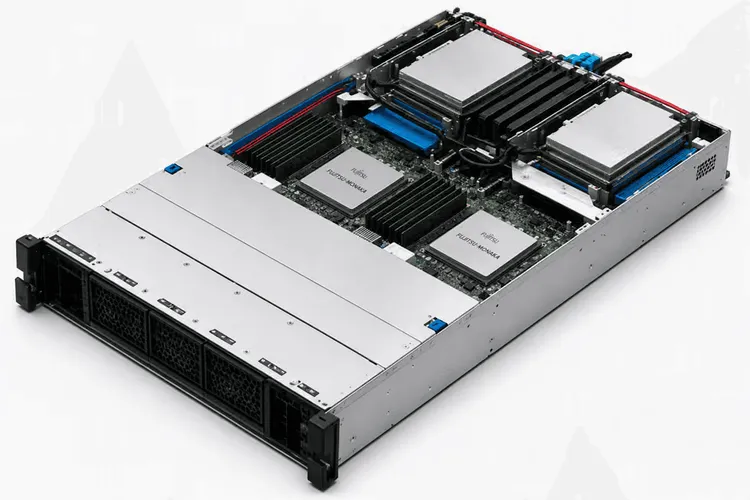
On September 14, 2026, Fujitsu announced that it will begin selling its domestically developed Arm CPU, "FUJITSU-MONAKA," as a standalone component, alongside the "Fujitsu MONAKA Server" that houses the chip, starting in November. MONAKA, which until now had only been discussed as a development plan or internal design, is becoming a product with two distinct distribution channels: the CPU component itself and the finished server. But it doesn't mean that anyone will be able to get their hands on a server starting in November. We need to separate what was confirmed in terms of product configuration in this announcement from the conditions that remain unresolved for evaluating performance, cooling, and sovereignty.
"On Sale" in November Doesn't Necessarily Mean "Available"
There are two entry points to MONAKA's commercialization. Starting in November, Fujitsu will sell the standalone CPU worldwide to cloud and data center operators as well as server vendors. In the same month, it will also sell the complete MONAKA Server in Japan and Europe. Target customers include businesses, universities, and research institutions, as well as the defense sector.
However, the terms "sales," "early availability," and "shipment" used in the announcement do not all refer to the same state. The "launch of sales" in November 2026 does not mean the start of general shipping. It will be preceded by early access for select customers, with sequential shipments to Japan and Europe beginning in April 2027 or later.
According to the timeline Fujitsu presented, actual units will first be provided to select customers in the second half of fiscal year 2026, followed by a transition to sequential shipping. The company has not disclosed the criteria for selecting these limited customers, nor the number of units to be provided. The date of "April 2027 or later" also does not mean that all models across the three server lines will be simultaneously available for immediate delivery in both Japan and Europe. November marks the milestone when sales begin; early access for select customers is set for the second half of fiscal 2026, and sequential shipments to Japan and Europe are positioned in the following fiscal year.
Selling the CPU as a standalone component opens up the possibility that other companies could design servers using MONAKA, separate from the route of purchasing a Fujitsu-made server. However, such adoption would require motherboards, firmware, an OS, and a maintenance framework. This announcement did not disclose the CPU's pricing, minimum order quantities, or supported platforms, so it's not yet possible to judge how large the component business will become.
The Three Server Lines Differ in Density and Cooling Method
Rather than a single standard configuration, the finished servers come in three lines: a 2U air-cooled model, a 1U scalable model, and a 2U multi-node model. What they share is a MONAKA CPU with 144 cores per chip and PCIe Gen6 support, but they differ significantly in CPU count, base clock frequency, cooling method, and storage configuration.
| Line | CPU and Base Frequency | Memory | Storage | Cooling / Primary Purpose |
|---|---|---|---|---|
| 2U Rack | 2 CPUs, 144 cores each at 2.1GHz | RDIMM, 24 slots | E3.S×4, M.2×2 | Air-cooled. Existing data centers, edge deployments, GPU expansion |
| 1U Scalable | 1–2 CPUs, 144 cores each. Air-cooled 2.1GHz / liquid-cooled 2.9GHz | 12 slots with 1 CPU, 24 slots with 2 CPUs | E3.S×8, M.2×2 | Air- or liquid-cooled. Configuration changes via CDI/CXL |
| 2U Multi-node | 4 nodes, 2 CPUs each. 144 cores each at 2.9GHz | 24 slots per node | E1.S×2 and M.2×2 per node | Liquid-cooled. AI data centers and large-scale computing |
Source: Fujitsu's announcement dated September 14, 2026. The frequencies listed are the base values shown in the product specification sheet, distinct from the CPU's maximum operating frequency of 3.8GHz.
The 2U multi-node model, with 8 CPUs at 144 cores each, reaches 1,152 cores per chassis. This figure represents configuration density, not overall processing performance of the chassis. Actual effective performance depends on how far an application can be parallelized and across how many nodes memory bandwidth is utilized.
For the 1U model, the base frequency of 2.9GHz under liquid cooling is roughly 38% higher than the 2.1GHz under air cooling (calculated as 2.9÷2.1−1). However, this frequency difference cannot be directly translated into a performance or power-efficiency gap. Fujitsu has not disclosed power consumption by model, sustained clock frequency under full-core load, or the costs involved, including liquid-cooling equipment.
Materials presented at ISC in 2025 included more detailed specifications for the 2U air-cooled model and multi-node proposal, such as memory capacity of up to 6TB. However, that table explicitly noted the specifications were subject to change. While this sales announcement discloses the number of RDIMM slots, it does not state maximum capacity. Therefore, the 6TB figure cannot be treated as a confirmed specification for the currently announced sales models.
"2x" and "80% Reduction" Are Not the Same Performance Metric
Fujitsu states that by combining dedicated matrix operation instructions, Arm SVE2, and software optimization, it can double AI inference throughput compared to competitors' CPUs. The company also claims this can halve the number of servers and power consumption needed for the same workload. The product page further states that the CPU alone can run 30–70B parameter-class LLMs with "practical performance."
The figures "2x," "halved," "up to 80% reduction," and "30–70B" cannot be placed side by side as a performance table under identical conditions, because at least some of the comparison targets, model settings, cooling standards, and token generation speeds have not been disclosed.
| Claimed Figure | What It Measures | Key Undisclosed Conditions |
|---|---|---|
| 2x competitors' CPUs | AI inference throughput | Comparison CPU, model, precision/quantization, batch size, software, whether measured or estimated |
| Halved server count and power consumption | Equipment and power needed for equivalent workload | Server configuration, workload, measurement scope, whether it includes components beyond the CPU |
| Up to 80% reduction in cooling power | Power used for server cooling | Comparison cooling equipment, load, outside air/water temperature, whether it includes the entire facility |
| Practical execution of 30–70B models | Scale of LLM that can be handled | Model name, precision/quantization, context length, batch size, output speed |
This table, as of September 15, 2026, categorizes the items disclosed in Fujitsu's announcement and product page. The absence of disclosure does not mean the performance claims are false—it means the industry is not yet at a stage where third parties can replicate the same conditions and make comparable measurements against other products.
Regarding cooling, Fujitsu states the system can operate with ambient air temperatures up to 40°C and water temperatures up to 45°C. Tolerating higher-temperature air or water could reduce the workload on cooling equipment. However, the meaning of "up to 80%" changes depending on whether the baseline is internal server fans, cooling water equipment, or the entire data center's cooling power. It is not a figure representing an 80% reduction in a facility's total power consumption.
Fujitsu has begun trial evaluations with test units to verify performance and application behavior in customer environments. What implementers need to do is fix their specific model, quantization, input/output length, and concurrency, then measure token generation speed and overall server power consumption. If choosing liquid cooling, the power consumption of supporting equipment—including pumps and heat exchangers—cannot be separated from the calculation either.
Extending Beyond the Chassis with CXL Requires a Complete Setup
As a feature of the 1U model, Fujitsu highlights a configuration that uses CDI and CXL to place memory and accelerators beyond the boundaries of a single server. The goal is to allocate resources to whatever host needs them, rather than fixing resources per CPU and leaving them underutilized.
Official materials from the CXL Consortium define memory pooling as a mechanism for allocating and releasing CXL-connected memory to different hosts as needed. Meanwhile, "sharing"—where multiple hosts simultaneously access the same memory—is a separate function. The mere ability to pool memory does not mean every application sees it as a single shared memory space.
Moreover, CXL cannot function on CPU capability alone. It requires compatible memory devices, accelerators, switches, plus a Fabric Manager and software to allocate resources. Fujitsu's announcement does not specify in what combinations these components can be purchased, nor whether the offering supports pooling, sharing, or both. The raw bandwidth figures touted for CXL 3.0's x16 link are specification values as well, not the effective bandwidth or latency of this particular server.
In short, what has been confirmed for the 1U model is the design direction enabling use of resources beyond the chassis, along with PCIe Gen6 support. Making a deployment decision would require knowing what CXL devices are sold, the connection configuration, management software, and failover procedures.
Domestic Server Manufacturing and CCA Address Different Layers of Sovereignty
The MONAKA Server is designed and developed domestically and manufactured at Fujitsu's Kasashima plant. The company states it will make component origin and manufacturing history traceable. Knowing where a server is assembled and being able to track its supply history increases procurement transparency.
The Arm Confidential Compute Architecture (CCA) adopted by the CPU addresses a different issue. CCA's "Realm" hides data being processed within a virtual machine from hypervisors and other high-privilege software, making it difficult to view or alter. It's a mechanism that isolates access to Realm contents while still allowing system administrators to manage hardware resources.
However, even CCA has software components that must be trusted. According to Arm's own explanation, a compromised hypervisor could still interfere with Realm execution, meaning availability is not guaranteed. What CCA protects is primarily data in use—it does not automatically determine where data is stored geographically, compliance with domestic law, component origin, or who operates the system.
Fujitsu itself explained in February 2026 that sovereignty requires not just minimizing the risk of data leakage, but also autonomous operation and compliance with domestic law. The company also cited transparency of security risks and the ability to independently manage the technology. Domestic manufacturing and component traceability address the supply side, while CCA handles isolation of data in use—but legal and operational conditions must be separately designed by the implementing organization.
Even the term "domestically made" has boundaries. What can be confirmed here is domestic server design and development, manufacturing at the Kasashima plant, and component traceability. The announcement does not state that the entire semiconductor manufacturing process or all constituent components are completed domestically.
Figures to Watch After Commercialization
MONAKA has progressed from a development goal of a 144-core domestic CPU to application-specific finished servers and standalone CPU sales. With the product specification sheet now available, options such as air- versus liquid-cooling, rack versus multi-node configurations, and GPU expansion versus CXL can be compared. Commercialization is a genuine step forward.
At the same time, pricing, maximum supported memory capacity, per-model power consumption, supported operating systems, a GPU compatibility chart, and purchasable CXL configurations remain undisclosed. The volume of general shipments is also unknown. To translate the claimed "2x" performance or "up to 80% reduction" into procurement decisions, results using identical models and equipment conditions from the second-half fiscal 2026 early access program need to be published.
By the time sequential shipments begin in April 2027 or later, if customer hands-on verification reveals token generation speed and overall server power consumption, and if the division of responsibility between CXL configuration and sovereign operation is settled, MONAKA will move beyond its label as a "domestically made CPU" and become an AI platform that can be chosen through genuine comparison.