

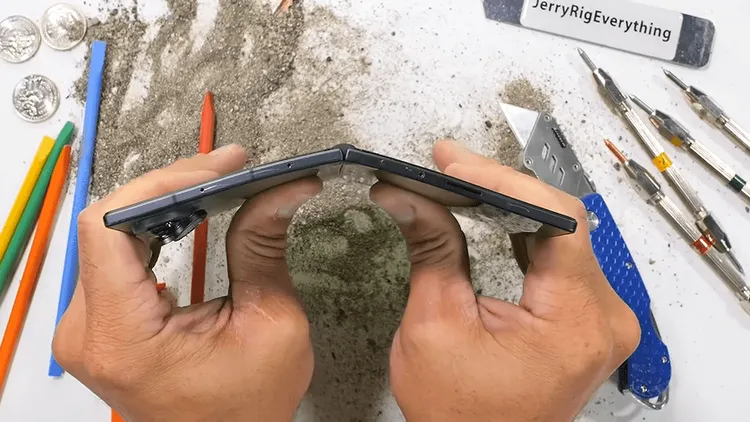
A single unit of Samsung's foldable smartphone "Galaxy Z Fold8" withstood a destructive test involving strong reverse bending. In a video published by JerryRigEverything on August 8, 2026, even when significant force was applied to the now shorter and wider body, the frame and hinge did not break, and the screen continued to function. In a follow-up teardown released on the 10th, the support structure beneath the screen—which Samsung calls "Flex Titanium"—and the wireless charging coil, now positioned lower on the body, were revealed. What emerged from this single test was both the structural resilience confirmed and the constraints that remain around the screen surface and magnetic accessories.
A 201g Wide Body Survives the Bend Test
The Galaxy Z Fold8 measures 123.9×161.4×4.5mm when open and 123.9×81.9×9.7mm when closed, weighing 201g. The previous, more vertically-oriented Galaxy Z Fold7 measured 158.4mm tall, 72.8mm wide, and 8.9mm thick when closed, weighing 215g. Fold8 reduced height by 34.5mm, increased width by 9.1mm, and shed 14g, while closed thickness increased by 0.8mm. These figures alone show that Fold8 isn't simply a thinner extension of the previous model—it's a fundamental redesign that changes how the device is held.
In JerryRigEverything's test, force was applied to fold the open device backward against the screen. The frame flexed but did not break, and the hinge sides did not separate. Even after the test, the inner screen continued to display and respond to touch. Despite the shift to a shorter, wider form factor, in this single unit, the chassis and hinge absorbed the load.
However, this is not a standardized test with fixed load or repetition counts. Long-term failure rates involving drops, repeated opening and closing, or water exposure remain unknown. What was confirmed is only that the one unit featured in the video did not immediately fail under strong bending. Still, the fact that the chassis didn't break in a product's first year adopting this new form factor helps ease concerns about early structural failure.
Two Layers of Flex Titanium Support the Screen From Below
The metal plate exposed in the teardown is part of the Flex Titanium that Samsung had described before launch. The structure has two stages. Directly beneath the OLED panel sits a thin titanium alloy film, and further below, a titanium plate supports the display module. According to Samsung, the film offers 20 times the mechanical strength of the previous polymer film while being roughly one-third the thickness of a human hair.
Using a hard metal at the fold line requires ensuring flexibility. Samsung achieved this by arranging tiny perforations along the fold line of the titanium plate. The film supports the OLED directly from below, while the plate supports the display module further down. In the teardown video, the titanium support structure described in official materials was extracted from the actual unit.
The previous generation Fold7 also used a titanium plate layer. In Fold8, the polymer film directly beneath the OLED was replaced with a titanium alloy film, resulting in a two-layer support structure combined with the existing titanium plate. Therefore, calling it a "titanium screen" isn't quite accurate. What titanium reinforces is the support structure beneath the display surface.
The Inner Screen's Softness Remains Unchanged
In the durability test, while the outer cover glass scratched similarly to typical smartphone glass, the folding inner screen showed marks even from light pressure. The topmost layer that fingers touch remains soft, and adding titanium beneath doesn't change the surface's susceptibility to scratching. The same care required with foldable devices—avoiding pressing fingernails or sharp objects against the screen—still applies to Fold8.
Here, extending Samsung's "20 times" figure to the device's overall strength would be a mistake. The comparison is between old and new film materials, not the frame's bending strength or the screen surface's scratch resistance. The bend test results reflect the behavior of the actual unit combining the chassis, hinge, and support structure beneath the screen. Which component contributed how much cannot be isolated from the video alone.
The same caution applies to battery labeling. The two disassembled cells were marked as lithium-ion, but this label doesn't indicate whether silicon-carbon is used in the negative electrode. Samsung's published capacity figures are 4,800mAh typical and 4,660mAh rated, and the label alone cannot confirm internal materials.
The Qi Coil Moves Lower, Magnets Shift to the Case
The most practically significant discovery from the teardown concerns the position of the wireless charging coil. The circular coil sits well below the center of the back panel, and no ring-shaped magnet array like those used for Qi2 was found inside the device. This is not an incidental assembly detail. Samsung explains on its support page that the coil was moved from center to lower on the body to match the new screen aspect ratio, and notes that charging may not begin unless the charging pad's center is aligned with the coil.
A lower coil position means users may need to adjust alignment with traditional charging stands or docks. Large wallets or mobile battery packs, when attached to align with the coil, may extend beyond the bottom edge of the device. Samsung's solution lies with the case. The official Clear Magnet Case incorporates magnets designed to hold compatible chargers and accessories in position aligned with the coil. Rather than building positioning into the device itself, this approach delegates magnetic alignment to a separately sold case.
There are also conditions on the charger side. Samsung notes that third-party products may have different coil configurations, meaning charging could be interrupted even when the device is centered, and recommends checking for WPC Qi certification. Cases exceeding 5mm in thickness or those with card slots must also be removed. Samsung has also explicitly noted that magnets in the official case may interfere with camera autofocus, compass functions, wireless charging, and NFC. Having magnets doesn't automatically improve usability—checking positioning and compatibility remains necessary.
What buyers can verify first isn't resistance to extreme bending but everyday charging conditions: whether their existing charging pad can properly align with the lower-positioned coil, and whether magnetic accessories interfere with the bottom edge of the device or the vertically arranged camera module. These two points deserve confirmation before selecting a case or charger. As for the chassis's long-term durability, the answer will come from post-launch repair statistics and units that have endured repeated opening and closing over time.