

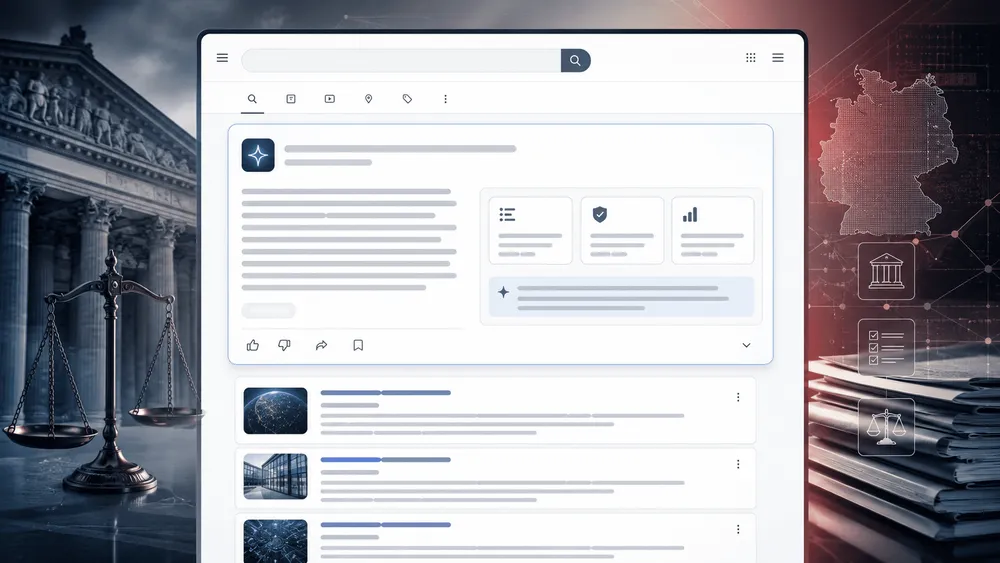
On July 14, 2026, Germany's Commission for Licensing and Supervision (ZAK) explicitly applied the Media State Treaty (MStV) to AI search and AI chatbots for the first time, targeting Google's "AI Overviews" and Perplexity. Traditional search services have long been regarded as intermediaries that help users find third-party information, but generative AI produces new text based on search results. ZAK drew a line here, treating the generated response as the operator's own content, while regarding the sources listed afterward as guidance toward third-party content. On a single search screen, two distinct forms of responsibility now arise: that of a content originator and that of an intermediary.
The First Administrative Orders Differ for Google and Perplexity
ZAK is a joint body composed of the heads of media supervisory authorities from Germany's 14 states. It oversees nationwide online media, with each case prepared and enforced by the relevant state authority. In this instance, the Hamburg/Schleswig-Holstein Media Authority handled the Google proceeding, while the Berlin-Brandenburg Media Authority handled the Perplexity proceeding.
For Google, the issue was how AI Overviews is positioned. The AI-generated response is displayed prominently as the main part of the search results, pushing the traditional list of links further down. ZAK judged that prioritizing Google's own content—the AI response—while making the traditional links harder to find constituted unjust discrimination.
Perplexity, on the other hand, functions as a chatbot that appends links to third parties as "Sources" or "additional information" after its response. Which sources are chosen and where they are placed determines whether users can find the original content. ZAK judged that this function meets the requirements of a media intermediary.
However, only a summary of the order has been made public; the specific corrective measures ordered for each company, compliance deadlines, and whether any financial penalties are involved have not been disclosed. Since both companies can seek legal remedies, this is not yet a finalized judicial decision. In a statement to Reuters, Google indicated it plans to appeal, countering that AI summaries help users discover new content and ask follow-up questions. Perplexity declined to comment on the order itself.
AI Responses as Own Content, Links as Media Intermediation
Through this two-part distinction, ZAK did not extend the liability exemptions provided under the EU's Digital Services Act (DSA) to generated responses, separating them from search-and-link intermediary functions. Articles 4 through 6 of the DSA grant intermediary services—such as transmission, caching, and hosting—exemption from liability for third-party information under certain conditions. In the case of hosting, this applies to information provided by users of the service.
ZAK views AI responses as falling outside these conditions. Rather than storing and displaying text posted by users, the operator's system summarizes, condenses, and blends multiple pieces of information into new wording. A legal opinion commissioned by Germany's state media supervisory authorities also concluded that, except in cases where it is clear to users that third-party text is being presented as-is, generated responses should in principle be considered the operator's own content.
This does not mean that search services as a whole fall outside the scope of the DSA. The part that gathers candidates from the web and lists them as links continues to function as an intermediary. As a result, even within the same service, generated text is subject to general liability law, while third-party links are subject to obligations of transparency and non-discrimination.
Transparency and Non-Discrimination Obligations Apply from One Million Monthly Users
The MStV defines media intermediaries as telemedia services that aggregate, select, and publicly present third-party journalistic and editorial content—such as content from newspaper or broadcaster websites. Article 91 applies these rules even when an intermediary function is embedded within another service. This provides the basis for covering a search screen that integrates AI responses with citation links.
Application of these rules depends on scale. If the average number of monthly users in Germany over the most recent six months is below one million, Articles 92 through 94—which cover designated agents, transparency, and non-discrimination—do not generally apply. However, the obligation to submit the required documentation under Article 95 remains. Intermediaries specialized in product or service information, as well as private or family use, are also excluded from Articles 92 through 94. Thus, small-scale AI chatbots are not automatically subject to the same obligations as of today.
Once a service falls under these provisions, Article 92 requires designating a domestic agent for service in Germany and clearly indicating this on the service. Article 93 requires the continuous, plain-language disclosure of the criteria used to include and retain content, as well as the main criteria and their weighting used for aggregation, selection, and display—including how algorithms function.
Article 94 prohibits intermediaries from discriminating against journalistic and editorial content in ways that significantly affect its discoverability. A violation can occur if there is a systematic, unjustified departure from published criteria, or if the criteria themselves systematically and unfairly disadvantage a particular service. ZAK framed the hierarchy between Google's AI responses and traditional links precisely as this kind of discoverability issue.
"We Added a Link" Is Not the End of the Story
Google has been strengthening links to websites. In an official statement on June 3, 2026, the company said that AI Overviews had surpassed 2.5 billion monthly active users, and cited efforts such as inline links within responses, the "Preferred Sources" feature allowing users to prioritize certain sites, and labeling for subscription media. It has also begun testing a Search Console management feature—currently limited to some sites in the UK—that lets site owners opt out of having their content used in generative AI search.
Even so, ZAK's underlying question remains. The issue is not whether links exist, but where the operator's own generated response is positioned relative to third-party content. Perplexity, in its official help documentation, also explains that it performs real-time web searches and generates direct answers by integrating multiple sources. While it attaches citations and original links to each response, it positions its value proposition as saving users the effort of visiting numerous pages.
Research on user behavior reinforces why regulators are focusing on screen layout. The Pew Research Center analyzed 68,879 Google searches conducted by 900 U.S. adults in March 2025. Among visits where an AI summary was present, traditional links were clicked 8% of the time, compared to 15% when no AI summary was shown. Only 1% of users clicked through to citation links within the AI summary itself. While this reflects a limited time period and sample within the U.S., it underscores the need to distinguish between adding source links and actually increasing traffic to original sources.
An Unfinalized Administrative Order Opens the Next Point of Contention
This ruling connects to a civil case from roughly a month and a half earlier. On May 28, 2026, the Munich Regional Court I issued an injunction against a specific display in AI Overview, which had linked two publishers to fraud and dishonest business practices. The case number is 26 O 869/26. The court held that because the display summarized and evaluated search results in its own words, creating a new claim, it could be attributed to the search operator.
However, this preliminary injunction concerns a separate matter under civil law regarding infringement of corporate personality rights, and had not become final as of the court's June 12 announcement. ZAK's order, by contrast, is an administrative proceeding concerning transparency and non-discrimination under media law, with a different legal basis and remedy. What the two share is the underlying idea that AI-generated summaries should not be treated merely as a display of third-party information.
Separately from ZAK's ruling applying the current MStV, the commissioned legal opinion also raised a future legislative issue. It recommended establishing an independent telemedia category under state law to more clearly address AI search services that combine generated responses with link intermediation. This is not a decision by a regulatory authority or a court ruling, but a non-binding opinion from experts. Nevertheless, it raises the question of whether, even while applying existing intermediary regulations, a legal category specific to AI search should be created.
Article 109 of the MStV lists measures for violations, including pointing out the violation and prohibiting provision of the service. Where necessary, a service can be blocked, and authorization can be revoked or withdrawn. It has not been disclosed to what extent these measures were applied in this order. Beyond the appeals filed by Google and Perplexity, confirming exactly what the authority is demanding and whether the display of AI responses versus traditional links actually changes will reveal how strong a precedent Germany has established.