

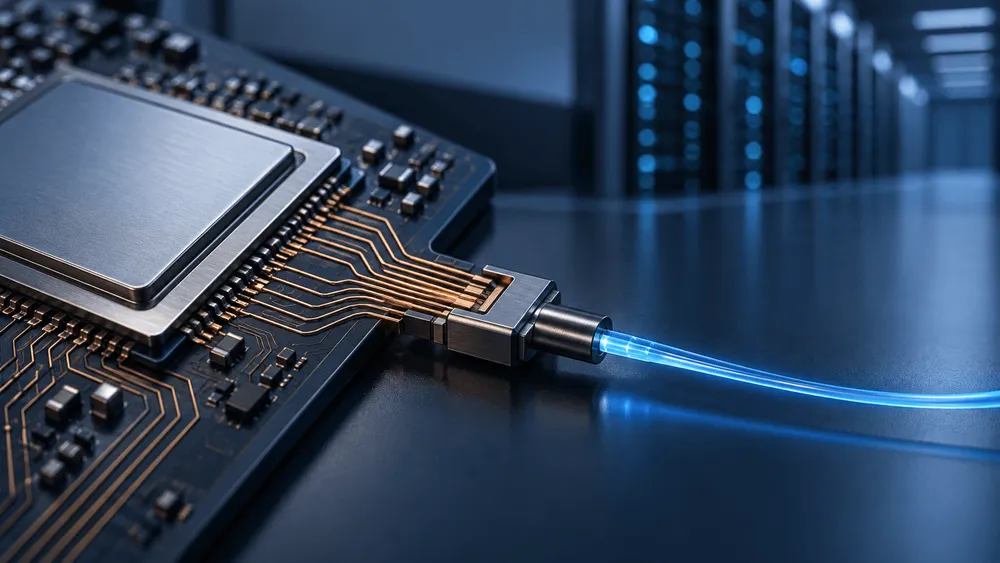
GlobalFoundries (GF) and Marvell announced on September 17, 2026 that they will expand manufacturing capacity for silicon germanium (SiGe), which underpins optical connectivity in AI data centers. Building on existing production at GF's site in Burlington, Vermont, the two companies are extending their multi-year agreement. It covers pluggable optical transceivers as well as NPO (near-packaged optics), which places optical components close to the processor, and CPO (co-packaged optics), which integrates them in the same package. Moving large volumes of data with light still requires high-speed electrical circuits to handle the signals before and after the optical stage. The capacity expansion supports AI infrastructure's optical links from the supply side of those circuits.
Expanding existing SiGe production in Burlington
The companies have collaborated for more than a decade. The expanded agreement builds on the production established over that time and adds manufacturing capacity to meet Marvell's growing demand. GF describes the AI data center as a distributed computing system and says moving data efficiently between accelerators is becoming increasingly important.
It is also notable that the capacity covers pluggable optical transceivers alongside NPO and CPO. An optical transceiver is a module that sends and receives optical signals, while NPO and CPO refer to approaches that place optical components close to, or inside the package of, compute and communication chips. The inclusion of all three suggests that GF and Marvell expect demand for high-speed signal-handling circuits to continue regardless of how the optics are attached.
According to GF, its current SiGe technology supports optical connectivity at 200Gbps per lane. A lane is an individual transmission path that carries data, so this figure does not represent the total bandwidth of an optical module. GF also has development plans for faster generations, but the announcement does not say that this agreement raises transmission speeds. What it increases is manufacturing capacity.
The investment amount, the added production volume, and the timing for when the new capacity will come online were not disclosed. How large the effect on supply will be, and when it will appear, remains to be seen as details emerge.
High-speed electrical circuits behind optical transmission
GF's description of its SiGe technology lists amplifiers and drivers for optical communications among its applications. Drivers drive the signal, and amplifiers boost it. The performance of an optical link depends on combining the part that carries light with electrical circuits like these.
SiGe stands for silicon germanium, and GF offers technology that combines high-speed SiGe transistors with CMOS, a semiconductor process also widely used for digital circuits. GF says this combination allows high-frequency and analog circuits to be designed together with digital circuits on the same chip.
Silicon photonics, by contrast, is a technology for building optical circuits in silicon. In this announcement, GF said it will combine SiGe, silicon photonics, and advanced packaging to support optical connectivity such as NPO and CPO. Optical circuits, high-speed electrical circuits, and the packaging technology that ties them together each play a role.
This shows that growth in optical connectivity also creates demand for manufacturing electrical circuits. Even if optical circuits can be integrated compactly, whether the surrounding circuits can be supplied in the required numbers is a separate challenge. Rather than lumping GF's expansion in with new silicon photonics technology, it is easier to understand as an agreement that deepens the supply of circuits made with SiGe, one of the components that make up an optical link.
Beyond more capacity: the conditions for combining components
Alongside securing manufacturing capacity, Marvell is working on common specifications for integrating optical components into equipment. In a technical explainer published May 28, the company said Open CPX, in which it participates, is developing specifications for integrating NPO and CPO into switches and servers. The aim is to make components from multiple manufacturers work together.
The scope goes beyond connector shapes to include thermal handling and electrical interface specifications. Optical signals and management interfaces also need to be aligned, so components coming off a production line cannot necessarily be installed in equipment as is. Marvell itself says that even with a common specification as a foundation, implementations will differ by customer and manufacturer.
There has been no announcement that the GF agreement sets out supply dedicated to Open CPX, and the two efforts are separate. Still, placing the work of increasing manufacturing capacity next to the work of making components connectable and usable shows what is needed to expand optical connectivity. The former concerns how many of the necessary circuits can be supplied, and the latter concerns the design of the equipment that incorporates them.
The announcement does not make it possible to infer shipping dates for CPO products or how much power data centers as a whole might save. Once SiGe supply volumes and ramp timing become concrete and the optical connectivity products that will use them are named, Marvell's customers will be better placed to judge when, and in what configuration, they can deploy the bandwidth they need. For the expansion plan to actually support AI infrastructure, circuit supply and equipment integration will both need to advance together.