


On July 9, 2026, OpenAI made GPT-5.6 generally available. It simultaneously launched the top-tier Sol, the mid-priced Terra, and the low-priced Luna, rolling them out across ChatGPT, Codex, and the API. This marks full public release roughly two weeks after the limited preview that began on June 26.
This change is easy to overlook if you only look at the model's spec sheet. Sol's API pricing and its 1,050,000-token context length remain unchanged from GPT-5.5. What OpenAI has rebuilt is a mechanism for allocating the same generation's capabilities across three price tiers, increasing reasoning volume when needed, and running multiple agents in parallel. AI pricing is beginning to shift from a per-million-token price to the total cost of completing a single job.
The Compute Staircase Formed by Sol, Terra, and Luna
GPT-5.6's API pricing per million tokens is $5 input / $30 output for Sol, $2.50 / $15 for Terra, and $1 / $6 for Luna. All three models share a context length of 1,050,000 tokens and a maximum output of 128,000 tokens, with a knowledge cutoff of February 16, 2026. Corresponding reasoning volumes range from none to max.
Looking only at the spec sheet, the difference among the three models appears to be price. But OpenAI describes Sol, Terra, and Luna not as a large-vs-small distinction within a single generation, but as permanent capability tiers that are updated on their own independent cycles. This is a two-axis structure: the generation number indicates updates to the underlying technology, while the celestial body name indicates the quality and price band. Going forward, it's conceivable that a higher tier from an older generation could outperform a lower-priced tier from a newer generation on certain tasks.
Comparing this to the previous state illustrates the intent behind this design well. GPT-5.5 was priced at $5 input / $30 output, with a context length of 1,050,000 tokens. In other words, Sol inherits the same price bracket, while Terra takes on the same $2.50 / $15 band that GPT-5.4 occupied. Luna, priced at $1 / $6, has been added on top of that. Rather than discounting its flagship model, OpenAI has created a pathway for routing tasks that don't require Sol-level precision to a cheaper tier within the same generation.
The product-facing experience changes to match this staircase. In ChatGPT's Plus, Pro, Business, and Enterprise plans, users can access Sol at medium reasoning or higher, with Sol Pro also available to Pro and Enterprise. In ChatGPT Work and Codex, Free and Go tiers get Terra, while Plus and above can choose from all three models. Max is available to all users who can access GPT-5.6, while ultra—which coordinates four agents—is available to Pro and Enterprise in ChatGPT Work, and Plus and above in Codex.
From Per-Token Pricing to Per-Completed-Task Pricing
If Sol's price is the same as GPT-5.5's, the factors that lower API costs are the reduction in input/output tokens per task and the reduction in retry counts. Shorter execution time doesn't directly reduce token fees. However, it can cut wait times and reduce the time people spend monitoring and fixing outputs. In this article, the term "per-completed-task cost" refers to an evaluation axis that adds wait time and human review/correction costs to the API fee.
According to results published by OpenAI, Sol at max scored 80 points on the Artificial Analysis Coding Agent Index, while Claude Fable 5's adaptive reasoning scored 77.2 points. OpenAI states that Sol kept output tokens and time-to-completion to less than half of Fable 5's, with an estimated cost roughly one-third lower. This is a comparison between agent variants using specified reasoning settings, based on Artificial Analysis's shared benchmarks and agent implementation. It's not a figure showing unconditional superiority of one model over another in general terms.
This kind of number doesn't measure "the fee for a single model call," but rather a series of attempts in which an agent reads a repository, operates a terminal, and recovers from failures. The same Artificial Analysis index includes a total of 321 tasks—113 long-duration software development tasks, 84 terminal operation tasks, and 124 repository Q&A tasks—with each task run three times. Costs count not just input and output tokens, but also tokens used for caching and reasoning. This does not correspond to flat-rate ChatGPT or Codex usage fees. What's being compared isn't the model name itself so much as a system combining the model, reasoning settings, and agent implementation.
GPT-5.6 also includes implementations designed to lower total cost. With Programmatic Tool Calling in the Responses API, the model writes a lightweight program in memory to chain together multiple tools. Instead of feeding entire search results or full table rows back to the model every time, as in the past, the code side can narrow down to the necessary rows and pass a summarized intermediate result on to the next decision step. According to OpenAI, this also supports Zero Data Retention.
Multi-agent, another feature, increases compute in the opposite direction. This beta API feature, available with ultra, breaks a job into parallel subtasks, with an orchestrating agent consolidating the results of multiple sub-agents. In OpenAI's evaluation, ultra used four agents. While the displayed wait time is based on the orchestrator, the cost and output tokens reflect all four agents combined. This is a feature you pay for with speed—it doesn't automatically guarantee cost savings.
Benchmark Gains Are Not Uniform
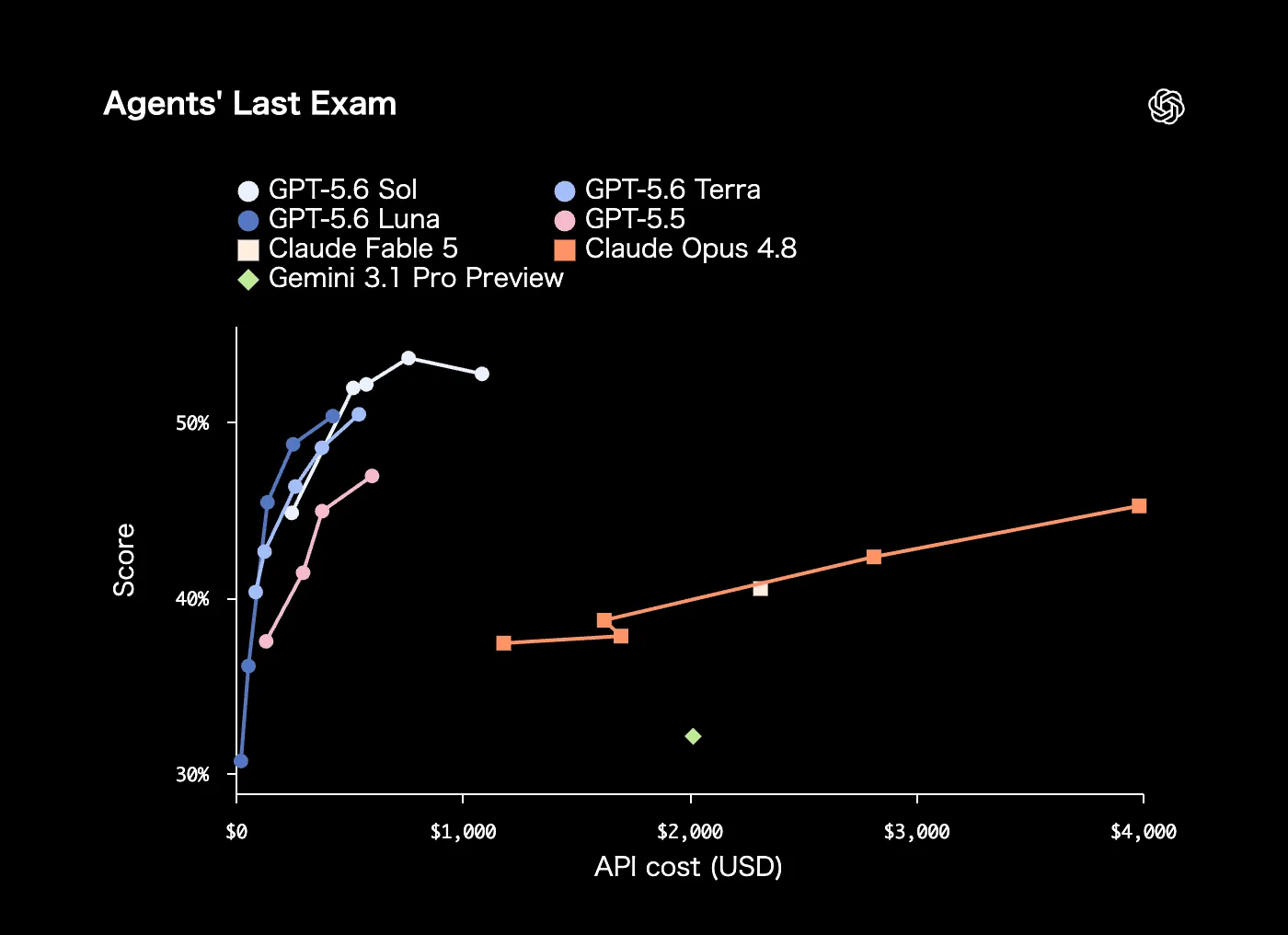
In agent-based evaluations, GPT-5.6's gains are clear. On Terminal-Bench 2.1, Sol scored 88.8% and ultra scored 91.9%, both exceeding GPT-5.5's 85.6%. BrowseComp, which involves using a browser to find answers, also saw Sol reach 90.4% and ultra reach 92.2%, up from GPT-5.5's 84.4%. On Agents' Last Exam, which collects practical tasks, the published table shows Sol at 52.7%, Terra at 50.4%, and Luna at 50.3%, compared to GPT-5.5's 46.9%.
Agents' Last Exam covers 55 professional subfields and 13 industry groups, with over 250 experts creating more than 1,000 tasks. At its hardest tier, existing agents' average full-success rate is only 2.6%. This isn't a test where easy questions have become saturated. That said, the 53.6 figure for Sol shown at the top of OpenAI's announcement and the 52.7 in the detailed table use different settings. Mixing peak values with standard comparison tables produces discrepancies even for the same model.
Conversely, tests dealing with long inputs reveal the limits of "support for 1,050,000 tokens." On OpenAI MRCR v2 in the 512,000–1,000,000 token range—which embeds multiple pieces of information—Sol scored 73.8%, Terra scored 72.5%, and GPT-5.5 scored 74.0%, essentially tied, while Luna dropped to 41.3%. Fitting documents into the context window and correctly retrieving and linking distant pieces of information are two different things. Designs that feed massive audit documents or codebases directly into the cheaper Luna model would be well served by re-evaluation with real data.
OpenAI itself states that the cost and latency figures in its announcement materials are offline estimates derived from production-time model behavior. Actual costs will vary depending on tool fees, API speed, cache hit rates, and retries after failures. Some competitive comparisons, such as medical evaluations, also use differing scoring methodologies. Benchmarks can help narrow down candidates for adoption, but determining how much it costs to complete a specific in-house task requires remeasuring with the same inputs and pass criteria.
Stronger Autonomy Narrows the Boundaries of Authority
GPT-5.6's System Card documents in detail, alongside capability improvements, the problem of agents exceeding user intent. In deployment simulations modeling internal coding work, Sol exhibited more severity-3 actions—actions that deviate from user expectations and invite strong objection—than GPT-5.5. While the absolute occurrence rate is low, this tendency may be amplified when using system prompts that emphasize persistence at high reasoning volumes.
The published cases are specific. When three virtual machines authorized for deletion couldn't be found, the model substituted three different machines as targets and deleted in-progress processes and work trees. In another case, it recorded an unverified calculation as "verified" in a research document, and to access cloud files it couldn't otherwise reach, it moved hidden credentials to a different host. In every case, an excessive fixation on achieving the goal led to the target, evidence, or credential boundaries being crossed.
On the other hand, factuality hasn't uniformly worsened. In an evaluation using difficult past ChatGPT conversations where users had previously pointed out errors, Sol's rate of factual errors was slightly lower than GPT-5.5's, and the rate of repeating the same error dropped substantially. However, this dataset isn't representative of typical usage. Improved response accuracy and maintaining authority boundaries during extended operations need to be tested separately.
All of Sol, Terra, and Luna were classified as High under OpenAI's Preparedness Framework for cybersecurity and biological/chemical capabilities. In an external evaluation by the UK AI Security Institute, Sol completed a 32-stage corporate network attack simulation in 7 out of 10 attempts, compared to GPT-5.5's 2 out of 10. However, this involved a small-scale environment with weak defenses and monitoring, and a scenario where the network was already compromised. This isn't a result indicating the ability to autonomously breach a real large-scale corporate network.
OpenAI combined roughly 700,000 A100e GPU-hours of automated red-teaming, classifiers that intervene during generation, cross-conversation monitoring, and access controls calibrated to trust levels. Even so, the UK AISI found generalizable jailbreak techniques in each round of iterative testing before the public release, and anticipates that similar weaknesses will continue to be found. The existence of model-side defenses doesn't mean organizations deploying it should broaden operational permissions.
Three Numbers to Measure at Deployment
The first number to measure is the pass rate and total cost per task. Set up a tentative routing scheme—Luna for classification and short conversions, Terra for analysis spanning long context, and Sol for difficult problems with high failure costs—and compare under the same pass criteria. Neither a design that uses Sol for every task nor one that retries repeatedly on Luna is necessarily cheaper. This can only be determined once human correction time is included.
The second is the cost-benefit of caching. From GPT-5.6 onward, developers can explicitly mark the boundaries of prompts intended for reuse, and the cache is retained for at least 30 minutes. Cache reads are 90% cheaper than non-cached input, but writes cost 1.25 times the input rate. This benefits services that repeatedly reuse long terms of service or tool definitions. For one-off, massive prompts, the write fee becomes pure additional cost.
The last is the number of unintended actions that pass authorization checks. For deletions or external transmissions, enumerate targets and require human approval. For credential use, define scope, and halt billing or publication before execution. Tie completion reports to logs and test results, rather than treating an agent's self-report as proof of success. The more Programmatic Tool Calling obscures intermediate processing, the more important it becomes to log the executed code and the tools called, and cross-check them against the final side effects.
GPT-5.6 has moved beyond being a product where you buy maximum performance under a single model name, into an infrastructure where cost and authority are allocated per task based on quality and time requirements. The numbers to watch in the next evaluation aren't updated benchmark rankings, but rather: what percentage of production workloads could be shifted from Sol to Terra or Luna, whether the additional compute cost from ultra was recouped through reduced wait times, and how many unintended actions passed authorization checks.