


On September 9, 2026, Jon Peddie Research (JPR) announced that PC graphics card shipments reached 12.5 million units in the second quarter of the year. JPR put the increase at 10% from the previous quarter. Shipments usually slow in the spring-to-summer season, and this rise ran counter to the slowdown in desktop CPUs.
The increase is not explained as the result of lower prices making cards easier to buy. JPR offers a hypothesis that consumers rushed to buy before prices rose further. Looking into memory supply shows why the rise in shipments cannot simply be read as a lasting recovery of the PC gaming market.
Card Shipments Rise to 12.5 Million as CPUs Slow
JPR counted add-in boards (AIBs), meaning expansion cards that carry a discrete GPU and dedicated memory. This needs to be distinguished from figures for the whole market, which include GPUs integrated into CPUs and GPUs built into laptops. This announcement covers only the PC card market.
Lining up the published April–June 2026 figures makes the difference in direction between cards and desktop CPUs clear.
| Metric | Q2 2026 shipments | Change from previous quarter | Change from a year earlier |
|---|---|---|---|
| PC graphics cards | 12.5 million units | Up 10% | Up 6.6% |
| Desktop PC CPUs | 14 million units | Down 10.5% | Down 33% |
Source: JPR's Q2 AIB announcement. Percentage changes are the company's published figures.
CPUs for building new desktop PCs fell, while cards rose. This was a quarter in which PC shipments and card demand could not be treated as moving together.
However, JPR's 10% quarter-over-quarter increase does not match a simple calculation from previously published unit counts. Using the 11.82 million units in the Q1 announcement, (12.5 ÷ 11.82 − 1) × 100 comes to about 5.8%. The public announcement does not explain the gap, so it cannot be determined whether it reflects a revision to past figures or an error. The table keeps the announced growth rate and does not treat 5.8% as an official correction.
NVIDIA Holds 90% of the Market
The expansion in shipments needs to be viewed separately from changes in competition among manufacturers. In JPR's public chart, AIB share in the second quarter of 2026 was 90% for NVIDIA, 8% for AMD and 2% for Intel. NVIDIA's share fell from a year earlier but remains overwhelmingly large.
| GPU maker | Q2 2025 | Q2 2026 |
|---|---|---|
| NVIDIA | 94% | 90% |
| AMD | 6% | 8% |
| Intel | 0% | 2% |
Source: JPR's AIB share chart by manufacturer. Values are rounded to whole numbers; 0% does not mean shipments were strictly zero.
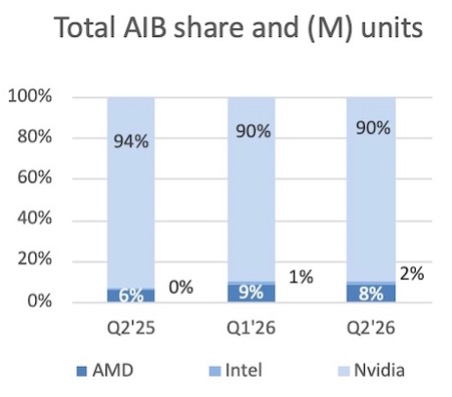
AMD and Intel increased their shares from a year earlier, but NVIDIA continues to account for the bulk of total shipments. NVIDIA was also at 90% in the same chart for the preceding first quarter, so this increase in shipments did not come with a major shift in share.
This table measures the mix of cards shipped in that quarter. It does not directly show the GPU configurations of PCs already in use or the preferences of gamers. The fact that NVIDIA is strong in new supply is a separate question from how many users are waiting to upgrade.
GDDR Can Rise in Price Even When Demand Is Weak
Supply constraints on memory for graphics cards were being pointed out before the second quarter began. In a March 31 report, TrendForce explained that as memory makers shift production capacity toward HBM and server applications, the capacity allocated to GDDR for graphics is limited. Even though rising memory costs were weighing on demand for laptops and gaming devices, the outlook was for GDDR prices to rise further.
Fewer buyers does not necessarily mean prices will fall. If suppliers prioritize other uses and hold down output, weak demand and tight supply can occur at the same time.
TrendForce's third-quarter outlook of July 3 laid out that relationship more specifically. The professional RTX PRO 6000 Blackwell did not generate as much GDDR7 demand as expected, and weak laptop shipments also reduced demand for GDDR6 and GDDR7. Even so, TrendForce's analysis is that because manufacturers are allocating production capacity to other major products, memory supply for graphics cards remains constrained and prices continue to rise.
In other words, it cannot be explained in one direction as memory becoming more expensive because card buyers are enthusiastic. Even if card demand weakens, costs may be slow to fall because of how memory makers allocate production. This is an analysis of the component market, not a forecast of how much individual cards will rise in price at Japanese retail.
The hypothesis offered by JPR's Jon Peddie, that buyers were rushing to purchase ahead of further price increases, is consistent with this cost environment. He said war, memory shortages and shifting tariff policies shook market expectations, and that sales of high-end products surged as prices rose. However, no results from consumer surveys confirming the reasons for purchase have been published, so it is unclear how many cards worry about price increases added to shipments.
Can the 89% Shipment Ratio Reveal Upgrade Demand?
JPR also announced that the ratio of AIB shipments to desktop PCs rose to 89%. Dividing this quarter's 12.5 million cards by 14 million desktop CPUs gives about 89.3%, nearly matching the published ratio.
Reading this ratio as meaning that 89% of new desktop PCs were fitted with a discrete GPU would be premature. The uses of AIBs that JPR describes include both installation in new systems and upgrades to existing systems. CPUs and cards shipped in the same period do not necessarily end up in the same PC.
A buyer who swaps only the card can raise GPU performance without buying a new CPU. The decline in CPUs and the rise in cards are therefore not inconsistent with a move to refresh existing PCs. However, the public statistics this time contain no unit counts by use. To assert that upgrade demand drove the market would require more granular sales data.
Furthermore, not all of the cards shipped were necessarily sold to users in the same quarter. Unless the portion remaining in distribution inventory is separated from what was actually purchased, an increase in supply cannot be read as an increase in users. It is reasonable to use the 89% as an indicator of the relationship between card and CPU shipments, not as a number that explains consumer behavior.
The Price Burden That Remains After the Rush
Alongside this increase in shipments, JPR forecasts a compound annual growth rate of minus 2.5% for AIB shipments in the 2025–2030 market. Even the research firm reporting the quarterly increase does not expect it to lead to long-term expansion.
If pull-forward buying was the main cause of the increase, there may be a reaction in later quarters, to the extent that people who planned to buy in the future bought early. On the other hand, if supply constraints persist, prices may not fall even as demand weakens. For buyers, the troublesome point is that falling shipments and persistently high prices can coexist.
What to check next quarter is not only card shipment numbers but also how retail sales and distribution inventory move. If inventory builds up even as high shipments continue, user demand may not be keeping pace. If actual sales follow and GDDR supply also eases, the increase in shipments could translate into easier availability for buyers.